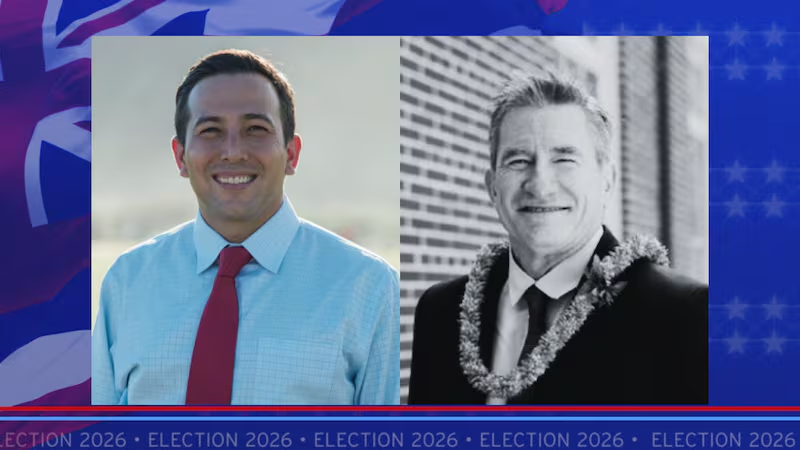
The Honolulu City Council District 4 race produced a clear front-runner on Sunday and almost no clarity about what happens next. Trevor Ozawa holds a commanding lead. Whether that lead means he faces a November runoff or should already have won the seat outright is now a legal question rather than an arithmetic one.
Where the Numbers Stand
The Hawaii Office of Elections released its third round of results Sunday.
Ozawa led with 12,252 votes, or 39.9 percent. Tommy Waters, the incumbent council chair, followed with 8,654 votes at 28.2 percent. Tara Malia Gregory took 4,212 votes for 13.7 percent, and Jason K. Liang received 2,674 votes at 8.7 percent.
On paper, Ozawa and Gregory advance to the general election in November. That outcome is conditional on how the pending legal challenges resolve.
The Rule at the Center of Everything
To understand why this is contested, you need one detail about Honolulu council elections.
If a candidate takes a simple majority in the primary, meaning 50 percent plus one vote, they win the seat immediately. No general election. No runoff.
That threshold is calculated against a total pool of votes. Which raises the question that has turned this race into a legal dispute: whose votes belong in that pool?
Waters was ruled ineligible to run by Circuit Court Judge James Ashford in late July. His name nonetheless remained on the ballot, and roughly 7,900 voters cast ballots for him.
The City and County of Honolulu decided to include those votes when calculating the majority pool.
Why That Decision Matters So Much
The consequence is measurable and it is not abstract.
After the first two rounds of results, excluding Waters’ votes from the total would have put Ozawa above the majority threshold against the remaining active candidates. He would have won the seat outright.
Including them kept him below it.
By the third printout, his share had fallen below the threshold regardless.
So the county’s methodological choice is the difference between a settled race and a November contest, at least during the earlier rounds of counting. That is the kind of decision that virtually guarantees litigation.
Multiple Legal Tracks Running at Once
There are now several proceedings moving in parallel, which is part of why the picture is so muddy.
Waters is appealing the ruling that declared him ineligible. He has also told Hawaii News Now that he is preparing a voter challenge to the primary outcome, saying he has more than the thirty voters required to formally contest the results.
Gregory has filed in court to oppose his appeal.
Attorneys familiar with the situation suggest Ozawa could bring his own challenge, arguing that counting votes cast for an ineligible candidate is not lawful in the first place.
Each of these could alter the outcome independently, and they are not necessarily resolved on the same timeline as the election calendar.
Ozawa’s Position
Ozawa, an attorney himself, said he is ready for whatever Waters files but does not want the race defined by it.
Speaking Saturday at a campaign gathering at J. Dolan’s in Kahala, he said the matter would be dealt with when it arrives, noting that the litigation has already been handled at the Circuit Court level where the judge found Waters ineligible and disqualified.
His argument is that East Honolulu voters have limited patience for courtroom procedure. He said residents are excited about moving past litigation toward practical questions: fixing the parks, addressing homelessness across the community, and whether their representative will actually show up to meetings and answer the phone at the office.
Whether that framing holds depends partly on how long the legal process runs. Campaigns that promise to move past a dispute tend to struggle when the dispute keeps generating headlines.
The Underlying Problem
Strip away the specific personalities and this is a procedural failure with predictable consequences.
A candidate was ruled ineligible by a court. His name stayed on the ballot anyway. Nearly eight thousand people voted for him. Election officials then had to make a judgment call with no obviously correct answer, and that call directly affected whether another candidate won outright.
Counting the votes respects what voters actually did. Excluding them reflects that those votes cannot elect anyone. Both positions have logic behind them, which is precisely why courts will end up deciding.
What to Watch
Three things will determine how this ends: whether Waters’ appeal succeeds, whether his voter challenge is filed and how it is received, and whether anyone successfully contests the county’s method of calculating the majority pool.
Until those resolve, Ozawa’s lead is real but its meaning is provisional.
A note on sourcing: this piece stays within the reported details. Multiple legal proceedings remain unresolved, and the final outcome of the District 4 race has not been determined.
Author
-
Lucienne Albrecht is Luxe Chronicle’s wealth and lifestyle editor, celebrated for her elegant perspective on finance, legacy, and global luxury culture. With a flair for blending sophistication with insight, she brings a distinctly feminine voice to the world of high society and wealth.