The latest Russian missile strike on Ukraine ranks among the most devastating of the war, pairing a punishing aerial assault with a sophisticated disinformation campaign that now appears to lean on artificial intelligence. Overnight from June 14 to 15, Russian forces battered major Ukrainian cities while simultaneously working to distort the truth about both the attack and the situation on the ground.
A Night of Overwhelming Firepower
The scale of the assault was staggering. According to the Ukrainian Air Force, Russian forces launched 70 missiles, a barrage that included six Zirkon hypersonic cruise missiles, 34 Iskander-M ballistic and S-400 air defense missiles, and 30 Iskander-K and Kh-101 cruise missiles. Alongside the missiles came an enormous swarm of 611 strike drones, loitering munitions, and decoy drones.
Ukrainian defenders managed to down a substantial share of the incoming threats, intercepting five Zirkons, 15 Iskander-Ms and S-400s, all 30 Iskander-Ks and Kh-101s, and 582 drones. Even so, 20 ballistic missiles and 27 drones struck 42 locations, with debris falling on a dozen more.
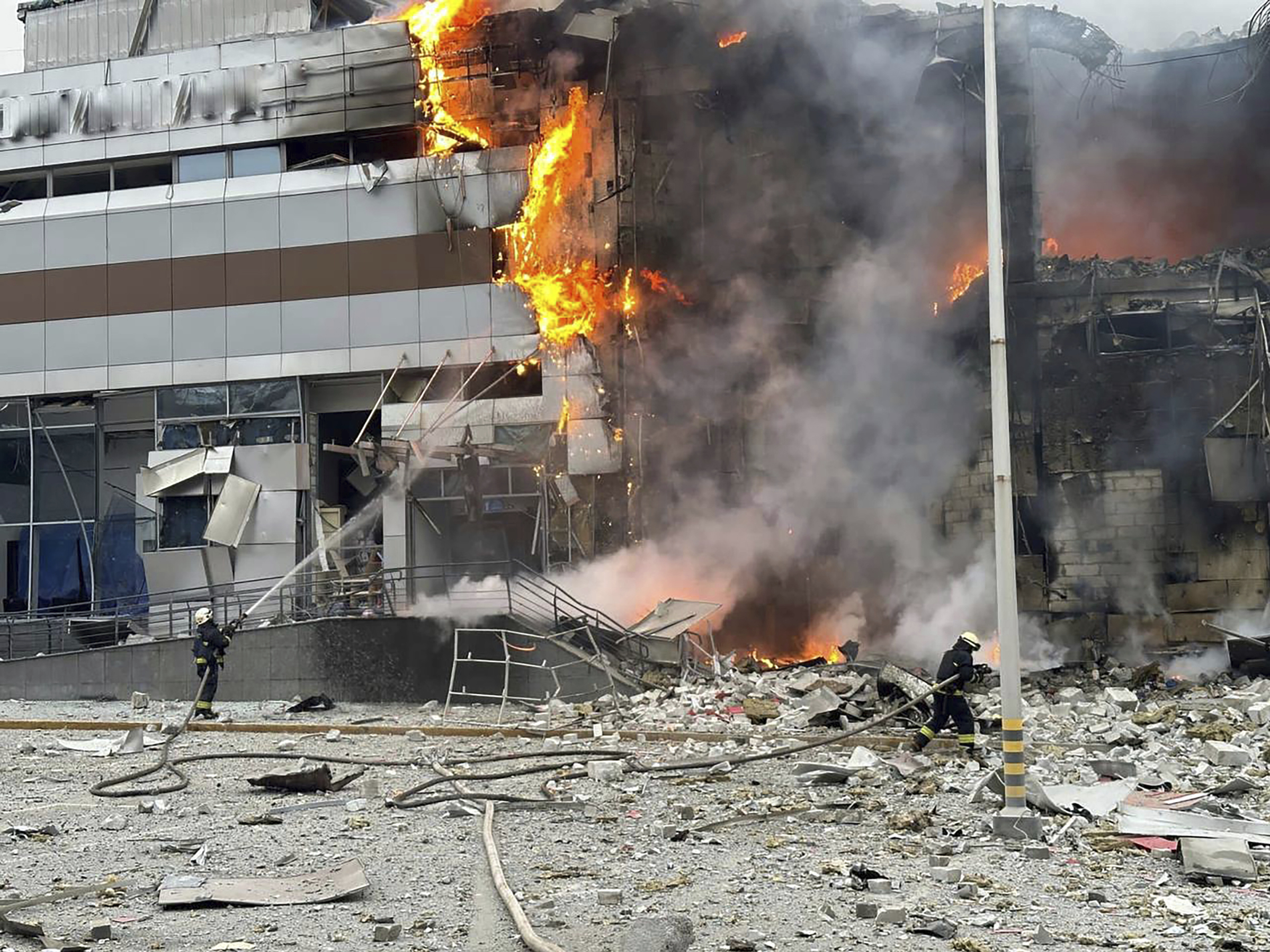
The human cost was severe. President Volodymyr Zelensky reported that the strikes killed at least 11 people and injured at least 53 across Ukraine, with Kyiv City alone accounting for five dead and 35 wounded. The barrage hit residential, energy, and educational infrastructure across Kyiv, Dnipro, and Kharkiv, leaving 140,000 residents in Kyiv City without power.
In one especially brutal episode, Russian forces carried out a double-tap strike against first responders rushing to the scene of an earlier attack on Kharkiv City, killing five of them. This marked the second strike in June alone to involve 70 or more missiles.
Sharper, Harder-to-Stop Tactics
Russian forces appear to be continually refining their methods to inflict maximum damage. Air Force spokesperson Colonel Yuriy Ihnat noted that this particular package broke from recent patterns by swapping out Kalibr cruise missiles in favor of Iskander-K cruise missiles.
Several adaptations stood out:
- Drones and missiles approached from multiple directions, so that both direct hits and falling debris from intercepted targets caused destruction.
- Russian forces flew drones at lower altitudes to evade detection.
- Fast, jet-powered drones made interception considerably more difficult.
Despite these tactics, Ukrainian forces, including F-16 fighter jets, air defense systems, and mobile fire groups, succeeded in downing all of the cruise missiles launched that night.
Cultural Landmarks Caught in the Crossfire
Beyond the human toll, the strikes inflicted serious damage on Ukraine’s cultural heritage. Officials reported hits on significant sites across three cities, including:
- The Kyiv-Pechersk Lavra, a historic monastery, and the Dovzhenko Film Studio in Kyiv
- The Dnipro House of Organ and Chamber Music in Dnipro
- The Kharkiv Art Museum in Kharkiv
UNESCO condemned the strike on the Kyiv-Pechersk Lavra and its associated monastic buildings, including the Saint-Sophia Cathedral.
Shifting the Blame
In the aftermath, the Russian information space moved quickly to deflect responsibility, either pinning the damage on Ukraine or casting the strikes as militarily justified. The Russian Defense Ministry claimed that a Ukrainian Patriot interceptor missile had struck the Lavra.
Ukrainian officials pushed back firmly. Ihnat acknowledged that missile debris on the ground could have come from a Ukrainian air defense missile that downed a Zirkon, but he refuted the broader claim, stating that investigations had already established a Russian Geran-2 drone hit the monastery. He noted that Russian sources were exploiting the mere presence of Patriot fragments to shift blame.
The disinformation extended to the highest levels. Foreign Ministry spokesperson Maria Zakharova asserted that the West had fabricated the claims about the Lavra strike, while other officials alleged Ukraine had staged the attack to provoke a response.
AI-Generated ‘Victory’ on the Battlefield
Perhaps the most striking development involves the fighting around Kostyantynivka, where Russia appears to be deploying advanced information operations. Footage published on June 15 showed Russian troops raising flags on the town’s outskirts and in nearby Dovha Balka, which the Defense Ministry claimed to have seized.
According to the Institute for the Study of War (ISW), there is reason to believe these flag-raising videos may be AI-generated, consistent with earlier Russian operations that used artificial footage to fabricate battlefield advances.
What’s Actually Happening in Kostyantynivka
The reality on the ground appears far more modest than Moscow’s narrative suggests. Ukrainian Brigadier General Alexander Bakulin assessed that Russian commanders had already reported seizing the town up the chain of command and were now attacking to make those premature claims come true. He pointed to a polished video from the Russian 4th Separate Motorized Rifle Brigade showing flag-bearing soldiers whom Ukrainian forces struck shortly afterward.
Ukrainian estimates put the number of Russian infiltrators at roughly 93 to 153, with Bakulin dismissing higher figures of 250 to 300 as exaggerated. He noted that while Russian forces had honed their infiltration tactics during the seizure of Pokrovsk, Ukrainian troops in Kostyantynivka were mounting stronger countermeasures this time, and that local logistics were no worse than elsewhere along the front.
Inflating a Local Fight Into a Regional Collapse
Though Ukraine’s tactical position in Kostyantynivka is deteriorating, the Russian Defense Ministry is framing its potential capture as a domino that would trigger the fall of the entire Fortress Belt and the rest of Donetsk Oblast. Russian officials claimed Ukraine was bracing for the imminent loss of Kostyantynivka, Druzhkivka, and Kramatorsk, and ultimately the whole Slovyansk-Kramatorsk agglomeration.
ISW views this as part of a familiar pattern. Russian sources have repeatedly claimed that capturing various towns would open the way to seizing the entire region. In reality, ISW assesses that while Russian forces will likely make tactical gains in Kostyantynivka through summer 2026, they remain unlikely to achieve a rapid breakthrough against the heavily fortified Fortress Belt, which would require fighting through a string of fortified cities with forces not optimized for maneuver or urban warfare. The broader goal of this cognitive warfare, ISW suggests, is to convince the West and Ukraine that Ukrainian defenses are collapsing in order to extract quick concessions.
Diplomacy at an Impasse
Against this violent backdrop, the diplomatic picture remains starkly one-sided. Zelensky said on June 15 that he had offered to meet Vladimir Putin at the G7 summit in France to negotiate an end to the war, but that Russia showed it was not ready to talk. He noted that both the United States and Europe had agreed to invite Putin, and a Ukrainian official said the invitation was delivered directly to Russian counterparts without a clear response.
This latest overture follows a series of Ukrainian offers for direct talks, including an open letter Zelensky sent Putin on June 4, which the Russian leader rejected. Moscow, for its part, continues to insist on Ukrainian capitulation to its maximalist demands. Foreign Minister Sergei Lavrov claimed Russia remained committed to an agreement supposedly reached at the August 2025 Alaska Summit and accused the EU and UK of sabotaging it. ISW assesses that the Kremlin is exploiting the absence of any public agreement from that summit to falsely portray itself as a willing negotiator.
The Bigger Picture
Taken together, the events of June 14 to 15 paint a portrait of a war being waged on two fronts at once: one of missiles and drones, the other of manipulated images and false narratives. As Russia pairs overwhelming firepower with increasingly sophisticated disinformation, including the apparent use of AI-generated footage, Ukraine faces the dual challenge of defending its skies and contesting the story of the war itself.
This is a developing and sensitive story, and the situation, both on the battlefield and in the information space, is likely to keep evolving in the days ahead.
Author