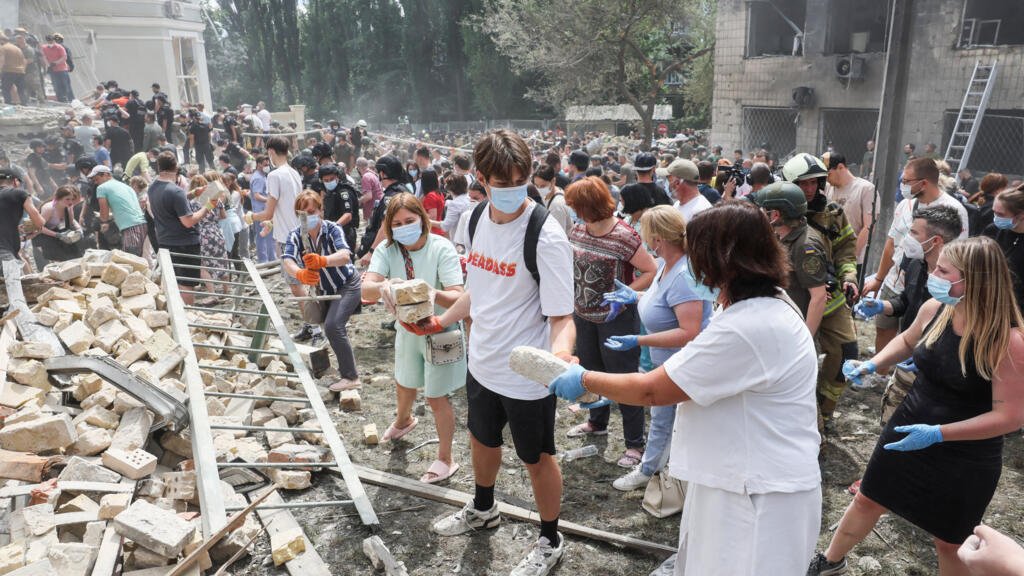
Russian strikes Ukraine civilians have borne the brunt of over the past 24 hours, with attacks on a humanitarian aid centre, a hospice for the terminally ill and a hospital killing at least 38 people and wounding scores more. The deadliest incident, a glide bomb assault on a village in the Zaporizhzhia region, has been described by President Volodymyr Zelensky as among the worst mass killings of the entire war, and the toll is expected to climb as rescuers search for more than 50 people believed trapped beneath collapsed buildings.
Komyshuvakha: A School Turned Aid Centre, Then a Tomb
On Monday night, nine aerial bombs weighing 3,000 kilograms each struck the village of Komyshuvakha, south-east of the city of Zaporizhzhia, as residents gathered at a school being used to distribute humanitarian supplies. Local reports indicate that when the attack began, people fled to shelter underground, only for the roof to give way and bury many of them.
At least 33 deaths have been confirmed. Regional head Mykhailo Semikin said the scale of the tragedy was almost impossible to grasp.
Zelensky linked the strike directly to diplomacy. Ukraine had proposed extending and broadening last week’s ceasefire in the Kherson region, which had allowed civilians to evacuate from the Russian-occupied town of Oleshky. The bombing of Komyshuvakha, he said, was Moscow’s answer.
Competing Accounts
Russia’s defence ministry claimed the attack targeted Ukrainian military units and killed 25 soldiers. The BBC’s Russian defence correspondent, Ilya Abishev, reported that there was no credible evidence the site was in military use and that Komyshuvakha contains no significant military or industrial facilities, though the village does sit within Ukraine’s defensive and transport network on the approaches to the regional capital.
The UN’s human rights monitoring mission noted that the aid distribution at the school had been widely publicised in advance and said the strike appeared to breach the most basic principles of international humanitarian law.
Hospice and Hospital Hit
In the central city of Dnipro, a Russian missile destroyed a hospice on Monday night. Nearly 50 terminally ill patients, the oldest aged 90, were being moved to other facilities. The city’s mayor, Borys Filatov, published photographs of the aftermath, acknowledging that doing so breached normal ethical boundaries but insisting that politicians and diplomats abroad needed to see what a Russian missile had done to elderly, dying people.
A separate strike elsewhere in Dnipro killed two and wounded 18. In Kharkiv, in the north-east, a hospital was hit; Zelensky said 73 people were injured, most of them elderly patients. Five more people died in bomb and drone attacks across the eastern Donetsk region.
Kyiv Without Water or Metro
The assault extended to energy infrastructure across nine regions, disrupting water and heating supplies. In the capital, Kyivvodokanal, the main water utility, reported that supply had been cut entirely due to attacks and damage to the city’s energy network. The entire metro system was suspended on Tuesday. Mayor Vitali Klitschko warned that the power situation was becoming very difficult.
The UN said last month that civilian casualties had reached record levels as Russia resumed systematic strikes on energy facilities, a tactic designed to make winter unbearable for ordinary Ukrainians.
Air Defence Crisis
Ukraine’s ability to intercept incoming missiles and bombs has been badly eroded. Deliveries of Western weapons have stalled, and the country faces a critical shortage of American Patriot interceptor missiles. Speaking in Berlin on Tuesday, Zelensky conceded that while the front line was stable, the picture in the air was far less favourable, particularly regarding the protection of civilians.
Earlier in the week he had warned that Russia was preparing a massive new attack on energy and logistics targets and urged Washington not to let the midterm elections distract from Ukraine’s defence needs.
Diplomacy Amid the Dead
Even as Ukraine counted its casualties, the Kremlin confirmed it would attend US-brokered trilateral talks with Ukraine in Abu Dhabi on November 10 and 11, the first such three-way meeting since February. Russia and the United States have grown closer in recent months, with President Donald Trump announcing a deal to import Russian diesel.
Zelensky said it was essential for Russia to engage seriously on a ceasefire and a settlement but added that he had seen no sign of that so far. Multiple rounds of talks late last year produced nothing, and Russian officials have publicly held to demands that amount to Ukrainian capitulation.
First Lady Melania Trump, credited with brokering last week’s Oleshky truce, is due to host Russian and Ukrainian representatives at the White House on Thursday. The White House has not said who will attend.
The Wider War
Russia’s full-scale invasion began in February 2022. Its ground advances have largely stalled, and Moscow has shifted toward intensified missile and drone bombardment of Ukrainian cities. The strikes of the past day fit that pattern: maximum pressure on civilians and infrastructure while negotiations are nominally under way.
For Ukraine, the juxtaposition is stark. Diplomats prepare for Abu Dhabi while rescuers dig through the rubble of a school in Komyshuvakha, and residents of Kyiv go without water. Whether the talks can change that reality, or whether Monday night’s attacks reveal Russia’s true intentions, will become clearer in the days ahead.
Author