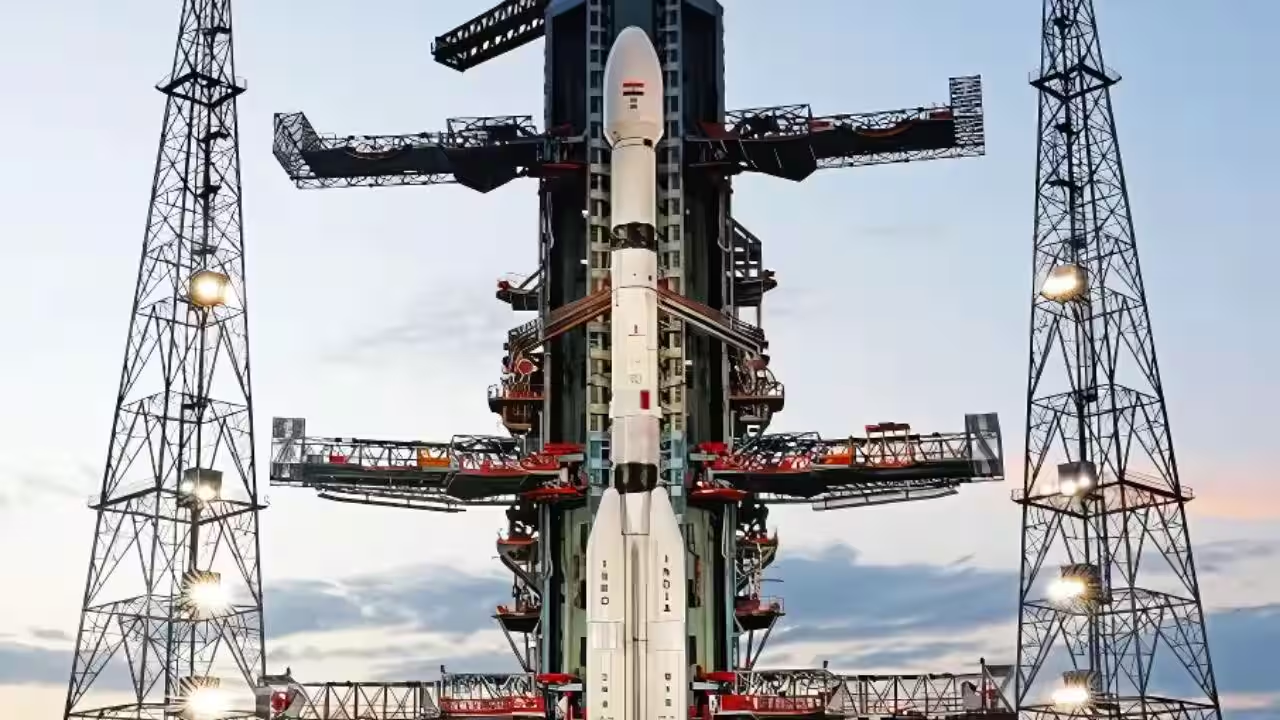
The IRIS2 satellite constellation moved into a new phase this week, as European officials approved a rollout plan that adds 66 low Earth orbit satellites to an already substantial fleet and named a Spanish company to lead the ground infrastructure.
The programme, formally called Infrastructure for Resilience, Interconnectivity and Security by Satellite, represents Europe’s answer to SpaceX’s Starlink. Its total value now exceeds €15.6 billion, roughly $18 billion.
What Was Decided
The European Commission said the decision to purchase additional satellites will strengthen capabilities across defence, security and emergency services.
The capacity gains are specific. Secure governmental connectivity is expected to rise by 60 percent within the European Union and 54 percent globally.
Several other elements were finalised alongside the satellite expansion:
- Advanced design work for the constellation
- Preparation for satellite construction and secure ground infrastructure
- Securing launch services
- A phased rollout of operational connectivity services beginning in 2029
The agreement is tied to an implementation deal reached with the SpaceRise consortium, which brings together three operators: Eutelsat of France, HispaSat of Spain and SES of Luxembourg.
Spain Takes the Ground Segment
HispaSat, part of Spain’s Indra Group, confirmed it has been selected as prime contractor for the ground portion of the programme, with first launches targeted for 2029.
The company put the value of that segment at €1.6 billion, approximately $1.85 billion. Its scope covers antenna infrastructure, control systems and terrestrial network connectivity supporting the entire constellation.
HispaSat described the agreement as including all facilities required to manage and operate the constellation’s various orbital layers, along with the interconnection points linking those satellites to ground networks, distributed across multiple sites.
The appointment carries national significance. Indra becomes the first Spanish company to lead a consortium in a major European space project, a milestone for a country that has historically played a supporting role in European space efforts.
A Discrepancy Worth Noting
One element of the announcements does not align neatly.
HispaSat said it will also lead development of a very low Earth orbit constellation, planned to operate below 75 kilometres, roughly 466 miles.
The Commission’s statement made no mention of a vLEO layer. It described the constellation as comprising 348 satellites in total, divided between 330 in low Earth orbit and 18 in medium Earth orbit.
Whether the vLEO component sits outside the headline figure or reflects a later phase is not clarified in either statement.
The Structure Behind the Programme
This week’s decisions build on a 12-year concession contract signed previously between the Commission and the SpaceRise consortium.
That arrangement established a public-private partnership designed to deliver both governmental and commercial connectivity services by 2030. The dual purpose matters, since commercial revenue is intended to help sustain a system whose primary justification is sovereign capability.
IRIS2 forms one of three pillars in European space strategy, alongside Copernicus for Earth observation and Galileo for satellite navigation. Together they cover imagery, positioning and communications, the three capabilities a bloc seeking independence in space would need to control.
Why Europe Is Building This
The programme, launched in 2022, is inseparable from the broader push for what European leaders call strategic autonomy.
The underlying concern is dependence. European governments and institutions have relied heavily on American government systems and American industry for space technology and services, an arrangement that looked reasonable when geopolitical alignment was assumed and considerably less comfortable when it is not.
Josef Aschbacher, director of the European Space Agency, framed the logic directly in a post published this week. He argued that strategic autonomy begins with independent connectivity, describing IRIS2 as Europe’s response to a changed geopolitical reality.
The Competitive Picture
Comparisons with Starlink are inevitable but somewhat misleading.
SpaceX operates thousands of satellites and has built its position on scale, launch cadence and vertical integration. IRIS2 is planned around 348 satellites and is designed principally for secure government communications, with commercial service as a secondary function.
The two systems are solving different problems. One is chasing consumer broadband market share. The other is trying to guarantee that European institutions can communicate securely without depending on infrastructure controlled elsewhere.
That distinction also explains the cost. Building sovereign capability with European suppliers, European launch services and European ground infrastructure is more expensive than buying capacity from an existing provider. The premium is the point.
The Timeline Ahead
First launches are scheduled for 2029, with operational services phasing in from that year and full commercial and governmental capability targeted for 2030.
Those dates leave limited margin. Satellite programmes of this complexity have a long history of slipping, and IRIS2 involves coordination across three operators, multiple national industrial bases and a ground network spanning several sites.
For now, the programme has money, structure and a contractor for the segment that connects everything together. The harder tests come when hardware has to reach orbit.
Author
-
Lucienne Albrecht is Luxe Chronicle’s wealth and lifestyle editor, celebrated for her elegant perspective on finance, legacy, and global luxury culture. With a flair for blending sophistication with insight, she brings a distinctly feminine voice to the world of high society and wealth.