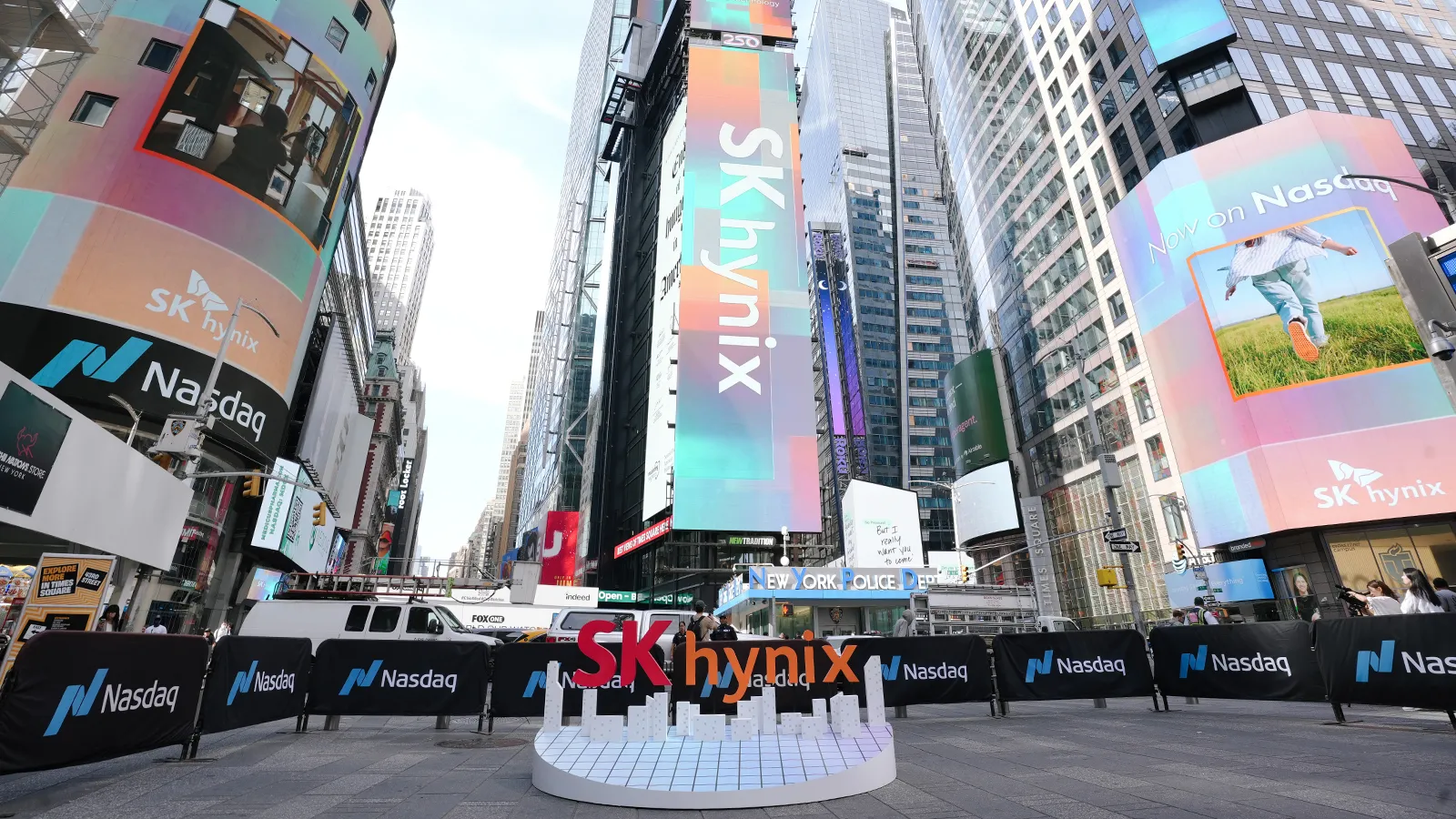
SK hynix Nasdaq listing has done far more than raise a staggering $26.5 billion; it may have fundamentally changed how investors should view one of the world’s most important AI memory companies. While much of the market has fixated on the eye-catching proceeds and the dramatic first-day trading, the real significance of this move runs much deeper, signaling a potential transformation in the company’s identity and valuation.
Note: This article reflects one analyst’s perspective and should not be taken as financial advice. Investors should conduct their own research before making decisions.
More Than a Capital Raise
At first glance, it’s easy to frame the listing as simply a tool to raise money and fund one of the largest semiconductor expansion programs the market has ever seen. That interpretation is accurate, but incomplete.
Historically, SK hynix occupied an unusual position. It was arguably the best AI memory company in the world, yet it traded at a discount because it was listed on the Korean stock exchange. Investors came to accept that discount as an unavoidable cost of doing business. The Nasdaq listing is now challenging that long-held perception.
The deeper story is about identity. Rather than positioning itself as just another memory producer trading on a Korean exchange, SK hynix appears to be repositioning as a global AI infrastructure platform. This shift may take years rather than quarters to fully play out, and many investors may be underestimating just how significant it could become.
A Fundamental Shift in the Investor Base
The most intriguing consequence of the listing isn’t the capital itself, but the entirely new group of investors who can now own the stock.
Many institutional investors are barred by their mandates from purchasing Korean securities, while others simply prefer to avoid the complications of settling foreign shares. By listing on Nasdaq, SK hynix has effectively removed those barriers. This matters enormously in an era where passive investing has become one of the most powerful structural forces in modern markets.
The benefits of this expanded access include:
- Access to index funds that previously couldn’t hold the stock
- Inclusion potential in tech-focused ETFs
- Broader institutional investment vehicles now able to participate
This mechanical demand doesn’t necessarily reflect improved fundamentals, but it can meaningfully alter valuation dynamics. There’s also a self-reinforcing quality here: leadership in the semiconductor space attracts capital concentration, and that capital concentration in turn supports continued industry leadership. These feedback loops are often underappreciated by the market.
HBM: The Economic Heart of AI
A central pillar of the bullish case rests on how dramatically memory’s role in AI has evolved. Just a couple of years ago, GPUs dominated the conversation while memory was treated as a mere enabler. That has changed profoundly.
Memory is now one of the key components of the AI server, and high-bandwidth memory (HBM) has begun shedding its commodity characteristics. Rather than competing solely on cost and storage capacity, HBM now competes on performance and reliability, granting the best companies significant pricing power and profitability.
SK hynix has increasingly tilted its portfolio toward AI memory through its HBM technology, DDR5 server DRAM, and high-performance computing solutions. In this environment, memory bandwidth has become a crucial determinant of performance for AI accelerators, hyperscale data centers, and advanced computing.
Crucially, this leadership appears structural rather than cyclical. In traditional DRAM cycles, manufacturers could quickly replicate one another’s production processes. HBM is different. Its complexity, involving packaging, TSV technologies, and demanding yields, requires years of accumulated experience to master, making SK hynix’s lead far harder to erode.
The Nvidia Connection
To understand AI infrastructure economics, it helps to follow where Nvidia spends its money. On that front, SK hynix occupies an enviable position.
Nvidia’s CEO has emphasized that SK hynix is the company’s largest memory provider, and the two are collaborating on HBM4 technology and beyond. On top of that, SK hynix benefits from the broader wave of AI infrastructure investment flowing from hyperscalers like Microsoft, Amazon, and Google, all of which continue to demand advanced memory.
This relationship carries particular weight because Nvidia has every incentive to diversify its suppliers. The fact that SK hynix continues to dominate despite aggressive investments from Micron and Samsung suggests the competitive gap remains substantial. Ordinarily, heavy customer concentration would be a red flag, but because Nvidia sits at the center of AI compute demand, being deeply integrated into its product roadmap arguably reduces commercial risk rather than increasing it.
Extraordinary Earnings, Extraordinary Ambitions
SK hynix’s financial profile has become almost difficult to believe. First-quarter revenue reached 52.6 trillion won, with operating margins exceeding 72%, figures that would have seemed impossible during past memory downturns. The market anticipates even stronger results in the second quarter as AI memory and HBM demand remains robust.
What’s most telling, however, is how management plans to use these earnings. Rather than maximizing short-term shareholder returns, SK hynix is pouring money into future AI memory capacity. Its planned investments include:
- 31 trillion won for its Yongin facility
- 19 trillion won for advanced packaging
- 12 trillion won for EUV equipment and semiconductor manufacturing facilities
This is not the behavior of a company trying to harvest a cyclical peak. Instead, it reflects a long-term conviction in capacity-constrained AI memory demand. There’s a risk of overbuilding, as has happened in past memory cycles, but this expansion is difficult to compare to previous ones, since earlier cycles never featured hyperscalers simultaneously committing enormous sums to AI infrastructure.
Why Traditional Valuation Falls Short
On the surface, SK hynix looks expensive, trading at roughly 4.4 times forward sales and 5.2 times forward EV/EBITDA, with a market capitalization exceeding $1 trillion. Yet these multiples may be misleading, because they’re anchored to results during an earnings inflection point.
What matters more is the company’s earnings power over the next two years. Given consensus expectations for a surge in operating profit driven by the HBM4 ramp and supply-constrained demand, the current valuation essentially assumes SK hynix can sustain its technological leadership rather than merely ride a cyclical upswing. That premium appears reasonable given the company’s edge, but it could compress sharply if that leadership were to slip.
The Risks Worth Watching
The primary threat isn’t the memory cycle itself, but the potential loss of HBM leadership. SK hynix commands premium pricing thanks to its technological advantage and tight integration with Nvidia’s roadmap. If Micron and Samsung close the gap faster than expected, those premium margins could normalize.
There’s also the classic supply-demand risk. As SK hynix invests billions into new capacity, a slowdown in AI infrastructure demand paired with rapidly rising supply could return the memory business to its cyclical roots, pressuring both earnings and valuation multiples.
The Bottom Line
Following its Nasdaq debut, the bullish case for SK hynix centers on its ability to broaden its shareholder base while cementing its role as a leader in AI infrastructure. As long as its HBM leadership remains intact, pullbacks may look like buying opportunities rather than warning signs.
Ultimately, the Nasdaq listing represents more than a financial milestone. It marks a potential redefinition of what SK hynix is, from a discounted Korean memory maker into a globally recognized AI infrastructure platform. Whether that transformation fully materializes remains to be seen, but for investors paying attention, it may be one of the more consequential shifts in the semiconductor landscape in years.
Author