“The Border Totally Collapsed”: Spain Sends Troops to Ceuta After a Day That Killed at Least Nine
Spain announced Thursday evening that it will deploy its armed forces to Ceuta, the small Spanish territory on Morocco’s Mediterranean coast, after thousands of people crossed the frontier in a single day.
At least nine died in the attempt.
The government said the military will assist the Civil Guard in maintaining security in the city. Prime Minister Pedro Sánchez will travel there Friday alongside Interior Minister Fernando Grande-Marlaska.
What Happened Thursday
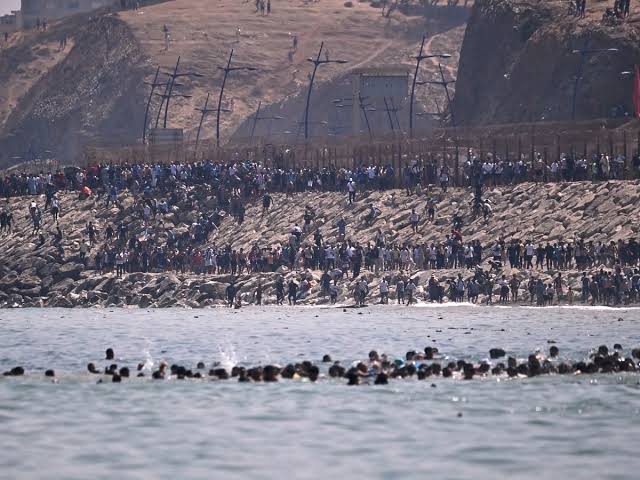
Video footage from the enclave showed large crowds moving around the breakwaters at Tarajal beach and out onto local roads. Most were young men, though families with women and small children were also visible. Some called out greetings to a photographer working for a news agency.
Rachid Sbihi, who heads the association representing Civil Guard officers who police the border, described the situation as absolute chaos. He said precise numbers were impossible to give, that thousands were crossing, and that the border had totally collapsed.
Achraf Maimouni of the Moroccan Association for Human Rights in northern Morocco called the circumstances exceptional, saying the Tarajal crossing had been opened under unusual conditions that morning and people simply walked through.
The Deaths
Spain’s government delegation in Ceuta confirmed at least nine deaths during Thursday’s events. It did not describe the circumstances. Bodies could be seen in the water.
Local authorities say dozens have died this year attempting to reach the territory.
That figure gives some sense of what the route ordinarily involves. Many who try to reach Ceuta swim from the Moroccan town of Fnideq, a distance of roughly five kilometres, or from Belyounech, where the crossing is shorter. It is an open-water swim in currents, frequently attempted by people with limited swimming experience and no equipment.
Nobody Is Certain Why
The most striking feature of this event is that no one has offered a confident explanation for it.
Ceuta officials had earlier connected the rising numbers to a Spanish Supreme Court ruling this month barring authorities from immediately returning migrants who arrive by sea without due process. That ruling does not apply to people who enter by land, including over the fence.
Some Moroccan activists have questioned that theory, arguing that most people attempting the crossing would have no awareness of a Spanish court decision.
Moroccan authorities have not commented publicly, and the country’s Interior Ministry did not respond to requests for comment.
Spain’s Interior Ministry said the Moroccan government is cooperating closely, that Moroccan police are stopping numerous people attempting to cross, and that both countries have agreed to work toward returning everyone who entered Ceuta unlawfully as soon as possible.
An Uncomfortable Precedent
The scenes recall May 2021, when more than 8,000 people entered Ceuta over two days.
That episode was widely understood as political. Morocco was accused of relaxing border controls after Spain permitted Brahim Ghali, leader of the Polisario Front, to receive hospital treatment on Spanish soil. The Polisario Front has for decades claimed to represent the Sahrawi people of Western Sahara, a territory Morocco claims as its own. The result was a serious diplomatic rupture between Rabat and Madrid.
No comparable trigger has been identified this time, and Spain’s public position emphasises cooperation rather than blame. But the memory of 2021 shapes how the events are being read in both capitals — which is part of why the absence of a Moroccan explanation is being noticed.
The Emergency Question
Juan Jesús Vivas, who heads Ceuta’s regional government, asked Madrid to declare a national emergency on security grounds, requesting additional police and army deployment to guarantee the inviolability of the frontier and the safety of residents.
He had warned on Wednesday that reception centres were already overwhelmed, with hundreds of people sleeping on the streets after more than 1,500 arrivals in the preceding week. Thousands more came overnight and through Thursday.
The Interior Ministry declined the emergency declaration, explaining that the legislation governing national emergencies does not treat migration flows as a national security risk. It said it would guarantee citizen safety and border integrity, and that agencies are coordinating to respond quickly.
Troops were sent regardless — a middle position that gives local authorities reinforcement without invoking a legal framework the government says does not fit.
The Numbers, Such as They Are
The Interior Ministry, which tracks irregular migration, would not confirm how many people reached Ceuta over the past few days. Its next migration report is due August 3.
As of July 15, ministry figures showed nearly 3,000 people had entered Ceuta by land or sea across the whole of this year. If Thursday’s estimates hold, a single day may have approached or exceeded that annual total.
Ripples Beyond Spain
Italian Prime Minister Giorgia Meloni responded by threatening to suspend Italy’s participation in the Schengen open-border arrangement with respect to Spain, framing it as defending Italy’s borders and citizens.
Italy does not share a border with Spain, which makes the practical effect of that threat unclear. It is a reminder that events at one point on the EU’s external frontier reliably become domestic politics elsewhere in the bloc.
The Place Itself
Ceuta sits on a historic isthmus and has been a Spanish possession since 1580. Its population mixes Christian and Muslim residents, Spanish citizens and Moroccan day workers, and it has generally functioned with a degree of everyday coexistence that its politics do not always suggest.
It is also, along with Melilla, one of only two places where the European Union shares a land border with Africa — which is why a city of roughly 85,000 people repeatedly finds itself at the centre of a continental argument.
What Comes Next
Sánchez and Grande-Marlaska arrive Friday. Spain and Morocco have said returns will proceed as quickly as possible, though the Supreme Court ruling on sea arrivals may complicate that for some of those who came by water.
The immediate humanitarian problem is more prosaic: a small territory with overwhelmed reception facilities, an unknown number of new arrivals, and people sleeping outside in a Mediterranean summer.
The deaths, meanwhile, have not been individually accounted for. Nine is the confirmed minimum from a single day, in a year that has already claimed dozens on the same stretch of water.
Author
-
Lucienne Albrecht is Luxe Chronicle’s wealth and lifestyle editor, celebrated for her elegant perspective on finance, legacy, and global luxury culture. With a flair for blending sophistication with insight, she brings a distinctly feminine voice to the world of high society and wealth.