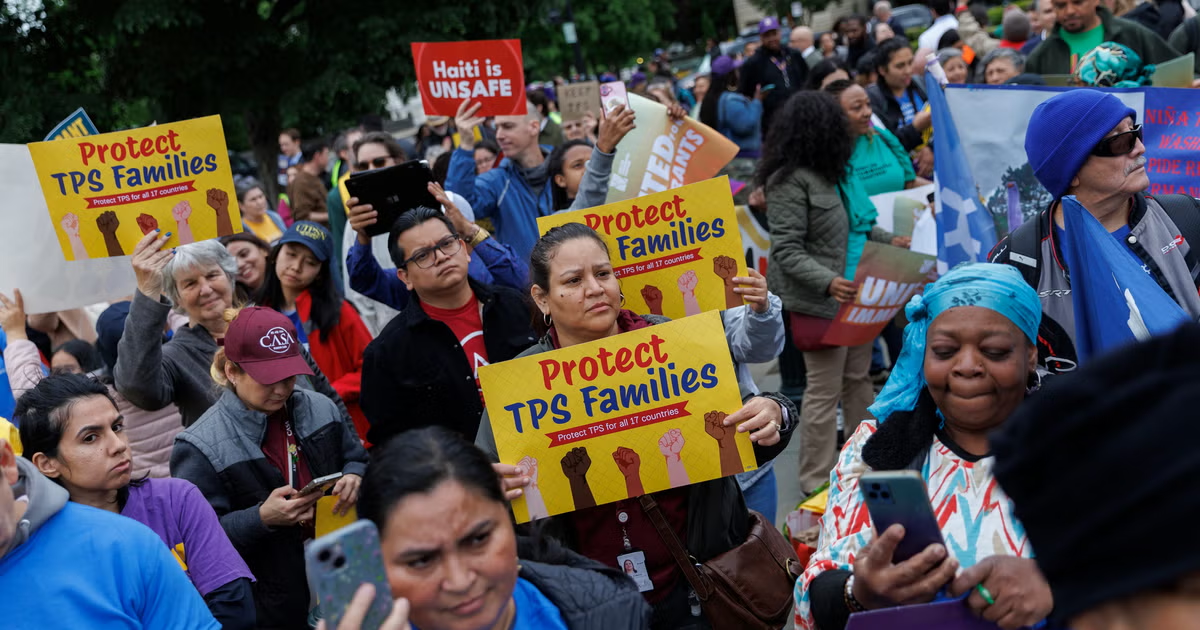
Supreme Court TPS decision has thrown the lives of more than a million immigrants into uncertainty, stripping deportation protections and work permits from hundreds of thousands of people who, until this week, were living and working legally in the United States. The ruling hands the Trump administration a major victory while sending shockwaves through communities and industries that depend on these workers.
A Sudden Reversal of Fortune
Until Thursday morning, hundreds of thousands of Haitians and thousands of Syrians held legal status in the country. Now, their work permits are set to expire and their deportation protections are slated for termination, leaving them in legal limbo.
The shift stems from a Supreme Court ruling that found the Department of Homeland Security holds broad discretion over when to extend or end a form of humanitarian relief known as Temporary Protected Status, or TPS. In a 6-3 decision, the court determined that lower courts have no authority to overrule DHS on these designations.
TPS allows nationals from countries facing humanitarian crises or natural disasters to live and work in the U.S. legally for as long as the designation remains valid. While the case centered on roughly 350,000 Haitians and 6,000 Syrians, its reach extends to hundreds of thousands of additional people from 11 other countries.
One legal expert who argued the Syrian TPS case before the court described the potential fallout in stark terms, calling it what could become the largest event of stripping legal documentation from people in U.S. history.
Two Wins in One Day
The TPS ruling was one of two immigration victories the court handed the administration on Thursday. In a separate 6-3 decision, the justices cleared the way for the administration to revive a contested policy allowing it to systematically turn migrants away at the southern border.
Together, the rulings give the administration, and future ones, significantly more latitude over who is permitted to be in the country. DHS General Counsel James Percival framed the outcome as providing new tools to secure the borders.
Yet an even larger immigration question still looms. The court is expected to rule soon on the administration’s executive order seeking to end birthright citizenship as it has been understood for more than a century, with the citizenship of hundreds of thousands of U.S.-born babies hanging in the balance.
What Happens Next
Of Thursday’s two decisions, the TPS ruling is likely to be felt most immediately, since border crossings remain low. The exact timing of when protections will be stripped is unclear, though the process is expected to unfold over months, leaving beneficiaries vulnerable to removal in the meantime.
Legal challenges against the administration’s TPS revocations will likely be dismissed in light of the ruling, allowing officials to proceed. The administration has argued that TPS was always meant to be temporary and that beneficiaries have extended their stays long past the point when it was safe to return home.
Seventeen countries currently hold TPS designation, and the administration has moved to end that status for 13 of them. Immigration attorneys are now urging affected individuals to pursue any other legal pathways without delay. As one managing attorney in Ohio cautioned, people should not wait until ICE is arresting them to act, since the immigration system moves slowly and last-minute emergencies are difficult to resolve.
The outcomes will vary by individual. One attorney who represented Haitian TPS holders stressed that the situation is not all-or-nothing, and that whether a person has a right to remain will depend on their specific circumstances. He also warned of grave consequences for those deported, saying he feared many people could face violent, needless deaths.
The Case of Haiti
The ruling lands especially hard on Haiti, a nation battered by decades of natural disasters, political turmoil, and violence. Since the 2021 assassination of its president, the country has effectively operated under gang control.
Haiti’s original TPS designation grew out of a devastating 7.0-magnitude earthquake in 2010, after which DHS determined that Haitians already in the U.S. should be shielded from return. That protection was repeatedly extended, most recently following the 2021 assassination, until the Trump administration moved to terminate it.
The timing carries a painful irony. The ruling arrived against the backdrop of a pair of earthquakes in Venezuela that killed scores and injured hundreds, the kind of disaster that previous administrations might have treated as grounds for TPS eligibility. Even so, DHS is not planning to extend protections to Venezuelans in the wake of those quakes.
Political Pushback
The decision has drawn criticism even from some Republicans. Representative Mike Lawler of New York, whose district includes a large Haitian community, said that while he has never questioned the president’s authority to end TPS designations, he disagrees with ending Haiti’s at this moment, citing the country’s ongoing humanitarian and political collapse. Advocates have urged Congress to pass legislation extending TPS for Haitians.
Ohio Governor Mike DeWine, a Republican who has strongly supported Haitian TPS holders, called the ruling a mistake that will harm his state, its economy, and the nation. He noted that more than 10,000 Haitians living legally in Ohio, mostly around Springfield, would suddenly be considered to be in the country illegally and subject to deportation, and that employing them, lawful the day before, would now become illegal.
Haitians have been a particular target of hostility from Trump dating to his first term. During the 2024 campaign, he and his running mate repeatedly denigrated the Haitian community in Springfield, falsely claiming immigrants there were eating pets. A local pastor warned that the decision could spell tragedy for the city, noting that the arrival of Haitians marked the first time Springfield had grown in half a century after a long decline.
A Major Economic Blow
Beyond the human toll, business groups warned of significant economic disruption. According to an analysis by the immigration advocacy organization FWD.us, nearly 190,000 Haitian TPS holders were employed in early 2025, contributing an estimated $5.9 billion to the economy and paying $1.6 billion in federal, payroll, state, and local taxes.
The CEO of the American Business Immigration Coalition Action called the decision a devastating setback, warning that the country stands to lose vetted, skilled workers across critical sectors including healthcare, hospitality, and construction.
The impact is already concrete for some employers:
- A Florida hotel executive expects to lay off roughly 20% of his staff across dozens of properties, potentially forcing him to keep some rooms closed and spend heavily to recruit and train replacements.
- The elder care industry, already grappling with severe staffing shortages, is bracing for disruption at nursing homes, assisted living facilities, and home care services that rely heavily on Haitian TPS holders.
One Boston-area skilled care director said he worried not only about replacing roughly 10 key staffers he expects to lose, but also about the effect on his 115 residents, who would lose caring caregivers with established relationships.
The Bottom Line
The Supreme Court’s TPS decision marks a turning point in the nation’s immigration landscape, converting legal residents into potential deportees overnight and rippling far beyond the immigrants themselves. As communities brace for the loss of neighbors, employers confront staffing crises, and advocates warn of life-or-death stakes, the full consequences of the ruling are only beginning to take shape, with the pending birthright citizenship decision poised to reshape the picture even further.
Author