The Man Who Carried the Dead Home: Ukraine Says Goodbye to Oleksiy Yukov
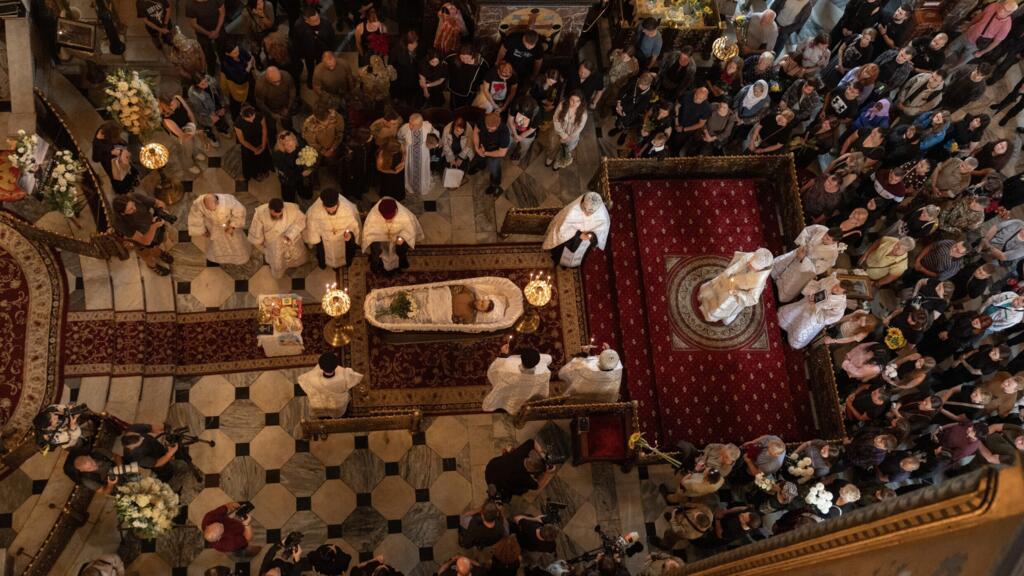
The Oleksiy Yukov funeral on Saturday drew thousands to central Kyiv, filling a cathedral and spilling into the city’s main square, where mourners dropped to their knees as his casket passed.
He was 40 years old. He died Wednesday when a landmine detonated during a recovery mission, doing exactly the work that had defined his adult life.
A Nation Stops to Mourn
An Orthodox Christian service was held at the Cathedral of Saint Volodymyr in central Kyiv.
Afterward, crowds gathered at Maidan Square, the site so central to Ukraine’s modern political identity. Many knelt as his casket was brought forward, a gesture usually reserved for fallen soldiers.
Memorial services took place in other cities across the country as well.
That scale of public grief is remarkable for a man who held no rank, no office, and no formal position in the state.
The Work That Made Him Known
Yukov founded an organization called Platsdarm, meaning Bridgehead, built around a single conviction: every person killed by war deserves a proper burial.
That belief made no exceptions. Over more than two decades he recovered the bodies of civilians and soldiers, and many of those soldiers were Russian.
People began calling him the collector of souls.
He came from the Donbas region and worked as a martial arts instructor. The recovery work started when he was still a teenager, after he came across the remains of Soviet and Russian soldiers left from the Second World War.
What began as a discovery became a vocation that lasted the rest of his life.
Working Where the Ground Is Mined
Platsdarm volunteers operate in some of the most dangerous terrain imaginable.
They move through fields and forest belts, among ruined buildings, across land where mines are frequently present and rarely mapped. The work happens within range of shelling and drones.
Yukov described those conditions himself in a social media post last month. Remote mines, artillery, drones, everything working against you, and still you go out and do whatever is required so that every soul returns home.
He had already paid for that commitment once. In 2022 a mine blast left him with serious leg injuries and cost him an eye.
He went back to the front line while still recovering.
A Family’s Promise
At the funeral, Yukov’s widow, Evhenyia Kaluhyna, stood over his open casket in an embroidered white dress and spoke through tears.
She acknowledged plainly what the work was: difficult and terrifying. Then she made a promise to continue it, saying the dead deserve it and that he deserved it for everything he had done.
His daughter, Diana Kaluhyna, spoke to The Associated Press about the effect he had on the families he encountered.
She said the love and kindness he showed grieving relatives had moved the entire nation. What stayed with her from the day, she said, was a simple truth: he honored the dead and healed the living. He offered more than hope. He restored people.
The Argument He Refused to Accept
Yukov’s insistence on recovering Russian bodies alongside Ukrainian ones was not universally popular, and he knew it.
He addressed the objection directly. When people said those bodies should simply be left to rot, he refused to agree. That refusal, in his framing, was itself a form of fighting for every soul.
It was a difficult position to hold in a country under invasion. It also gave his work a moral weight that transcended the conflict.
He spoke about it in religious terms. A body, to him, was a soul waiting to go home.
He described what he did not as a belief but as an act. Action, he wrote, carried out every day in the fields, in the forest belts, among the ruins, in places where a life can end at any moment.
Why This Work Matters So Much
For families of the missing, the absence of a body creates a particular kind of suffering that grief alone does not describe.
Without remains, there is no death certificate. No funeral. No inheritance settlement, no closure to legal status, no place to visit. Families remain suspended indefinitely between hope and mourning, unable to fully do either.
Recovery work resolves that suspension. It is why Yukov’s role reached beyond the technical into something families experienced as mercy.
The scale of the need in Ukraine is immense. Years of fighting across a wide front have left remains scattered through contested and abandoned terrain, much of it now heavily mined.
The Cost of Continuing
Yukov’s death illustrates the arithmetic of this work. Every recovery mission carries genuine risk of adding another body to the list.
Demining and remains recovery in active or recently contested areas remain among the most hazardous humanitarian tasks anywhere in the world. Unexploded ordnance does not expire, and mines laid during fighting can remain lethal for decades after the fighting stops.
His widow’s promise to continue means accepting that risk knowingly.
What He Leaves Behind
Yukov built an organization, trained volunteers, and returned an uncounted number of people to their families. He also left an argument about dignity that Ukraine appears to have taken seriously.
The kneeling crowds at Maidan on Saturday suggest something beyond mourning for one man. They suggest a country recognizing that how it treats its dead, including its enemies’ dead, says something about what it intends to be when the war ends.
He spent twenty years insisting on that. The work continues without him.
Author
-
Lucienne Albrecht is Luxe Chronicle’s wealth and lifestyle editor, celebrated for her elegant perspective on finance, legacy, and global luxury culture. With a flair for blending sophistication with insight, she brings a distinctly feminine voice to the world of high society and wealth.