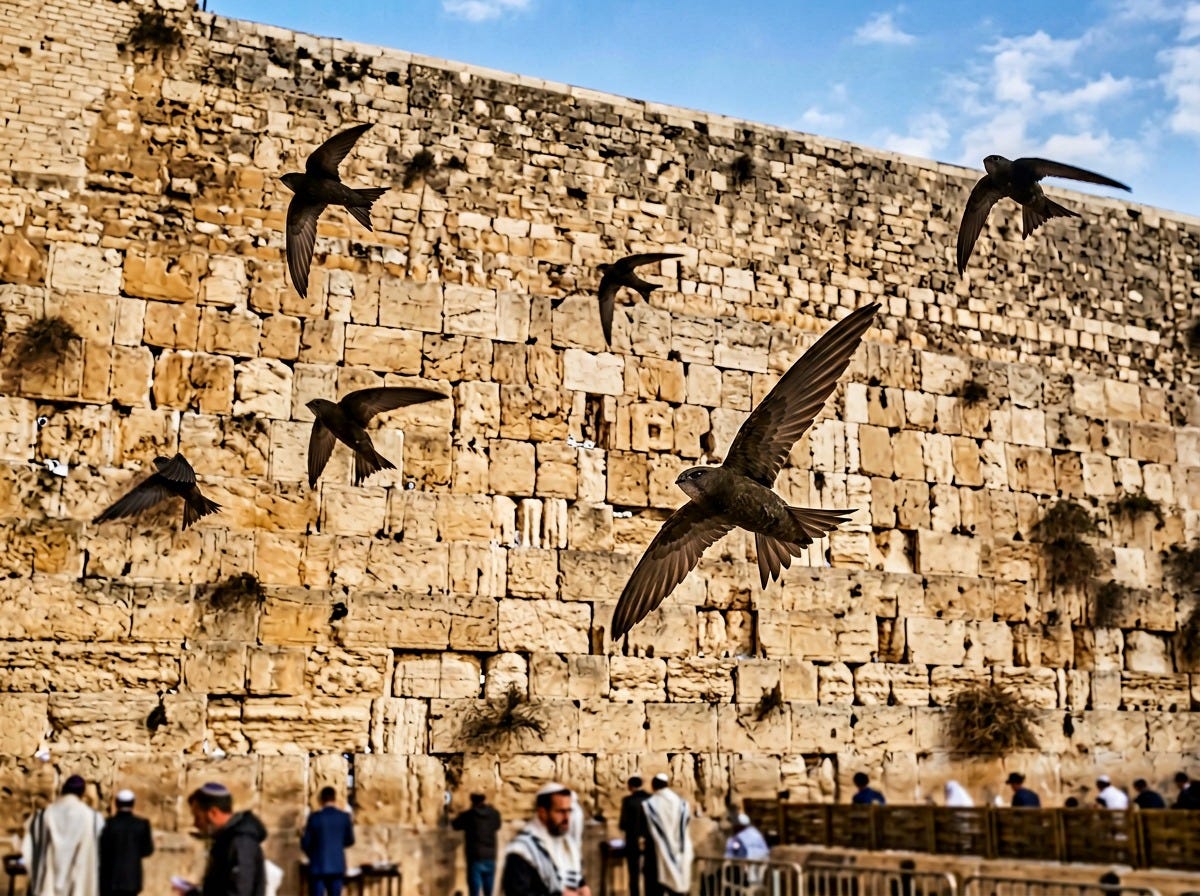
JERUSALEM — The common swifts Western Wall community welcomes each spring are honored with something unusual: a ceremony. A rabbi presides as the birds complete a migration of roughly 2,800 miles from Africa, arriving at one of the world’s most contested holy sites.
From February through June, the prayers of men and women at the wall mingle with the calls of birds darting overhead.
Two Thousand Years in the Same Stones
Researchers believe swifts have raised their young in the gaps and crevices of these stones since Herodian times — two millennia of continuous return. Recent counts have identified 88 nests.
The birds appear in scripture too. Modern translations of Jeremiah contrast the reliability of migrating birds with human failure, noting that the stork, turtledove, swift and swallow all keep their appointed times while the faithful neglect theirs.
Sarah Wurtzel, a New York-born Israeli who came with her family to pray, describes the connection between birds and Torah as deep. Watching the swifts, she said, brings her closer to God. If God sustains these creatures in the air every moment, she reasons, how much more must he be watching over people. That sense of protection is what she feels when she sees and hears them.
Birds That Belong to No One
In a city divided along political and religious lines, swifts have become a symbol precisely because they ignore those divisions.
They are everywhere in the Old City, which holds sacred sites for the three largest monotheistic faiths. Beyond the Western Wall, they have nested at Al-Aqsa Mosque and the Church of the Holy Sepulchre.
British artist Mark Coreth worked with Jewish, Christian and Muslim communities on a sculpture meant to express that unity — an olive tree whose canopy is formed from swifts instead of leaves. It stands in the courtyard of St. John Eye Hospital in the Old City. Coreth also mounted bronze swifts on hospital walls in Gaza and the West Bank.
Amnonn Hahn, chair of the Friends of the Swifts Association in Israel, who consulted on the project, put the hope plainly: where the white dove failed to bring peace, perhaps the swift will succeed.
A Population in Freefall
The birds arriving in Israel travel from East Africa through the Jordan Valley, following a corridor rich in insects.
Across Europe, their numbers are collapsing. In Britain, the population has dropped roughly 70 percent since the mid-1990s.
Scientists point to three converging causes:
- Steep declines in the insect populations swifts feed on
- Increasingly erratic weather linked to climate change
- Loss of suitable nesting sites
Hahn sees the same pattern in Israel, and the third factor is where human construction bears direct responsibility.
Modern Buildings Have No Gaps
Swifts adapted to living alongside people, Hahn explains, nesting around window shutters and beneath roof tiles.
That partnership has quietly ended. Glass-facade towers and tightly finished modern construction leave, in his words, no space for swifts.
Forced into inadequate sites — small holes between broken bricks — adults raise chicks in quarters too tight to hold them. Within two or three weeks of hatching, Hahn says, there simply isn’t room, and at least one nestling falls out.
An Unexpected Solution
Hahn, 72, spends much of the nesting season responding to reports of fallen nestlings.
By 2018 the problem had become acute enough that people were bringing dozens of birds to the Israeli Wildlife Hospital. The hospital called Hahn asking for a solution.
What he tried was simple and, to him, astonishing in its result. He placed rescued nestlings into the roomier nesting boxes he had installed around his home, where other swifts were raising chicks.
The adults fostered them without hesitation. More than that — they fed the newcomer before their own young. The parents, Hahn believes, recognized that the new arrival was hungrier.
Twenty-Five Minutes That Changed a Life
Hahn’s devotion traces back to a paragliding championship in 1999.
Searching for a thermal to gain altitude, he followed a group of swifts. Maneuvering toward them, he was abruptly lifted and found himself flying alongside the birds for about 25 minutes, climbing to over 6,500 feet.
Circling with them in the thermal, he said, felt like magic.
He switched off his variometer — the instrument that beeps to indicate climb and descent — and flew in silence among birds shaped like arrows, wingspans around 16 inches. He describes their large eyes, their white throats, the precision of their communication and movement. With the sun behind him they appeared completely black. Circling into the sun, they turned golden.
He was enchanted. He also won the competition.
Building Homes From Ammunition Boxes
After retiring from a career importing motorcycles, Hahn committed himself to the birds.
In 2005, his daughter’s school underwent renovation. He remembers the distressed calls of swifts returning from Africa to find nowhere to nest.
His response was resourceful. He obtained ammunition boxes from the Israeli army, converted them into nesting boxes, and installed 18 around the school, with the rest distributed among nearby houses and his own home.
Through the Friends of the Swifts Association, he has since worked with city councils and schools nationwide. At one Tel Aviv kindergarten he helped install 222 nesting boxes, fitting cameras inside some of them.
A Life Lived Entirely in the Air
On a warm May evening at that kindergarten, the swifts raced around the rooftop play area at full speed — black arrows against a gold sky.
Researchers call this a screaming party, named for the piercing calls the birds make. Hahn suspects that evening’s display was aimed at the nestlings, a demonstration of skill meant to coax them out of the nest. They like showing off, he jokes.
What happens next is remarkable. Once fledglings take flight, they may not land again for two or three years.
They accomplish nearly everything airborne:
- Eating and sleeping on the wing
- Bathing by slowing to catch raindrops during storms
- Mating in flight
- Gathering nest material from feathers and straw carried on the wind
They pair for life but migrate separately, potentially wintering in different African countries and reuniting only at the nest. If both survive the journey, they meet again at the same site year after year. Landing, for a swift, is something done only to raise young.
What Threatens Them Next
Iranian missile strikes on Tel Aviv during the war with Israel drove many nesting pairs from the kindergarten site. More than 30 pairs remain.
Standing on that rooftop, Hahn looks across the surrounding neighborhood and sees the more permanent threat. The buildings around him are slated for demolition, replaced by skyscrapers that will offer nowhere for swifts to nest.
The boxes he has spent two decades installing are the answer to that. When the birds return from Africa, they will still find somewhere to raise the next generation — not in the gaps modern architecture no longer provides, but in spaces someone deliberately made for them.
Author