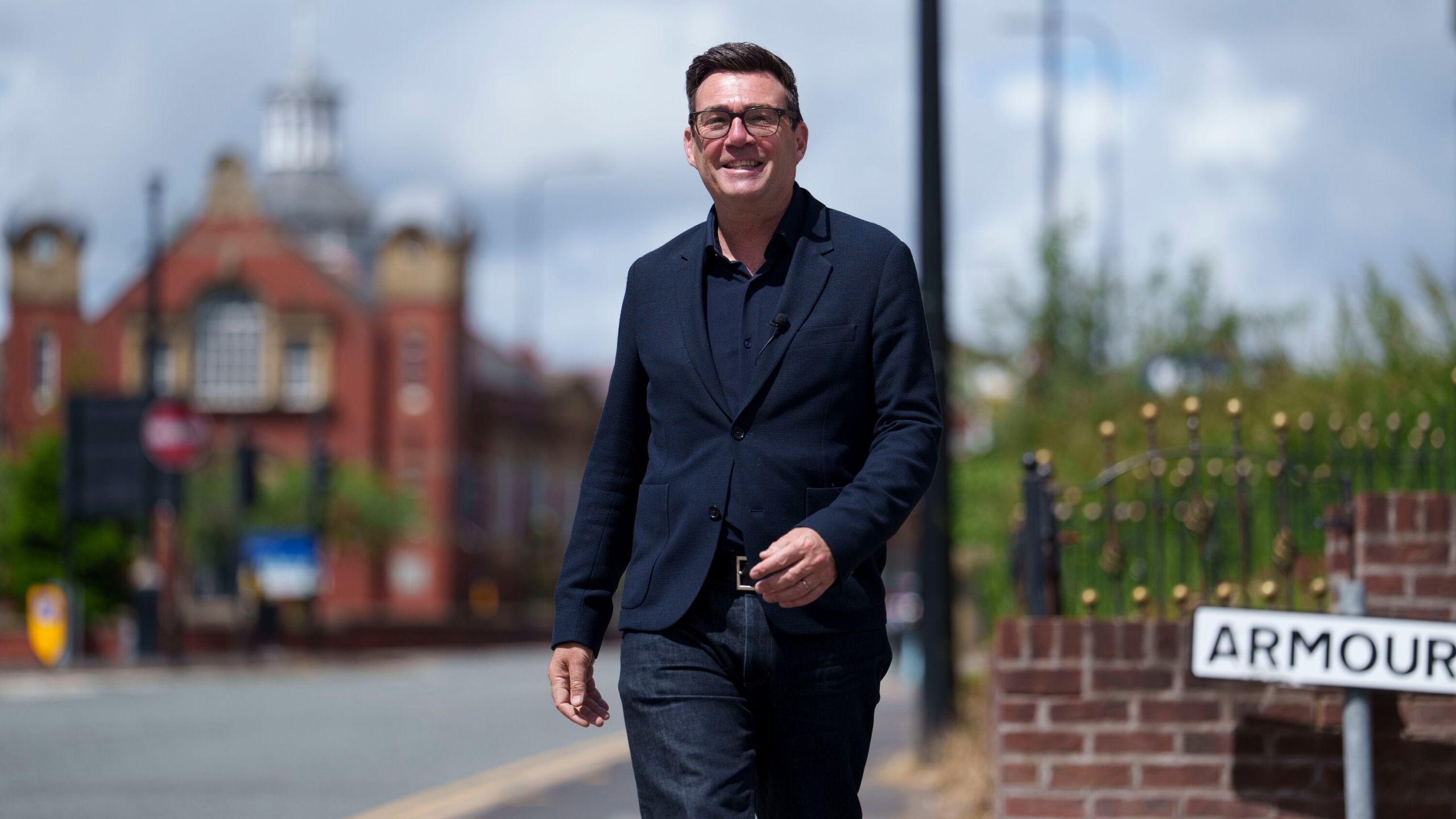
LONDON — Andy Burnham UK prime minister is a phrase that becomes official on Monday, when the newly chosen Labour leader takes over from Keir Starmer at the head of the British government.
Burnham is not a household name outside Britain. At home, he is one of the most genuinely popular figures his party has.
A Class Divide That Shaped Everything
Burnham grew up in northern England and then moved south to study English literature at Cambridge — a transition that in Britain carries more weight than geography alone suggests.
One of his professors, John Mullan, told the Times of London that Burnham turned up to class in a soccer jersey. Mullan noted that while this might pass unremarked on the streets of northwest England, it was not typical of a Cambridge college.
Mullan remembered a soccer-obsessed student who could recite Shakespeare and who dated the coolest girl in the college. That was Marie-France van Heel, born in the Netherlands. They are now married.
The jersey turned out to be an early signal of the working-class identity that would define his politics.
Roots and Early Career
Burnham, 56, was born in a suburb of Liverpool. His father worked as a telephone engineer, his mother as a receptionist. He was raised in a village roughly midway between Liverpool and Manchester.
After Cambridge, he and van Heel moved to London. He entered Parliament at 31 as a Labour MP representing a northern constituency.
Under Prime Minister Gordon Brown, he served as secretary of state for culture, media and sport.
The Speech That Made Him
In 2009, Burnham was dispatched to Liverpool to speak on the anniversary of the Hillsborough disaster, in which nearly 100 soccer fans were crushed to death in an overcrowded northern stadium in 1989 — the deadliest sporting accident in British history.
The victims had been labeled hooligans. Survivors and families believed the government had failed to investigate properly.
The crowd heckled him. Fighting back tears, Burnham abandoned his prepared remarks and nodded along as the crowd chanted for justice.
Charlotte Wildman, a University of Manchester historian who studies the working class, said he was among the first politicians to genuinely listen.
He then launched a government inquiry, which concluded that police failures — not the fans — caused the disaster.
Wildman describes the significance in terms broader than one tragedy. Northern working-class men in particular had been demonized as violent, aggressive and criminal, and that stereotype was deeply entrenched. The inquiry helped dismantle it.
Twice Rejected, Then a Different Route
Burnham ran for the Labour leadership twice as an MP. In 2015, his nomination came from a fellow lawmaker and friend: Keir Starmer.
He lost both times. After 16 years in Parliament, he quit and went north.
In 2017, voters elected him mayor of Greater Manchester. Local government turned out to be where he built a national reputation.
Rebuilding a City’s Image
Manchester in the 1980s and 90s was known for two things: post-industrial decline and an extraordinary indie music scene that produced The Smiths, New Order, The Stone Roses and Oasis.
Burnham attacked the first and immersed himself in the second.
Redevelopment was already underway when he arrived, and he accelerated it. He brought the city’s buses under public control and persuaded the central government to devolve more authority over education and housing to cities like his.
Wildman frames it partly as a branding exercise. Manchester’s image had been so bound up with urban decay that changing perception was itself a policy goal.
The results are visible. Cranes line the skyline. A district of canals and former warehouses now houses an arts center. Glass towers give parts of the city a look closer to Dubai than to traditional England. Greater Manchester’s economy is among the fastest-growing of any municipality in the UK.
What “Manchesterism” Means
Burnham is now selling that experience as a national model.
His stated plan involves shifting power away from Whitehall toward cities and regions, including opening a branch of Downing Street in the north.
In a June 29 policy speech, he asked listeners to imagine good growth in every postcode and hope in every heart — then said the time for imagining was over.
His specific commitments include:
- Cutting tax rates for retail businesses
- Building more public housing than any government since the Second World War
- Reducing welfare spending in a way he describes as fair and lasting
Rose Marley, chief executive of Co-operatives UK, defines Manchesterism as people organizing to create change themselves with a can-do attitude. In economic terms, she says, Burnham would call it the end of neoliberalism.
Marley advised Burnham during his mayoralty, but met him earlier on the city’s music scene, where he moonlights as a DJ. She recalls him arriving from London suited and booted, behaving like a Westminster MP.
That lasted about a day. The tie came off, she says, and the Westminster persona went with it. The Mancunian uniform is trainers and T-shirts — and that is when the DJing started.
The Moment That Made Him National
The pandemic turned a regional figure into a household one.
The UK government tailored lockdowns to local infection rates, and Manchester faced tighter restrictions than many cities under rules that were frequently confusing.
In October 2020, Burnham was holding a live televised news conference when an aide handed him a phone carrying news of another lockdown. He reacted on air, angrily criticizing the central government.
He said this was no way to run a country during a national crisis, and predicted the restrictions would fall hardest on lower-paid blue-collar workers — people too often forgotten by those in power.
The clip went viral. Joshi Herrmann, founder of the Manchester news site The Mill, says Burnham became a national hero during a frightening period.
Herrmann’s reading is that Burnham expressed helplessness and a sense that the government did not understand life in a place like Manchester, marking himself as a different kind of politician. Without that moment, Herrmann believes, Burnham would not be walking into Downing Street.
The Problems Waiting for Him
The job comes with the same difficulties that wore down his predecessor:
- Weak national growth
- High energy prices
- Pressure to increase defense spending amid Russia’s war in Ukraine
- A volatile relationship with Washington
Herrmann is uncertain how Burnham will handle them, and raises one particular vulnerability. He describes Burnham as someone who craves affirmation, and wonders how far he might go to avoid being attacked by Donald Trump on social media overnight. That kind of criticism, Herrmann suspects, would wound Burnham more deeply than it wounded Starmer.
A Different Scale of Job
Running Greater Manchester and running the United Kingdom are not the same task, and the transition is not gradual.
Burnham built his political identity on being close to a place — on knowing its neighborhoods, its music, its grievances. The premiership demands something else entirely: distance, breadth, and constant negotiation with forces well beyond any city’s control.
Whether the instincts that worked in Manchester translate to Downing Street is the question that will define his time there. Britain finds out starting Monday.
Author