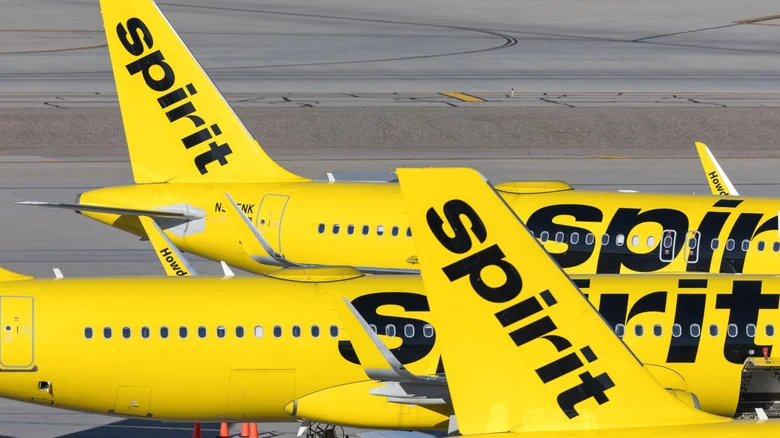
The story of Spirit Airlines abandoned planes has become one of the more unusual chapters in recent aviation history. With the budget carrier shutting down operations, attention has turned to a complicated question: what happens to a fleet of more than 90 aircraft left scattered across the country? As it turns out, repossessing planes from a collapsed airline is far from an ordinary recovery job.
The Collapse of a Budget Carrier
Spirit Airlines ceased operations on May 2, ending a difficult stretch that saw the company file for bankruptcy twice, first in 2024 and again in 2025.
According to the New York Times, the airline had bled billions of dollars in recent years, weighed down by intense competition, rising labor costs, and mounting aircraft maintenance expenses. There had been a plan for Spirit to emerge from its second bankruptcy this summer as a leaner company. However, a sharp spike in jet fuel prices tied to the war in Iran reportedly caused those plans to unravel.
The airline also pursued a roughly 500-million-dollar lifeline through a potential deal with the Trump administration, but that arrangement ultimately fell through.
The shutdown left some travelers stranded, though other carriers stepped in with affordable rescue flights. Now, with passengers rebooked, the far trickier challenge is dealing with the fleet itself.
Why the Fleet Is So Hard to Untangle
When Spirit stopped flying, more than 90 aircraft were left behind at dozens of airports nationwide, according to a report from NPR.
The company hopes to liquidate its valuable assets, including engines, spare parts, and real estate. But the aircraft present a more tangled problem, because Spirit does not actually own most of the planes it operated. More than 60 aircraft, nearly two-thirds of its active fleet, were leased rather than owned.
That distinction matters enormously. Leased jets must be returned to their owners, which sets off a large and logistically demanding repossession effort.
Flying the Planes to Arizona
Captain Robert Allen, a partner at Nomadic Aviation Group, a firm that handles aircraft deliveries, returns, and repossessions, described the relocation effort in an interview with Fox 10 Phoenix.
Many of the aircraft are being flown to Phoenix Goodyear Airport, where the state’s dry climate makes it an ideal storage location. As Allen explained, planes that sit in wet climates tend to deteriorate, so Arizona offers a far safer environment for long-term storage.
Getting the jets there, however, is a mission in itself. Nomadic has contracted pilots to retrieve the abandoned aircraft, including some who recently lost their jobs when Spirit shut down.
The work can be surprisingly contentious. Because the pilots are not wearing airline uniforms, they sometimes meet resistance from airport staff. Steve Giordano of Nomadic told NPR that approaching an official and announcing an intent to repossess a plane almost always triggers an immediate refusal. In his account, the instinctive response is to say no, often prompting calls to airport police, sheriffs, and airport managers.
The Real Prize May Be the Engines
Not all of the aircraft will simply sit in storage indefinitely.
Giordano, who works with six of the companies that own Spirit’s jets, told NPR that some planes are likely already in the pipeline to be leased again. Others will have their engines removed and installed into different aircraft, which can then be leased out as well.
That detail points to where much of the real value lies. Court filings indicate that Spirit owns 28 aircraft outright, all part of the Airbus A320 family, which the company could sell. Fox 10 reported that some buyers will likely purchase certain aircraft purely for their engines, which can be worth between 15 million and 20 million dollars each.
A Tougher Market for Selling Planes
Even with valuable assets on hand, Spirit and its creditors may face a slower path to recovery.
Experts told NPR that the steep cost of jet fuel, up roughly 70 percent, could make Spirit’s owned aircraft harder to sell. Henry Harteveldt, an airline analyst at the Atmosphere Research Group, explained that high fuel costs make many of Spirit’s planes less attractive to potential buyers.
Still, Harteveldt expressed confidence that buyers would eventually emerge. He suggested the airline would find purchasers, though the selling cycle is likely to be slower than it might have been a few years ago, or even just months earlier.
The Bigger Picture
The saga of Spirit Airlines abandoned planes highlights just how complex an airline’s collapse can be once the flights stop. Behind the headlines about stranded passengers lies an intricate process of repossession, storage, leasing, and resale, all unfolding against the backdrop of a difficult fuel market.
For now, dozens of jets are making their way to the Arizona desert, where they will wait, some destined for new airlines, others valued mostly for the powerful and expensive engines they carry.
Author