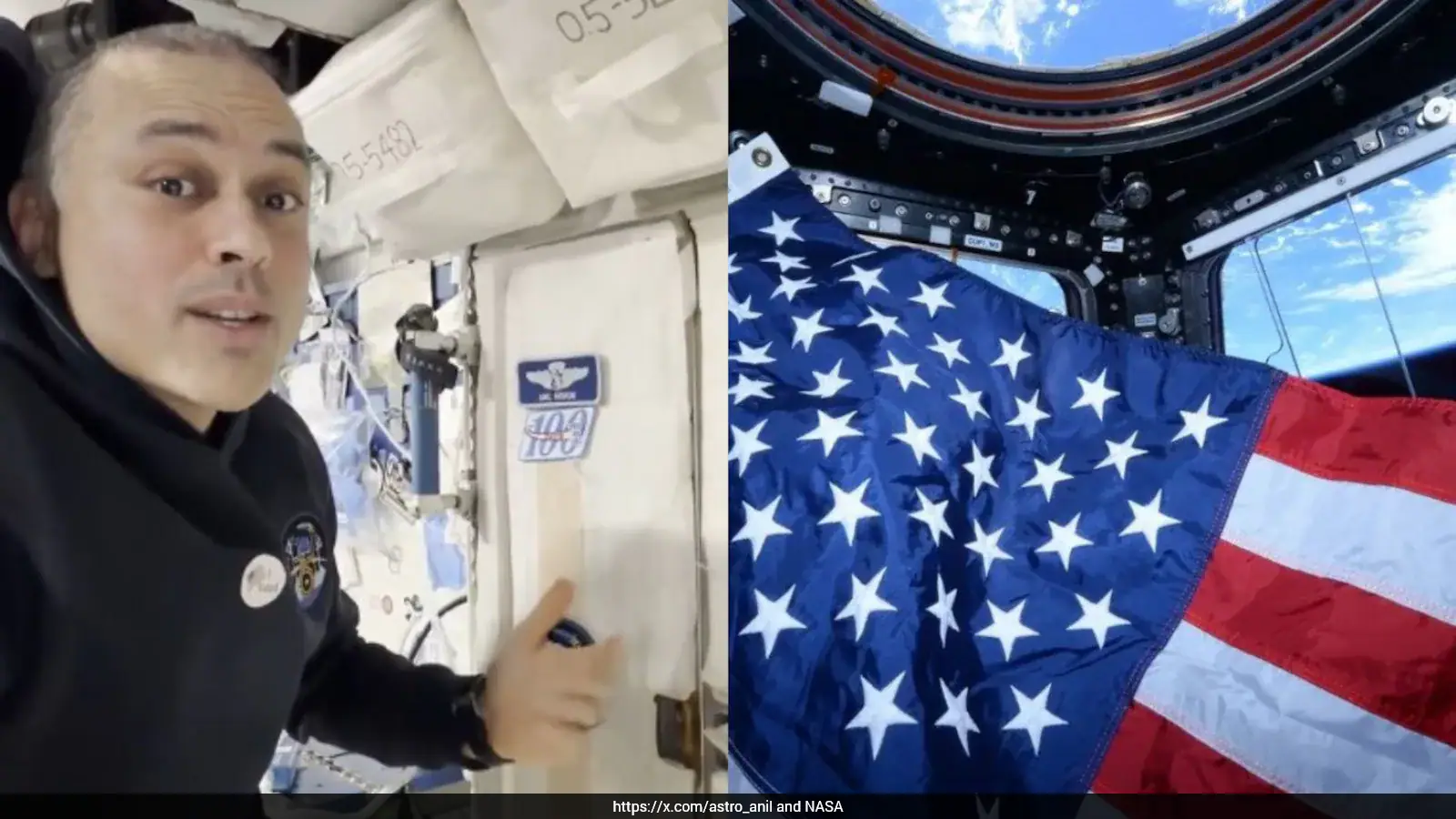
Astronauts vote from space, and on Tuesday three Americans orbiting roughly 400 kilometres above Earth did exactly that, casting ballots in the US midterm elections from the International Space Station. NASA astronaut Anil Menon confirmed the news in a post on X, saying he and crewmates Luke Delaney and Jessica Watkins had all exercised their right to vote without ever setting foot on the ground.
A Voting Booth Unlike Any Other
Menon shared a short video, just 29 seconds long, offering a tour of what he called his voting booth. It turned out to be his personal sleeping quarters aboard the station, a compact compartment containing his computer. From there, he explained, he completed an electronic ballot and transmitted it to election officials in Harris County, Texas, the jurisdiction that covers NASA’s Johnson Space Center in Houston.
Like millions of Americans back on Earth, Menon appeared in the video wearing an “I voted” sticker, a small touch that connected the extraordinary setting to an ordinary civic ritual.
How the Process Works
Voting from orbit is possible but involves considerably more steps than dropping an envelope in a mailbox. According to NASA’s own explainer, astronauts begin the same way as any American living away from home: by submitting a Federal Post Card Application to request an absentee ballot.
Once the astronaut fills out the electronic ballot aboard the station, the document travels through NASA’s Tracking and Data Relay Satellite System to a ground antenna at the agency’s White Sands Test Facility near Las Cruces, New Mexico. From there, it is relayed to the Mission Control Center at Johnson Space Center and finally forwarded to the county clerk responsible for recording the vote.
To protect the integrity of the ballot, it is encrypted throughout the journey and can be opened only by the astronaut who cast it and the clerk who receives it. No one at NASA or anywhere along the relay chain can view the astronaut’s choices.
A Tradition Decades in the Making
The practice of space voting dates back to 1997, when Texas lawmakers passed legislation allowing astronauts to cast ballots from orbit. The change was prompted by the realisation that long-duration missions could keep crew members away during elections, effectively disenfranchising them. Since then, numerous astronauts have voted from the station during presidential and midterm cycles.
Because most NASA astronauts are based in Houston, the Texas law and Harris County’s procedures have become the standard framework for the process.
The Crew in Orbit
Delaney and Watkins arrived at the station on October 1 aboard SpaceX’s Crew-13 mission. Menon has been in orbit since mid-July, having launched on a Russian Soyuz spacecraft.
The three Americans share the orbiting laboratory with four other crew members: Canadian Space Agency astronaut Joshua Kutryk and Russian cosmonauts Anna Kikina, Pyotr Dubrov and Sergey Teteryatnikov. Kutryk and Teteryatnikov flew up with Crew-13, while Dubrov and Kikina travelled on the same Soyuz as Menon.
The international makeup of the station means that on any given election day, only some residents are eligible to participate, but the American contingent has consistently made use of the opportunity.
Why It Matters
The sight of astronauts voting from orbit carries symbolic weight beyond the three ballots themselves. It demonstrates that civic participation can extend to the most remote and demanding environments humans occupy, and it reinforces the principle that physical distance should not strip citizens of their voice.
For NASA, the tradition also serves as a reminder of the agency’s human dimension. Astronauts are not only scientists and engineers conducting experiments in microgravity; they are citizens with homes, communities and stakes in the decisions made on the ground.
A Busy Election Day on Earth
The ballots from the ISS joined more than 230 million eligible voters’ potential choices in an election that reshaped Congress. Democrats retook the House of Representatives and made sweeping gains in the Senate, driven by voter concerns over living costs and the war with Iran. Whether the three astronauts’ votes played any role in close races is unknown, and by design, their choices remain private.
The Future of Voting Beyond Earth
As human spaceflight expands, with plans for extended lunar missions and eventual trips to Mars, the question of how to ensure crew members can vote will grow more complex. A relay through satellites and ground stations works for low Earth orbit, but communication delays on deep-space missions could require new approaches.
For now, the system functions smoothly enough that three astronauts could complete their ballots, send them securely across hundreds of kilometres of space and still find time to share a video celebrating the moment. As Menon put it in his post, voting from the space station was a privilege, and one that all three American crew members were glad to exercise.
Author