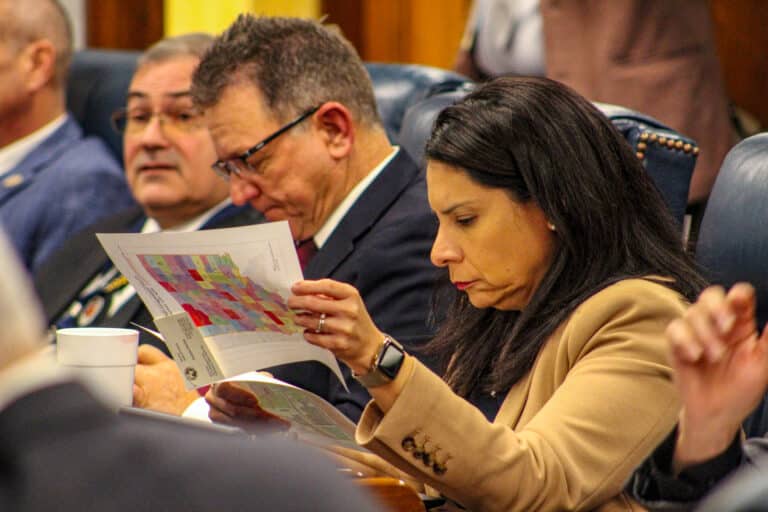
The Indiana Senate primary recount that consumed four months has ended with the result reversed, handing the Republican nomination to Trump-backed challenger Paula Copenhaver by a margin of three votes over incumbent state Senator Spencer Deery.
The three-member commission overseeing the process, which includes Republican Secretary of State Diego Morales, certified the outcome.
A Result That Traveled Full Circle
The arithmetic here is unusually tidy and unusually brutal.
On May 5, Deery finished ahead by three votes. After the recount concluded, Copenhaver finished ahead by three votes. The same razor-thin margin, pointing in the opposite direction.
The shift came from ballot invalidation rather than recounting. Copenhaver’s campaign succeeded in having eight votes cast for Deery thrown out, largely over procedural defects such as missing initials and stamps. Copenhaver herself lost two previously counted votes in the process.
Six net votes, and a state senate seat changed hands.
The Argument That Did Not Work
Copenhaver’s campaign initially pursued a far more aggressive theory. It argued that ballots cast by left-leaning voters who crossed over to support Deery should be invalidated, pointing to social media posts in which those voters discussed doing so.
The commission did not accept that reasoning.
The votes Deery lost were struck on entirely different grounds, rooted in administrative errors made by poll workers rather than anything about voter intent or affiliation.
That distinction matters. The reversal ultimately turned on paperwork inside polling places, not on who voted or why.
The Redistricting Backdrop
This race did not exist in isolation. It was one front in a broader campaign targeting Indiana state senators who opposed redistricting.
Presidential endorsements combined with substantial spending from dark money groups produced a string of primary defeats for incumbents on the wrong side of that fight in May. Deery was among only two anti-redistricting senators who survived a difficult election, and he has now lost that standing.
The result nudges the balance of power in the Indiana Senate further toward the redistricting effort’s supporters.
Copenhaver’s Account
Speaking after the commission hearing, Copenhaver declared victory and said she is focused on November. Asked about the possibility of a legal challenge from Deery’s side, she indicated she was not worried.
She pushed back on the framing that has surrounded her candidacy. Despite receiving a full-throated presidential endorsement, she rejected the characterization of her campaign as part of a retribution effort, saying she had simply drawn attention to Deery’s voting record. She argued there was a statewide mandate among Republicans on redistricting.
Her background gives her a particular vantage point on the recount itself. As a former Fountain County Clerk, she said all valid votes should be counted and noted that election workers receive training precisely to prevent errors. She declined to comment specifically on the commission’s examination of worker mistakes, including one rejected ballot in the office she once ran.
Her assessment of the outcome was blunt: nobody was disenfranchised.
Pressed by reporters about who financed her legal effort, she did not provide an answer. She said her campaign was not paying for it and repeatedly referred to having great supporters.
The Democratic Response
David Sanders, a West Lafayette City Councilman and the Democratic nominee, issued a sharp statement following the certification.
He criticized Copenhaver’s attempts to subpoena voters and what he described as an intrusion into ballot secrecy. He also argued that she had compromised her integrity through dependence on dark money political action committees, contending she could not have won without that financial backing.
Sanders positioned himself as offering a different model of politics, with government transparency as a central commitment. His platform includes:
- Opposition to large-scale water transfers
- Access to high-quality health care
- Support for public education
- Expanded broadband internet
- Benefits for veterans
Independent candidate Joshua Brant will also appear on the November ballot.
What This Case Reveals
Beyond the partisan stakes, this recount exposed something uncomfortable about election administration.
Eight ballots were discarded not because voters did anything wrong, but because poll workers omitted initials or stamps. Those voters cast valid ballots, followed the rules, and had their votes discounted over clerical steps entirely outside their control.
In a race decided by three votes, those administrative details became decisive.
The episode raises questions likely to outlast this particular contest. How consistently are procedural requirements applied across counties? Should a voter bear the consequence of an official’s oversight? And in an era where razor-thin margins are common, how much weight should certification formalities carry against the intent clearly expressed on a ballot?
Copenhaver, notably, is a former county clerk who declined to discuss the worker errors that shaped her own victory.
Looking Toward November
The nominee now pivots quickly to a general election campaign against Sanders and Brant.
Whether a legal challenge from Deery’s camp materializes remains unresolved, though Copenhaver has signaled confidence that it will not disrupt her path.
What is settled is the shape of the race ahead. A challenger who won through a recount will face a Democrat who has already made that recount, and the money behind it, a central line of attack.
Author
-
Lucienne Albrecht is Luxe Chronicle’s wealth and lifestyle editor, celebrated for her elegant perspective on finance, legacy, and global luxury culture. With a flair for blending sophistication with insight, she brings a distinctly feminine voice to the world of high society and wealth.