Trump-Backed Prayer Festival Turns the National Mall Into a Worship Service
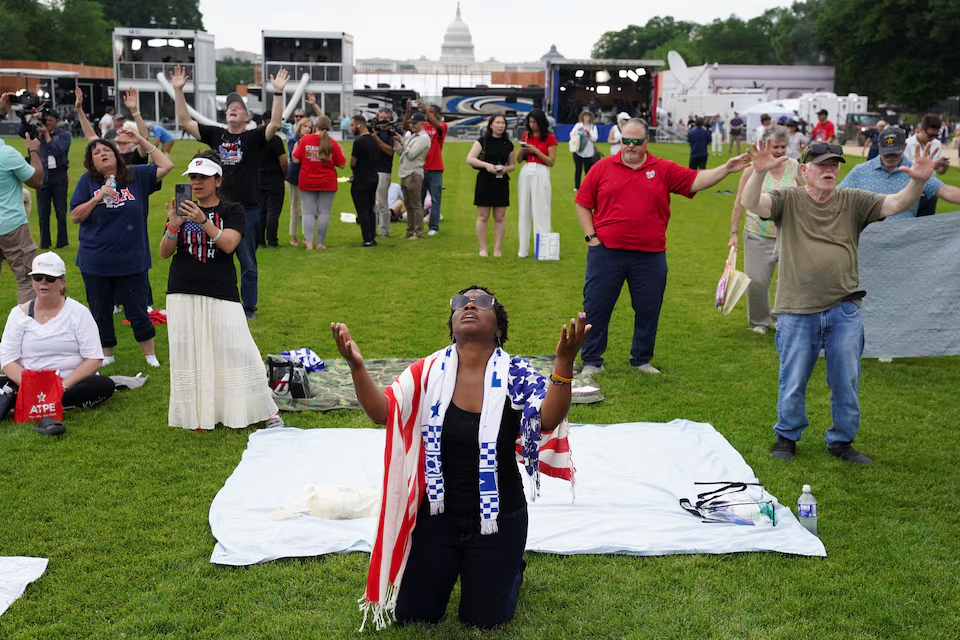
A Trump-backed prayer festival drew thousands of worshippers to the National Mall on Sunday, turning a stretch of one of America’s most iconic public spaces into something resembling a sprawling evangelical revival. For roughly eight hours, attendees prayed, sang, danced and lifted their hands skyward under a bright sun, while a lineup of speakers — many of them senior government officials — described the United States as a nation founded to be explicitly Christian.
The event, titled “Rededicate 250: A National Jubilee of Prayer, Praise & Thanksgiving,” was backed by President Donald Trump and reportedly supported by millions of dollars in taxpayer funding. That combination — overt religious messaging paired with government sponsorship — is exactly what made the day so celebrated by supporters and so alarming to critics.
A Mall Transformed Into a Sanctuary
The setting itself was striking. Organizers built a stage framed by ivory-colored pillars meant to echo the neoclassical architecture of Washington’s federal buildings, blurring the visual line between civic and sacred space.
“We welcome Jesus into this place!” worship leader Andy Frank called out as the program began. From there, the day unfolded like a large-scale church service, complete with music, scripture readings and emotional appeals.
Many in the crowd, dressed in red, white and blue, said they were moved to see the country and its leadership tied so directly to Christian faith. For them, the message felt overdue rather than controversial.
Government Officials Take Center Stage
What separated this gathering from a typical religious festival was the prominent role played by sitting government leaders.
- Secretary of State Marco Rubio appeared by video, arguing that civilizations before Christianity viewed history as a “wheel to nowhere,” and calling Christian faith the enduring “soul of our nation.”
- Vice President JD Vance, Director of National Intelligence Tulsi Gabbard and Defense Secretary Pete Hegseth also delivered recorded remarks.
- House Speaker Mike Johnson spoke at length in person.
President Trump — not typically known for quoting scripture — read a biblical passage in which God promises to heal the ancient Israelites if they humble themselves and pray.
For most of modern history, it has been rare for U.S. officials to publicly bind the federal government to a single religious tradition. Critics argue that Trump’s second-term cabinet has steadily eroded that long-standing norm, and Sunday’s event placed that shift on full public display.
A Christian Retelling of American History
Several speakers reframed the nation’s origin story through an explicitly Christian lens.
Hegseth described George Washington praying at Valley Forge as his exhausted army endured a brutal winter, urging the crowd to “pray as he did” and to do so “on bended knee.” Sen. Tim Scott pointed to the Civil War and World War II as moments when Americans, in his telling, turned to God for strength and guidance.
Speaker Johnson struck a darker, more combative tone. He warned that “sinister ideologies sow confusion and discord among our people” and lamented what he called attacks on America’s history, heroes and spiritual identity. He rejected the idea that the American story should be understood mainly “through the lens of our sins.”
The program also leaned heavily on evangelical heritage. The sons of Billy Graham, Jerry Falwell and Pat Robertson appeared on stage, evoking the Religious Right of an earlier generation. Contemporary appeal came from podcaster Sadie Robertson Huff and actor Jonathan Roumie, known for playing Jesus in the series “The Chosen.”
Supporters Embrace the Message
For attendees, the event felt less like a political statement and more like a long-awaited national course correction.
Richard Nuccitelli, 87, a real estate agent from Connecticut who came with friends from his Bible study group, said the Constitution simply doesn’t function without a “moral and Christian population.” Dennis Colado, 68, of Florida, wore a shirt reading “Jesus is my savior. Trump is my president,” and said he came to “rededicate our country to Jesus.”
Interestingly, the crowd’s faith was not uniform. Several people described their beliefs in broad terms — good versus evil rather than any specific denomination — and some said they blended Christianity with Native American spirituality or astrology. Many viewed Trump as flawed but divinely positioned to confront a “deep state” or hidden global forces.
Deborah McManus, 61, from Iowa, admitted she wasn’t sure she would even call herself Christian, yet felt the country was “fighting powers” that wanted it to fall. Since Trump’s return to office, she said, the nation had entered “a period of grace.”
Critics Warn of Christian Nationalism
Outside the event’s gates, smaller groups of protesters voiced sharp objections.
Karen Irwin, 50, of New York City, said she didn’t want to live in a country that dictates how she worships, calling the gathering “the antithesis of being an American and of being a Christian.” Michelle Peterson, 44, stood for more than eight hours holding a sign reading “America is not a Christian nation,” and said she was especially troubled that public money helped fund the event.
Historians raised similar concerns. Matthew Sutton, author of a recent book on Christianity and American identity, argued that Trump’s use of scripture cast the president himself in the role of a divinely backed king — with the implication that defying him meant defying God. Scholars also stressed that the nation’s founders deliberately kept religion at a distance from government in the Constitution.
A Few Different Voices
Not every speaker was an evangelical Protestant. Rabbi Meir Soloveichik told the crowd it was a “privilege to pray with all of you,” then recalled Irving Berlin — a Jewish immigrant who fled persecution and later wrote “God Bless America.” He used the moment to warn that rising antisemitism is “utterly un-American.”
Still, the day’s dominant tone was unmistakable. Some attendees voiced openly Islamophobic views, drawing a sharp line between Muslims and those they considered Christian or Jewish.
Asked whether the festival was inclusive of non-Christian Americans, Nuccitelli was blunt: “If they’re offended, it’s their problem. We’re not forcing them to do anything. We’re offering salvation.”
A Nation Still Divided Over Its Identity
The “Rededicate 250” gathering captured a fundamental and unresolved tension in American life. To its supporters, it was a heartfelt act of national repentance and renewal. To its critics, it was a taxpayer-funded blurring of church and state that misrepresented a diverse founding story as a purely Christian one.
What both sides seemed to agree on is this: the question of whether America is — or was ever meant to be — a Christian nation is far from settled, and Sunday’s event ensured the debate will only grow louder.
Author