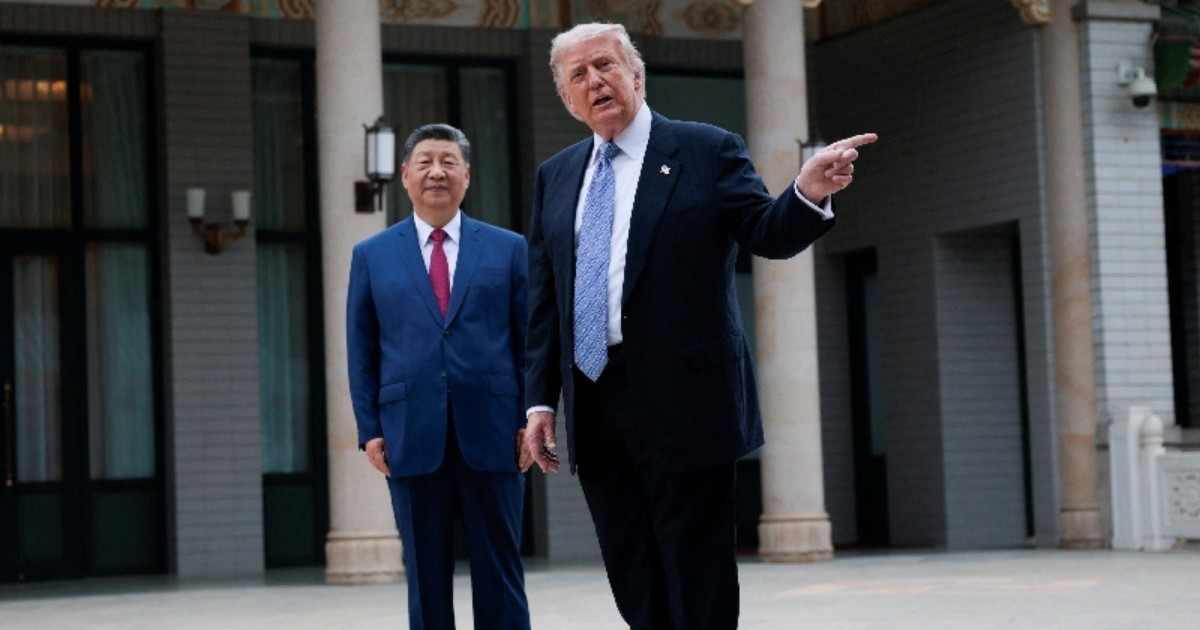
The Trump China summit this week ended much the way many analysts predicted: with a sense of calm restored but few real victories to point to. President Donald Trump’s two-day visit to Beijing produced only modest economic agreements, leaving the deeper tensions between Washington and Beijing firmly in place.
A Return to Familiar Ground
After the turbulence of last year’s trade war, the United States and China have settled back into a recognizable pattern of economic and strategic rivalry. The talks between Trump and Chinese leader Xi Jinping confirmed that, even following the steep “Liberation Day” tariffs and the fragile truce that followed, the two powers remain locked in the same long-running competition Trump inherited at the start of his second term.
For Washington, that means the issues it finds most troubling remain unresolved. Concerns over what the U.S. views as China’s mercantilist trade practices, along with Beijing’s expanding military presence in the Indo-Pacific, were left largely untouched.
For Xi, however, the outcome offered something valuable: a measure of breathing room and a return to predictable challenges. The Chinese leader appeared to capture this shift with a new phrase for the relationship, describing it as “constructive strategic stability.”
Why China Came Out Ahead
Several China experts argue that Beijing benefited most from the summit, mainly because Washington has stepped back from the aggressive trade posture it adopted in early 2025.
Scott Kennedy of the Center for Strategic and International Studies described the change as a reversal of course. He noted that a year ago the relationship was defined by tariffs as high as 145 percent and a U.S. push to force sweeping changes on China and the wider world. That confrontational approach, he said, has now given way to a return to stability.
Trump arrived in Beijing with a delegation of high-profile American business leaders, including Tesla’s Elon Musk and Nvidia’s Jensen Huang. Yet most of them left with little to show beyond an extravagant state banquet.
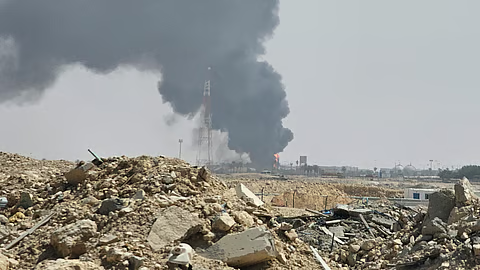
The summit also failed to produce any public pledge from China to help end the war in Iran, a conflict that has unsettled global markets and weighed on Trump’s approval ratings.
Craig Singleton of the Foundation for Defense of Democracies summed up the result bluntly, saying the meeting projected stability but did nothing to break the underlying stalemate. He described the outcomes as modest and carefully managed, roughly the limit of what the relationship can currently sustain.
Competing Interpretations
The two governments naturally framed the summit in their own terms.
A White House official said Trump used his positive rapport with Xi to deliver tangible benefits for Americans, pointing to Boeing aircraft sales and agricultural agreements designed to boost U.S. exports.
A spokesperson for the Chinese embassy in Washington described the discussions as candid, in-depth, and strategic, saying the two sides explored how major nations can coexist.
Still, analysts suggest the broader picture reveals the limits of Trump’s earlier strategy. By relying heavily on tariffs last year, the administration appears to have overestimated their power to pressure China into one-sided concessions. Beijing responded with tariff increases of its own and signaled it could restrict exports of critical minerals essential to American industry, creating a tense standoff.
Since then, the White House has shown little appetite for using its other tools of leverage, such as sanctions on major Chinese banks, given the economic damage that would follow. Notably, several long-standing U.S. demands, including calls for China to address industrial overcapacity, went unmentioned this week.
For its part, Beijing seems comfortable with the current truce as it manages a sluggish domestic economy and works to strengthen technologies it hopes will give it an edge in the long-term contest with the United States.
Results That Fell Short
Expectations for the summit were modest from the outset. Senior Trump administration officials had played down hopes for major outcomes, noting there was no urgency to extend the existing trade truce, which is set to expire in five months.
A source familiar with the negotiations said China had pushed for a longer extension than the U.S. was prepared to offer, along with assurances about pending American investigations that could revive tariffs previously struck down by the Supreme Court. According to that source, neither side brought much to the table, and some commercial agreements may be held back until the fall, when Xi is expected to visit the White House.
The contrast with Trump’s 2017 trip to China is striking. That earlier visit produced deals and memorandums valued at around 250 billion dollars. This week’s meeting fell well short of that figure.
Among the notable non-developments:
- There was no breakthrough on selling Nvidia’s advanced H200 artificial intelligence chips to China, an outcome that likely pleased China hawks in both parties who had warned against fueling Beijing’s AI ambitions.
- Trump said Boeing had reached a deal for China to buy 200 jets, far below the 500 once anticipated and even fewer than the 300 agreed to in 2017.
- The White House announced a new Board of Trade intended to help lower tariffs on non-sensitive goods, but offered few specifics.
Wendy Cutler, a former acting deputy U.S. Trade Representative, called the economic results far below expectations.
A Relationship Defined by Long-Term Rivalry
Despite the thin deliverables, some observers in China viewed the summit positively. Cui Shoujun, a professor of international affairs at Renmin University in Beijing, said the meeting reflected a more honest acceptance of reality.
According to him, Washington and Beijing are no longer trying to revive a cooperative “golden age.” Instead, both sides now recognize that competition and disagreement are likely to define their relationship for years to come.
In that sense, the Trump China summit may be best understood not as a failure or a success, but as a snapshot of where the two superpowers truly stand: stable for now, yet still at odds.
Author