Trump’s Iran Gamble: Why the President Is Running Out of Options in the Gulf
The Trump Iran standoff has reached a dangerous impasse, leaving the American president with few appealing paths forward. What began as an unusually generous peace offer has spiraled into renewed fighting, missile exchanges, and a tense deadlock over one of the world’s most vital waterways. As the crisis deepens, it’s becoming clear that Donald Trump may have boxed himself into a corner with no easy way out.
A Remarkably Generous Offer
When Trump first proposed peace with Iran, the terms he put on the table were striking in their generosity. In exchange for Iran reopening the Strait of Hormuz and abandoning its nuclear ambitions, America dangled the prospect of hundreds of billions of dollars in income and investment — a lifeline for an Iranian economy battered by years of sanctions and conflict.
The scale of the offer was so significant that it alarmed hawks in both the United States and Israel. Their horrified reaction spoke volumes: it’s hard to imagine any other American leader willing to concede so much in pursuit of a deal.
Money Alone Wasn’t Enough
Yet the events of the past week have delivered a sobering message. For Iran, financial incentives simply aren’t sufficient. With hardliners firmly in control, Tehran appears to want something beyond economic relief — and whatever that something is, it doesn’t bode well.
The possibilities are unsettling. Iran’s leadership may be seeking revenge, control over the strait, regional dominance, or the continuation of its nuclear program. Whatever the motivation, the message from Washington’s perspective is that America cannot afford to give in.
A Deal Unraveling at the Halfway Point
At the heart of the dispute lies a memorandum of understanding signed roughly a month ago. The agreement set a 60-day window to achieve peace, but now, halfway through, the document itself has become a source of conflict.
The core of the disagreement comes down to interpretation:
- The MOU asks Iran to ensure safe passage for commercial vessels, free of charge, for 60 days.
- Iran reads this as confirmation that it controls the strait.
- The United States interprets it as an obligation for Iran not to restrict sea traffic.
This clash of understandings has helped fuel the current escalation.
Escalating Tensions and Rising Oil Prices
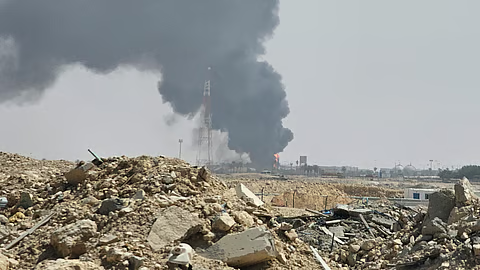
The two sides are now trading missile and drone strikes, and the situation on the water has grown precarious. Tankers are hesitant to sail through the region, even with American offers of protection.
So far, these military exchanges have stopped short of full-scale war, which offers some measure of relief. But the consequences are already rippling outward. Oil prices are creeping upward, and negotiations on thornier issues — including nuclear materials and Iran’s uranium enrichment efforts — have stalled with no progress in sight.
A Crisis of Trust
Decades of hostility have left trust between Washington and Tehran in desperately short supply. Even so, America had been upholding its end of the bargain by allowing Iranian oil to reach international markets. If there was ever a moment for the two nations to build a more stable relationship, this was it.
Reports suggest that moderates in Tehran understood just how favorable the offer was. But the hardliners ultimately prevailed. Adding to the uncertainty, the new Supreme Leader, Mojtaba Khamenei, has remained out of public view while issuing hardline pronouncements. It’s unclear whether he genuinely favors squeezing America for more or is simply being controlled by those pushing for war.
Trump’s Lack of a Clear Plan
Perhaps the most troubling aspect of the standoff is that Trump appears to have no coherent strategy. This week, he floated the idea of having America itself levy tolls on ships passing through the strait — a proposal so ill-conceived that advisers quickly stepped in to talk him out of it. To his credit, he reversed course.
He has also issued a series of threats, including destroying Iranian bridges and energy facilities. Yet a return to all-out war offers little promise of success. The intense fighting back in February was meant to topple the regime but instead ended up strengthening its hardliners.
Trump has additionally hinted at sending troops to seize Kharg Island, the terminal responsible for nearly all of Iran’s oil exports. The problem is obvious: any American forces stationed there would become an easy target for Iranian missiles and drones.
Why Giving In Is Not an Option
If military escalation is fraught with risk, capitulation would be no better. Allowing Iran to control international waters in the Gulf would be damaging on multiple fronts:
- It would be harmful in its own right, undermining freedom of navigation.
- It would set a dangerous precedent for future conflicts.
- It would signal to allies worldwide that America is willing to abandon its partners.
On top of that, Iran’s nuclear program remains a genuine threat, one that demands close monitoring and oversight by international inspectors. Handing Tehran a victory would jeopardize all of these interests at once.
The Only Path Forward
With every option carrying serious drawbacks, the path ahead comes down to resolve. America must demonstrate to Iran’s hardliners that it has the will to impose and sustain a blockade on Iranian oil exports — even if doing so pushes up gas prices ahead of the November midterm elections.
The United States has already restored its embargo against Iran, which marks a starting point. To reinforce its determination, it should also continue matching Iranian strikes rather than backing down.
A Self-Made Dilemma
Ultimately, this is a crisis largely of Trump’s own making. By initiating this confrontation, he set in motion a chain of events that has left him with few good choices. No matter how much he maneuvers or shifts his position, he now has little option but to see it through.
The blind alley he finds himself in is a reminder that bold gambits in foreign policy can quickly turn into traps. For now, the standoff in the Gulf remains unresolved, and the world watches to see whether resolve or escalation will define what comes next.
Author