Ukrainian drone strikes Moscow region residents woke to over the weekend delivered something more disruptive than a hit on a military target: they set fire to the warehouses of Russia’s largest online retailer, cutting straight into daily commerce.
The attack ranks among Ukraine’s largest long-range drone operations since 2022.
What Was Hit
Two facilities operated by Wildberries — widely known as the Russian Amazon — took the brunt of it.
One was a warehouse in Kotovsk, in the Tambov region. The other was a logistics center in Elektrostal, in the Moscow region.
Regional authorities reported eight people killed and 25 injured.
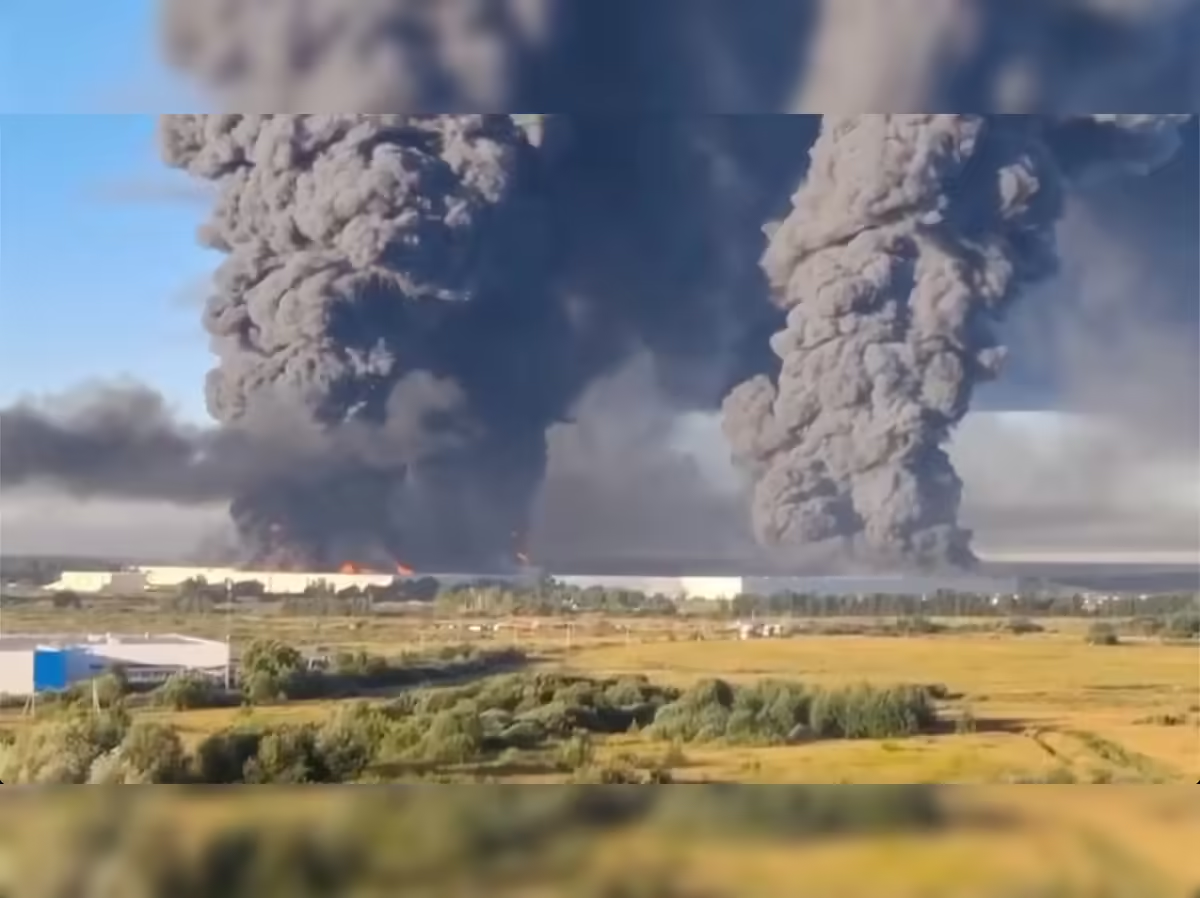
Footage circulated by Russian media showed enormous flames and dense black smoke pouring from the Elektrostal site.
Damage Beyond the Warehouses
The strikes and their aftermath spread across several locations:
- A drone hit an oil depot in nearby Noginsk, igniting a fire that forced the evacuation of a maternity hospital and a residential building
- Drone debris started a blaze at a kindergarten in Elektrostal
- Another strike hit a residential building in the city of Vladimir, with no injuries reported
Sellers Absorb the Loss
The commercial fallout landed immediately on small business owners.
Russian merchants who sell through Wildberries went to social media to describe destroyed inventory and predicted bankruptcies. Their frustration has a specific cause beyond the fire itself.
Earlier this month, Wildberries revised its seller contracts to state that the company bears no financial liability for damages or lost products resulting from drone strikes.
That clause, drafted before this attack, now determines who eats the cost. Sellers do.
CEO Tatyana Kim called it a terrible night and offered condolences to the families of those killed.
Kyiv’s Justification
President Volodymyr Zelensky said the operation deliberately targeted what he described as two significant logistical facilities in the Moscow and Tambov regions.
According to him, the aggressor used those sites to move sanctioned components for producing drones and navigation equipment — framing commercial warehouses as part of the military supply chain rather than civilian infrastructure.
That distinction is contested by nature. Dual-use logistics facilities occupy genuinely ambiguous legal territory, and both sides have incentives to characterize them differently.
A Test of Ukraine’s Drone Program
The timing carries particular weight.
The strikes came days after Zelensky removed Defense Minister Mykhailo Fedorov, who was widely regarded as a principal architect of Ukraine’s long-range drone campaign.
His dismissal triggered protests in Kyiv, driven by fears that the shakeup would damage one of the country’s most effective military capabilities.
This barrage suggests otherwise. Whatever the political consequences of Fedorov’s exit, the deep-strike program appears to be functioning at scale without him.
Putin’s Numbers Are Moving
The attack coincides with a measurable shift in Russian public opinion.
A Kremlin-linked poll released this week recorded a 5 percentage point drop in Putin’s approval rating — the sharpest weekly decline since the 2022 invasion began.
More striking than the number is what respondents said was bothering them. For the second consecutive week, more people identified fuel shortages as Russia’s biggest problem than identified the war.
Why Fuel Beats War in the Polling
That inversion is the most consequential detail in the entire story.
Ukraine’s sustained campaign against Russian oil infrastructure has produced gasoline shortages in one of the world’s leading oil producers. The effect is not abstract. It shows up at the pump, in queues, in prices, in the ordinary logistics of getting to work.
A war fought hundreds of miles away can remain psychologically distant for most citizens. An empty fuel station cannot.
Attacking Wildberries extends the same logic from fuel to consumer goods. When packages stop arriving and small sellers go under, the war stops being something happening elsewhere.
The Strategy Behind the Targets
Ukraine’s deep-strike campaign has evolved past purely military objectives.
Refineries, depots, pipelines and now retail logistics all share a characteristic: they connect the war effort to civilian experience. Damaging them simultaneously reduces Russian capacity and raises the domestic cost of continuing.
Whether that translates into political pressure on the Kremlin is a separate question. Approval ratings in Russia are difficult to interpret, and a single week’s movement proves little on its own.
But the shift in what Russians name as their primary concern is harder to dismiss. It suggests the war’s economic effects have become impossible to keep at the periphery of public attention.
What Comes Next
Russia will likely respond with its own escalation, as it has consistently done after significant Ukrainian deep strikes.
For Wildberries sellers, the immediate reality is simpler and harsher. Their goods are gone, their contracts absolve the platform, and no mechanism exists to make them whole.
That is the version of this war most Russians are now encountering — not battlefield maps, but fuel lines, insurance clauses, and businesses that do not reopen.
Author