A Danube drought has forced a nuclear plant shutdown in Romania and pushed Hungary into an emergency engineering project on the riverbed, as record-low water levels strip both countries of the cooling capacity their reactors depend on.
Romania closed Cernavoda entirely on Thursday. Hungary is building a weir and sinking barges to keep Paks alive.
Romania Goes Dark at Cernavoda
Cernavoda is Romania’s only nuclear facility, and the Danube is its sole source of cooling water. Under normal conditions it supplies roughly a fifth of the country’s electricity.
Operator Nuclearelectrica had already taken one of the two reactors offline last month. On Thursday it announced the second would follow, citing the significant and ongoing decline in Danube water levels.
The plant has been shut down only once before, in 2023 — also the result of drought and a hot summer.
Plant director Romeo Urjan told AFP that no restart is anticipated within the next ten days.
An Unusual Attempt to Save It
Before the full shutdown, Nuclearelectrica made a genuinely extraordinary effort to keep the facility running, working alongside the Romanian Navy.
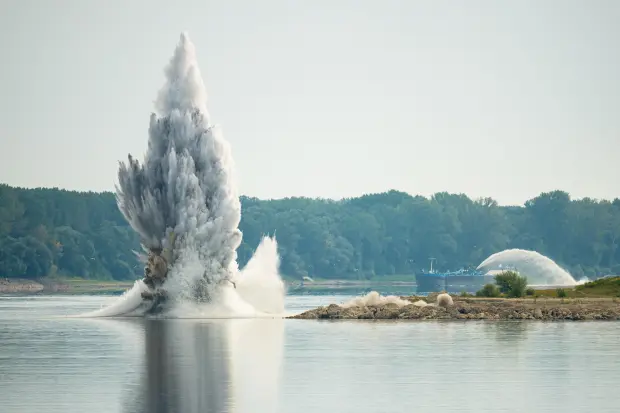
The most striking measure involved explosives. Engineers blew up a rocky outcrop that low water had exposed, then deposited the resulting rubble at strategic points on the riverbed in an attempt to channel more water toward the plant’s intake.
Continued dry weather defeated the effort. Levels kept falling, and the reactors went offline.
Keeping the Lights On Without It
Losing a fifth of national generation is not a minor gap, and Romania’s Energy Ministry has moved to fill it.
The response involves several elements:
- Procuring alternative sources, including wind generation
- Increasing electricity imports
- Appealing to the public to consume responsibly
- Preparing evening restrictions on large industrial users as a last resort
Two major manufacturers have already acted. Carmakers Ford and Dacia committed to pausing production until 19 August to conserve power.
Hungary’s Race Against the River
Roughly 100 kilometres south of Budapest, Hungary is fighting a parallel battle at Paks, its only nuclear plant and likewise cooled by the Danube.
The situation there is precarious. Just one of the four reactors is currently operating.
Nine days ago the plant came close to shutting down completely. Those plans were abandoned at the last moment when Danube levels came in a few millimetres above forecast — a margin that illustrates how finely balanced the situation has become.
Under normal operation, Paks accounts for around half of Hungary’s electricity generation and roughly a third of national consumption.
Building a Weir in an Emergency
Prime Minister Peter Magyar visited the site on Thursday and announced that construction has begun on a low weir intended to permanently raise water levels on that stretch of the river.
He said Hungarian soldiers are working around the clock and expects completion within four weeks. The finished structure should lift water levels in front of the Paks cooling intake by more than a metre.
In the interim, authorities plan a stopgap measure that is unusual by any standard. Two barges, each 80 metres long, will be deliberately sunk end to end and positioned perpendicular to the current, creating an initial damming effect to raise levels somewhat while the weir is completed.
The Silver Lining in the Drought
There is an odd logic to the timing that Hungarian officials have noted.
The weir may not be finished long before summer fades and autumn rains return, reducing its immediate value.
But low water makes riverbed construction dramatically simpler and cheaper than it would be under normal flow. Work that would ordinarily require extensive coffer dams and underwater engineering can be carried out in comparatively dry conditions.
The crisis has created the opportunity to build the infrastructure that addresses the crisis.
Why Nuclear Plants Are Vulnerable to Drought
The dependency is structural rather than incidental.
Thermal power stations — nuclear included — generate electricity by producing steam to drive turbines. That steam must then be condensed back into water, which requires a heat sink. Rivers, lakes and seas serve that function.
When river levels fall, two problems arise simultaneously. There is less water available to draw, and the water that remains warms more quickly, reducing its cooling efficiency. Environmental regulations governing discharge temperature can also constrain operation before physical limits are reached.
The result is that a facility built to run continuously for decades can be halted by weather.
The Broader Picture
Both shutdowns sit within a wider pattern. Drought has driven record lows across the Danube and other major European waterways this year, exposing riverbeds, disrupting shipping and — as these cases demonstrate — undermining energy infrastructure designed around historical flow assumptions.
Cernavoda’s previous shutdown was in 2023. Its second is happening three years later.
That interval is the detail worth watching. Nuclear plants were sited on rivers because rivers were reliable. If events like this arrive every few years rather than once in a generation, the calculation that placed them there begins to look different — and the weir Hungarian soldiers are building may be the first of many.
Author