Trump’s drone tariffs proclamation was one of two documents signed Thursday, the other directing sweeping changes to how the US Navy builds and equips its warships. Together they touch two areas the administration has framed as national security priorities: unmanned aircraft and shipbuilding capacity.
Rolling Back Carrier Technology
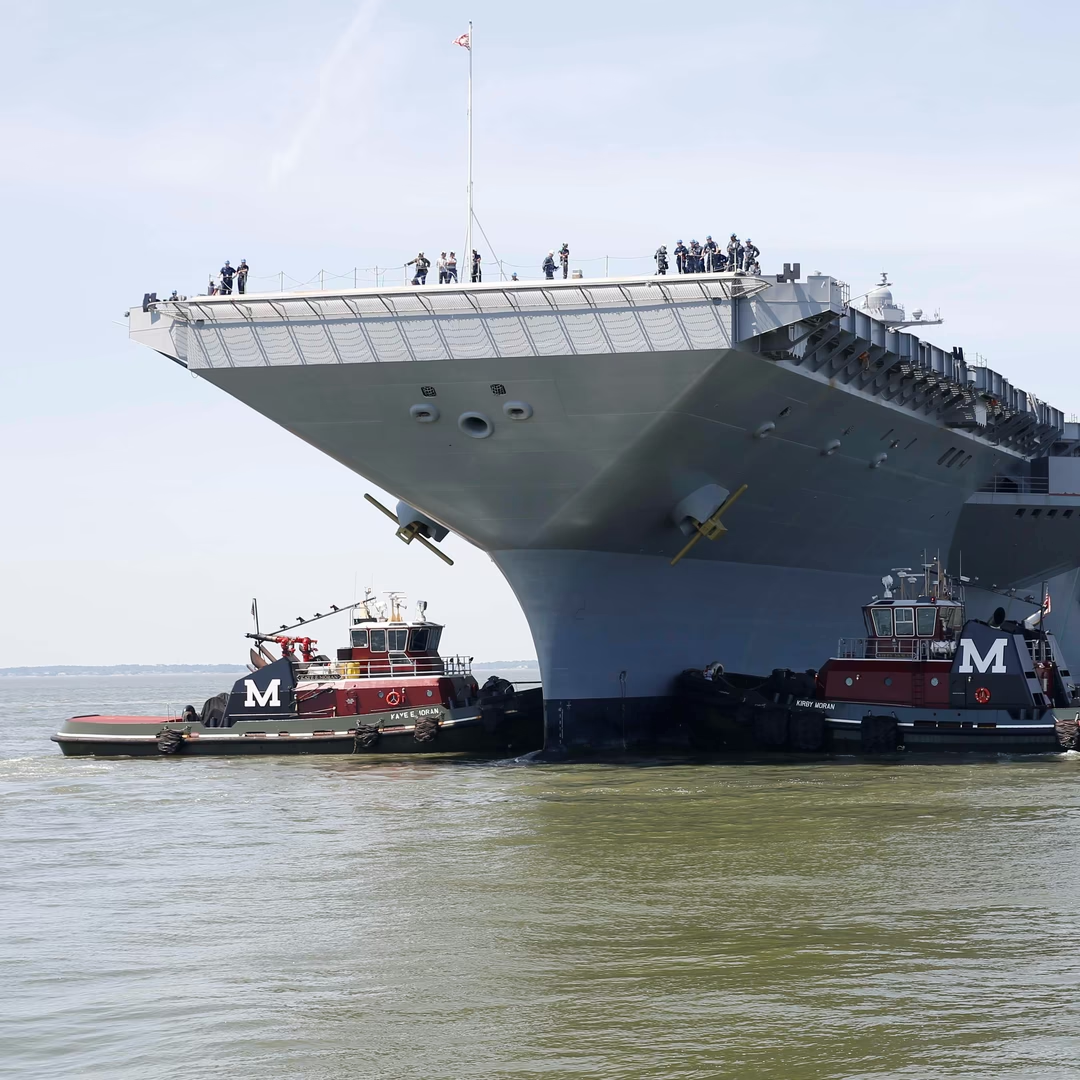
The naval memorandum instructs Defense Secretary Pete Hegseth to replace the Advanced Electromagnetic Aircraft Launch Systems and the Advanced Weapons Elevators with traditional steam and hydraulic equipment.
This is not a new position for the president. He has argued repeatedly for a return to steam catapults over their electromagnetic successors.
Speaking last month at a Defense and Innovation Summit held at the Army War College, he told Hegseth directly that no further ships would be built with what he called ridiculous electric catapults, citing billions in additional spending and arguing the systems are inferior and overly complex.
The technical debate behind that judgement is genuine, if contested.
Electromagnetic launch offers finer control over acceleration, which reduces stress on airframes and allows a wider range of aircraft weights to be launched. Steam catapults are older, proven and mechanically simpler, but heavier, more maintenance-intensive and less precise.
The Advanced Weapons Elevators, designed to move ordnance from magazines to the flight deck electromagnetically, have faced their own well-documented reliability problems during introduction.
Opening the Door to Foreign Shipyards
The same memorandum contains a more structurally significant provision.
Hegseth is directed to establish a fifth naval shipyard and to permit foreign shipbuilders to construct American warships.
The White House fact sheet outlines the arrangement carefully. Foreign builders making substantial and durable investments in American shipyards, and training an entirely American workforce for the jobs those investments create, will be temporarily allowed to build up to two vessels in their parent yards. Those ships would be delivered on a rapid timeline to bridge existing gaps, while additional vessels are constructed in revitalised American facilities.
The logic is a trade. Foreign yards get limited access to US naval contracts; in exchange they invest in domestic capacity and train American workers.
Why This Is Being Attempted
American shipbuilding capacity has contracted substantially over decades. Fewer active yards, a thinner skilled workforce and long production timelines have combined to make warship delivery slow and expensive.
Foreign yards — particularly in South Korea and Japan — operate at higher throughput and lower cost.
The proposal attempts to borrow that capacity temporarily while rebuilding domestic capability. Whether two ships constitutes a meaningful bridge, and whether foreign investment materialises at the scale envisioned, are open questions.
The Drone Tariffs
The second proclamation imposes ad valorem tariffs — duties calculated as a percentage of value — on drones and drone components, justified by the national security threat the administration says such devices present.
The rate structure is tiered:
- 100 percent on drones classified as particularly sensitive
- 25 percent on smaller drones deemed to pose less pressing security concerns
- 15 percent on drones and components from the European Union, Japan, Liechtenstein, the Republic of Korea, Switzerland and Taiwan
- 10 percent on certain drones from the United Kingdom
Timing Matters
The proclamation uses staggered implementation.
The main tariffs take effect 21 days after signing. Duties on drone components considered not particularly sensitive begin 180 days after signing.
That six-month delay on less sensitive components suggests an attempt to give American manufacturers and importers time to adjust supply chains before costs rise — a recognition that abrupt tariffs on inputs can damage the domestic industry they are meant to protect.
The Security Argument
Framing drone imports as a national security matter rather than a purely commercial one is deliberate, and it carries legal significance.
Trade measures justified on national security grounds operate under different statutory authorities than ordinary tariffs, typically giving the executive broader latitude and requiring less procedural groundwork.
The substantive concern is straightforward enough. Drones collect data, can be controlled remotely and depend on firmware and communications systems built by their manufacturers. A drone fleet dependent on foreign supply raises questions about both data security and wartime availability.
The Allied Rate Puzzle
One detail worth noting is that allied nations are not exempt.
The EU, Japan, South Korea, Switzerland, Taiwan and Liechtenstein all face a 15 percent rate; the UK faces 10 percent on certain drones.
Those rates are far below the 100 percent applied to the most sensitive category, indicating a graduated approach rather than a blanket barrier. But their inclusion signals that the policy is aimed at building domestic production capacity broadly, not solely at excluding adversary-manufactured equipment.
What to Watch
Several outcomes will determine whether these measures achieve their stated aims.
On shipbuilding: whether foreign yards accept the investment-for-access bargain, and whether the fifth naval shipyard moves from directive to construction.
On carriers: how much the technology reversal costs, and whether vessels already built or under construction are retrofitted.
On drones: whether American manufacturers can scale production quickly enough to absorb demand once import prices rise, or whether the tariffs simply raise costs for buyers without generating domestic supply.
Each of these depends less on the signing than on execution over the years that follow.
Author
-
Lucienne Albrecht is Luxe Chronicle’s wealth and lifestyle editor, celebrated for her elegant perspective on finance, legacy, and global luxury culture. With a flair for blending sophistication with insight, she brings a distinctly feminine voice to the world of high society and wealth.