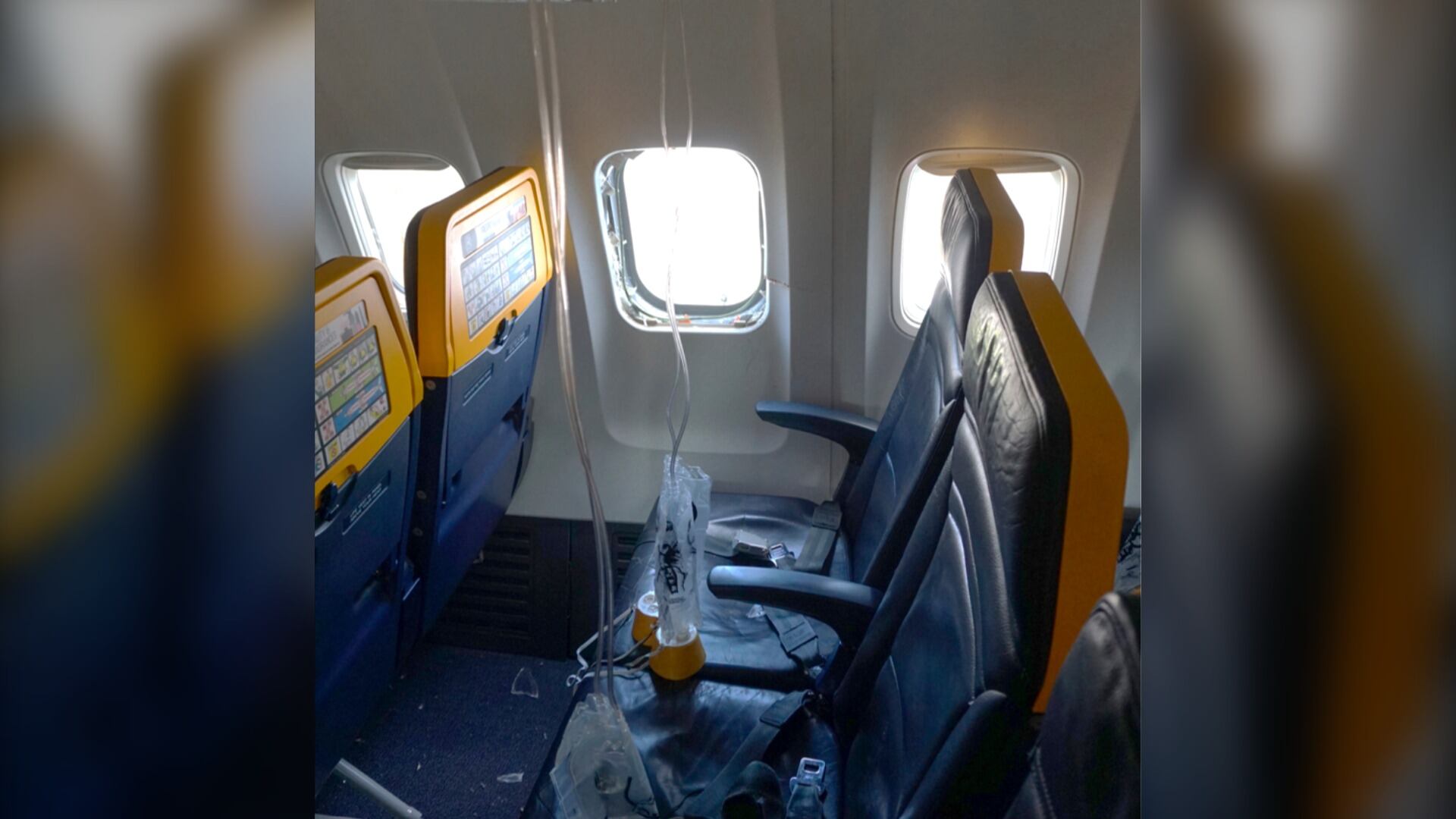
A Ryanair window shattered by fan blade debris nearly cost a passenger his life last month, and a preliminary report from US investigators has now laid out how it happened — while leaving the central question unresolved.
A man’s head was pulled partway through the broken window before other passengers dragged him back into the cabin.
What Broke
According to the National Transportation Safety Board, a fan blade in the right engine of the Boeing 737-800 separated shortly after departure from Thessaloniki in northern Greece on 10 July.
Fragments exited the engine at speed, shattering a cabin window and damaging the fuselage in several other locations.
Greece transferred the investigation to the American agency under international aviation protocols, given that the aircraft was US-manufactured.
Investigators recovered bird remains from inside the engine, raising the possibility of a bird strike during takeoff. They have not yet determined what actually caused the blade to come loose.
Inside the Cabin
The accounts given to investigators describe a rapid and disorienting sequence.
Flight attendants reported hearing and feeling loud, continuous vibration. Smoke or fog filled the cabin. Oxygen masks dropped from the ceiling.
One attendant then saw passengers standing and shouting for help. A man seated at a window in row 11 was partially lodged in the damaged window opening. Other passengers pulled him back inside.
He was moved to row 12, where a doctor travelling on the flight attended to him. The 61-year-old sustained neck and shoulder injuries along with friction burns.
Meanwhile, passengers obtained a metal box from the crew and attempted to use it to block the opening until the aircraft could land.
Short videos filmed aboard and shared by Radio Thessaloniki showed passengers in oxygen masks after the cabin lost pressure, the broken window with a man seated nearby wearing a mask, and — apparently after landing — first responders working in the aisle.
The Flight Path Home
The aircraft climbed above 15,000 feet roughly six minutes after departure before descending to around 6,000 feet, where it spent about 30 minutes burning fuel, according to Flightradar24.
It returned to Thessaloniki approximately an hour after takeoff.
The landing was normal and passengers returned to the terminal. One person requested and received medical assistance on the ground, the airline said at the time.
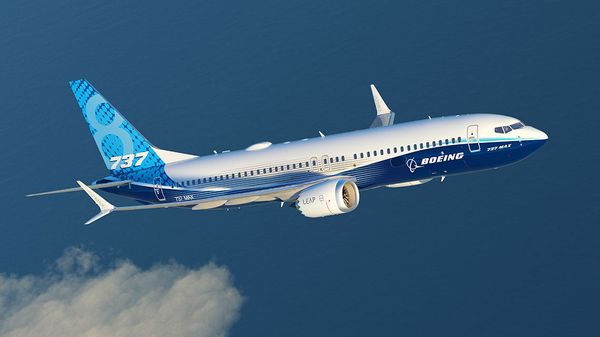
The 737-800 can carry up to 189 passengers and was delivered new to Ryanair in 2008. The flight was operated by Malta Air, a Ryanair subsidiary.
The Maintenance Record
The fan blades in the right engine had undergone ultrasonic inspection twice — in November 2025 and again in May 2026 — with no damage detected on either occasion.
But the NTSB noted something else. Flight crews had reported four suspected bird strikes involving that same engine over the preceding year. Bird remains were recovered after two of them.
Jeff Guzzetti, a former investigator with both the NTSB and the FAA who reviewed the preliminary report, told the Associated Press that required maintenance appears to have been carried out on schedule.
He expects investigators to look more closely at how those inspections were conducted, and whether the earlier suspected bird strikes left damage that accumulated over time.
His summary of where the inquiry stands was concise: the sequence of events is understood, and the reasons partly so, but significant questions remain for the NTSB to work through.
A Public Dispute
The investigation has already produced friction between the agency and the airline.
Last month the NTSB reprimanded Ryanair chief executive Michael O’Leary after he told investors the inquiry was centred on foreign object damage rather than the aircraft’s age or maintenance history.
The agency responded that nothing had been ruled out and that O’Leary was not authorised to characterise the investigation.
Ryanair said Thursday it would offer no further comment until the NTSB completes its work. Boeing and engine manufacturer CFM International both said they are assisting.
The Modification That Had Not Been Made
This is arguably the most consequential detail in the report.
The FAA issued three directives last year requiring airlines to reinforce portions of the engine coverings on Boeing 737s. Those directives followed two earlier fan blade failures in which pieces of engine cowling broke away and struck the aircraft.
In one of those accidents, a Southwest Airlines passenger was killed in 2018 when debris hit the fuselage, knocked out a window and caused rapid decompression.
The directives took effect in April 2025. They require changes intended to prevent cowling fragments from separating and striking the aircraft when a fan blade fails — including replacement of specific fasteners and spacers securing the engine inlet covering, along with revisions to maintenance and inspection programmes.
Airlines were given until July 2028 to complete the major work.
The NTSB report states that the required modifications had not yet been performed on the Ryanair aircraft.
Whether the Deadline Holds
Guzzetti suggested this accident could prompt regulators to reconsider that 2028 timeline.
His explanation of how the original schedule was set is instructive. Maintenance takes time, parts must be sourced, and the risk assessment at the time indicated the industry could reasonably wait. An event like this, he said, may change that calculation.
Asked directly whether the deadline might move, the FAA declined to comment on an open investigation, stating that it works closely with the NTSB and will take any necessary safety action based on the evidence.
What Remains Open
Three questions will shape the final report.
Why the blade separated, given that inspections found no damage.
Whether repeated bird strikes to the same engine created cumulative weakening that inspection methods did not detect.
And whether the cowling modifications — designed for precisely this failure mode, and not yet installed — would have contained the debris that reached the cabin.
The passenger pulled back through the window survived. The report explains how close that outcome came to being different.
Author