A Landmark Ruling on Gun Rights
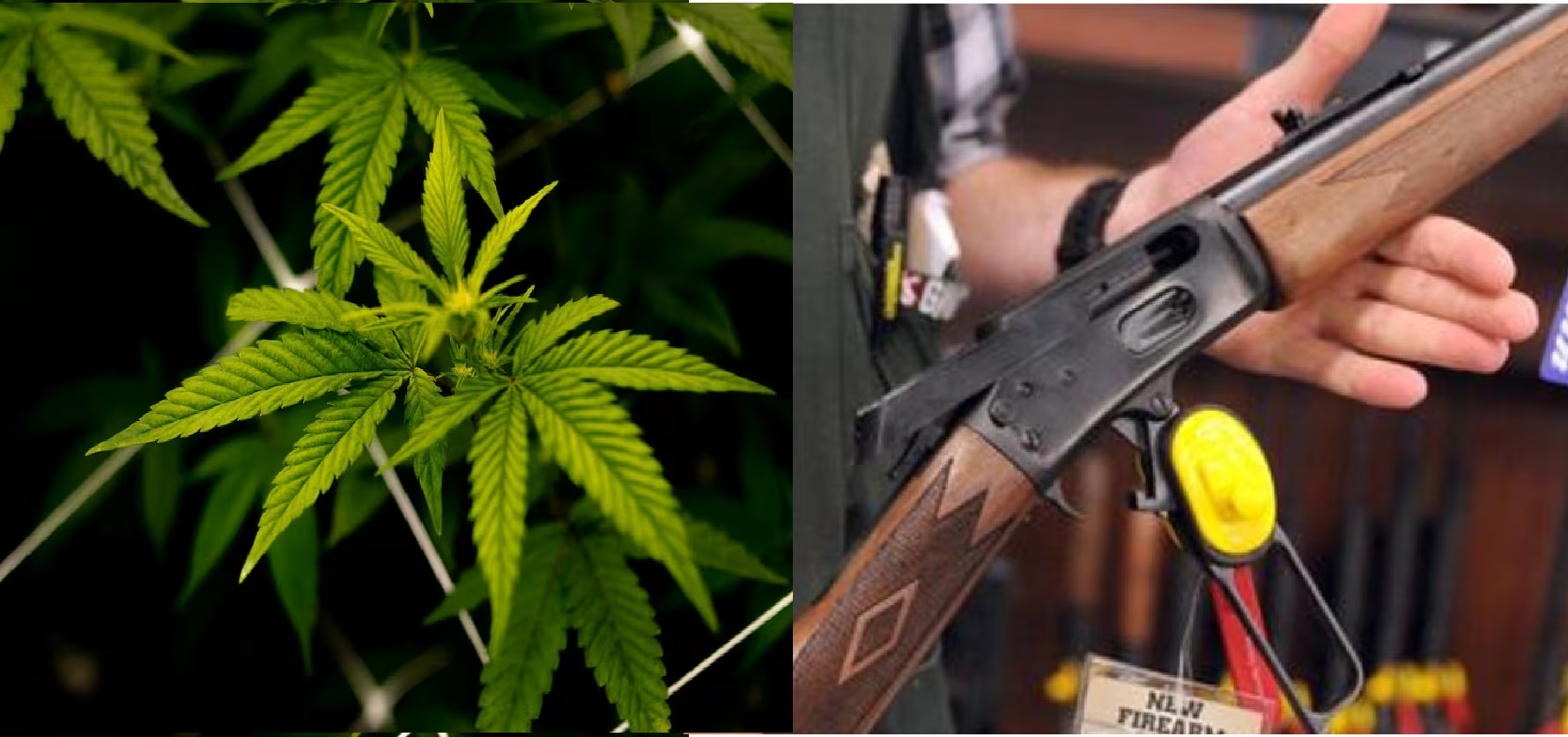
In a significant decision, the Supreme Court ruled on Thursday that marijuana users guns cannot be banned through a sweeping federal prohibition. The ruling strikes down a broad ban on gun ownership for those who regularly use the drug, marking the latest in a series of cases from a court that has steadily expanded gun rights.
The decision carries major implications for millions of Americans and reflects the shifting legal landscape surrounding both firearms and cannabis.
A Unanimous Decision
The justices ruled unanimously in favor of Ali Danial Hemani, a Texas man who challenged the law. Hemani argued that a statute barring firearms from anyone who regularly uses illegal drugs violated his Second Amendment rights.
Writing for the court, Justice Neil Gorsuch crafted an opinion that narrowly limits the government’s authority to strip guns from drug users who are not deemed dangerous.
Importantly, Hemani had not been charged with any other crimes, nor was he accused of using his weapon while under the influence. His attorney, Zachary Newland, said his client was grateful to finally have closure after a long legal battle.
A Setback for the Trump Administration
The ruling represents a notable loss for President Donald Trump’s Republican administration, which had defended the 1968 law. The position was somewhat unusual, given that the administration had argued against other gun restrictions in different cases.
Gorsuch was blunt in his assessment, writing that the government’s core argument failed under every measure. He pointed out that while the law was originally designed to keep firearms away from dangerous individuals, the millions of people who now use marijuana cannot all be lumped into that category.
The Changing Reality of Marijuana Use
Central to the court’s reasoning was the dramatic shift in how marijuana is treated across the country. Although recreational use remains illegal under federal law, roughly half of all states now permit it, and cannabis use for health purposes has become widespread.
Gorsuch highlighted what he saw as a contradiction in the government’s stance. He noted that the federal government had not merely tolerated these developments but had actually helped fuel them.
This, he argued, left the government in an awkward position when trying to claim that the millions of Americans who regularly use marijuana are categorically and unusually dangerous.
Connection to the Hunter Biden Case
The law at the center of this ruling has a notable history. It was previously used in the prosecution of Hunter Biden, who was convicted in Wilmington, Delaware, of purchasing a firearm while addicted to cocaine in 2018.
Hunter Biden was later pardoned by his father, Democratic President Joe Biden. The connection underscores how the statute has touched high-profile cases across the political spectrum.
Limits of the Ruling
Despite the victory for gun rights advocates, the decision is narrower than it might first appear. The court left open the possibility of prosecuting individuals in certain circumstances.
Gorsuch clarified that the ruling did not address efforts to bar those actively addicted to illegal drugs or currently intoxicated from possessing firearms. He explained that prosecutors could still charge a marijuana user if they had evidence demonstrating that the person posed a genuine danger.
This distinction leaves room for future cases while limiting the broad sweep of the original law.
Federal Law Still Lags Behind
Even with these developments, recreational marijuana remains illegal at the federal level. This holds true despite the Trump administration’s decision in April to reclassify medical marijuana as a less-dangerous drug.
The gap between federal law and the reality of widespread state-level legalization continues to create tension, a dynamic that played heavily into the court’s analysis.
Unusual Political Alliances
One of the most striking aspects of the case was the unexpected coalition it produced. The American Civil Liberties Union and the National Rifle Association, often on opposite sides of major issues, both supported Hemani’s case.
Cannabis legalization groups such as NORML also backed him. On the opposing side were gun safety organizations like Everytown, which typically clash with the administration on Second Amendment matters.
The case blurred the usual political lines, uniting groups that rarely find common ground.
Reactions to the Decision
The ruling drew a wide range of responses. The ACLU celebrated the outcome, noting that nearly half of all Americans have reported using marijuana at some point in their lives.
Cecillia Wang, the organization’s legal director, said the court had delivered a powerful message that the government cannot criminalize the behavior of large groups of people based on broad and unfounded assumptions about their dangerousness.
NORML hailed the ruling as a vindication of personal freedom, while the Second Amendment Foundation described it as a major victory for gun owners.
Critics Voice Concern
Not everyone welcomed the decision. The group Smart Approaches to Marijuana, which opposes legalization, sharply criticized the outcome.
CEO Kevin Sabet argued that while the justices appeared focused on historical Second Amendment debates, public health and safety had become collateral damage in the process.
Gun control groups offered a more measured response. Everytown acknowledged the ruling while emphasizing that the decision still recognizes how drugs and guns can form a dangerous combination.
A Rare Type of Charge
It’s worth noting that standalone criminal charges against individuals accused solely of owning guns while using drugs are relatively uncommon. Such charges are far more frequently filed against people who are also accused of committing other crimes.
This context helps explain why the ruling, while significant, may affect a narrower set of prosecutions than the broad language of the law might suggest.
Part of a Broader Trend
Thursday’s opinion fits into a larger pattern of firearm cases reaching the Supreme Court. Since its landmark 2022 ruling that expanded gun rights, the court has faced a wave of legal challenges nationwide.
In that time, the justices have upheld a law protecting victims of domestic violence and strict regulations on ghost gun kits. At the same time, they struck down a ban on bump stocks, an accessory that enables rapid fire.
The court is also weighing another firearm case this term involving strict regulations on carrying guns in Hawaii.
Looking Ahead
As the legal landscape continues to evolve, Thursday’s ruling stands as a meaningful moment in the ongoing national conversation about gun rights and drug policy. The decision reflects the complex interplay between shifting cultural attitudes, state-level reforms, and constitutional protections.
For now, the ruling offers clarity for marijuana users who own firearms while leaving important questions for future courts to resolve. As cannabis laws and gun rights continue to develop, this case may well serve as a reference point for the debates still to come.
Author