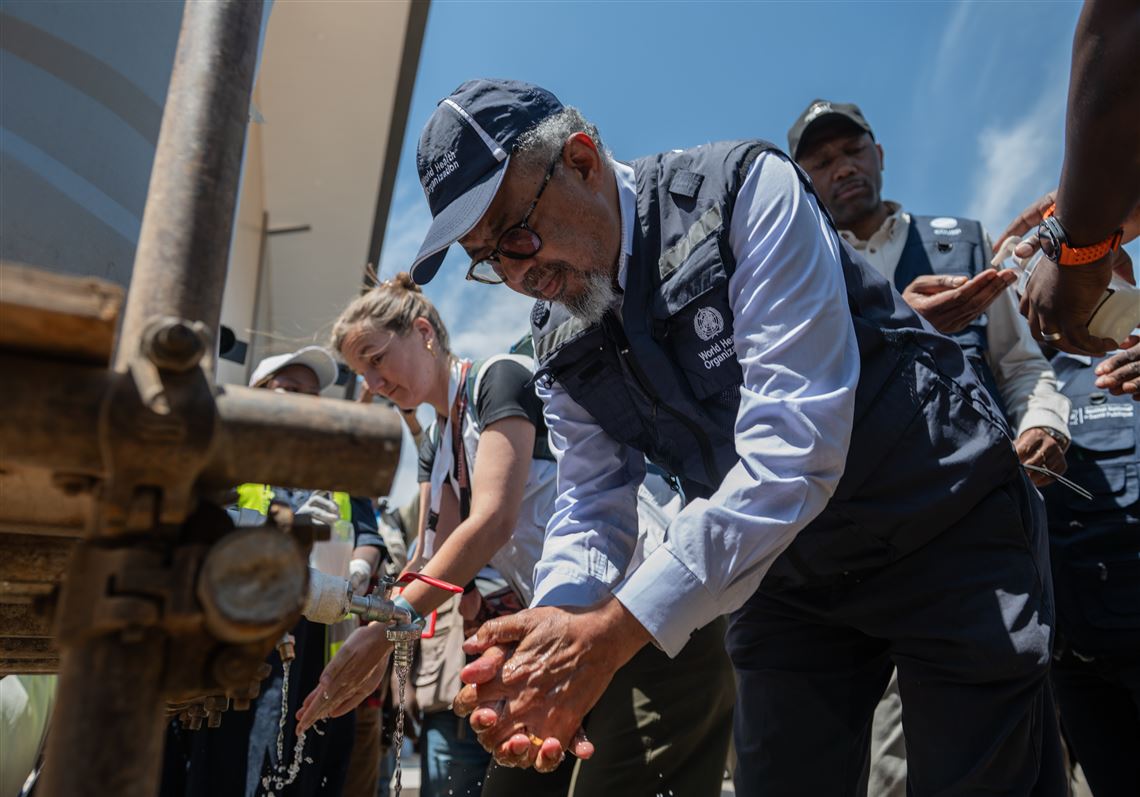
The escalating Congo Ebola outbreak drew the world’s top health official to its epicenter on Saturday, as the head of the World Health Organization traveled to the eastern city of Bunia to confront a crisis spreading faster than the response can contain it. Despite better-organized facilities and fresh aid arrivals, the virus continues to outrun efforts to stop it, raising alarm among health agencies on the ground.
A High-Profile Visit to the Frontline
WHO Director-General Tedros Adhanom Ghebreyesus visited Bunia, the city at the heart of an outbreak of a rare type of Ebola. His itinerary included a treatment center and meetings with local authorities, health workers, and families affected by the disease.
Speaking to reporters late Friday, Tedros emphasized the importance of concentrating resources where the crisis is most severe. He said the best approach was to provide all necessary support to fight the disease at its epicenter and to keep offering every form of assistance needed.
His message blended urgency with a measure of confidence. After meeting Congo’s Prime Minister Judith Suminwa Tuluka on Friday, Tedros acknowledged the difficulty of the situation but pointed to the country’s long experience battling Ebola, expressing confidence that the Democratic Republic of Congo could once again bring the outbreak under control.
The Scale of the Crisis
The numbers paint a sobering picture, and officials warn they likely understate the true toll. According to the WHO, the latest official figures showed 906 suspected cases and 223 suspected deaths. Reporting suggested the real figure could be three to four times higher than what is currently being recorded.
The outbreak has not stayed within Congo’s borders. Neighboring Uganda has confirmed nine cases and one death, according to the Ugandan ministry of health.
Last week, the WHO upgraded its risk assessment to “very high” at the national level, and Tedros described the outbreak as spreading rapidly.
A Strain With No Cure
Part of what makes this outbreak so dangerous is the specific virus involved. The current strain is the Bundibugyo virus, a form of Ebola that has no approved treatment or vaccine.
That absence of medical countermeasures places enormous weight on containment, supportive care, and the speed of the overall response, making the gap between the spread of the disease and the capacity to fight it especially perilous.
Aid Arrives, but Falls Short
Help has begun to flow into the region. Medical aid donated by the European Union reached Ituri, the heart of the outbreak, on Thursday, with more shipments expected in the days ahead. On the same day, the United States announced an additional $80 million in aid, bringing its total commitment to more than $112 million.
On the ground, the improvements are visible. At Bunia’s Rwampara and General hospitals, response efforts appeared more organized, with additional staff, protective gear, and medical supplies. Yet patients continued arriving around the clock, a sign that demand keeps outstripping capacity.
The warnings from aid groups were stark. Doctors Without Borders, known as MSF, cautioned on Saturday that the response had not kept pace with one of the fastest-spreading outbreaks on record. Dr. Alan Gonzalez, the group’s deputy director of operations, said no previous Ebola outbreak had recorded so many cases so soon after being declared, adding that no one knows the true scale and severity of what is unfolding.
Gonzalez called for immediate action on several fronts:
- A rapid expansion of testing
- Faster deployment of aid workers
- Sustained access for the delivery of medical supplies
Violence and Mistrust Hamper the Response
The medical challenge is compounded by danger and conflict. Health workers face heightened risk amid anger among residents over strict medical protocols for handling victims’ bodies, which clash with local burial traditions. That tension has already boiled over, with residents launching at least three attacks against health centers.
Armed conflict has further complicated matters. Attacks in Ituri by the Allied Democratic Forces, a rebel group aligned with the Islamic State, along with a coalition of ethnic militias, have hindered the response. The disease has also spread to the provinces of North Kivu and South Kivu, areas where the Rwanda-backed M23 rebel group controls key cities including Goma and Bukavu. Those rebels have reported two cases of their own.
A Dispute Over Border Closures
As the outbreak spreads, the question of how neighboring countries should respond has sparked disagreement. Uganda and Rwanda have closed their borders with Congo, but Tedros pushed back firmly against such measures, calling border closures and travel bans not effective at all in preventing the outbreak’s spread.
He argued that shutting borders only discourages transparency, praising Congo for reporting the situation openly and urging countries to reconsider their restrictions. His point was that punishing transparency could ultimately make outbreaks harder to track and control.
The US Response
The United States has taken a notably stricter stance. Secretary of State Marco Rubio said on Wednesday that no Ebola patients would be allowed into the country, and banned entry for non-US passport holders who had recently visited Congo, Uganda, or South Sudan.
Several major US airports have ramped up precautions. Enhanced health screenings are underway at facilities including JFK in New York, Washington-Dulles, Hartsfield-Jackson Atlanta, and George Bush Intercontinental in Houston. CDC officials will evaluate travelers showing symptoms, who could then be transported to a hospital for further treatment.
Not all of the administration’s efforts have proceeded smoothly. On Friday, a Kenyan High Court judge temporarily blocked a Trump administration attempt to establish an Ebola quarantine facility on an air base in Kenya, adding a legal wrinkle to the broader response.
The Bottom Line
The Congo Ebola outbreak has reached a critical juncture. With hundreds of suspected cases and deaths, a strain that has no approved cure, and the very real possibility that the true numbers are far higher, the gap between the disease and the response remains dangerously wide.
The WHO chief’s visit signals the seriousness of the moment and the international attention now focused on Bunia. Yet aid, however welcome, has yet to catch up with the speed of transmission, and violence, mistrust, and armed conflict continue to obstruct those trying to help. Whether Congo can draw on its hard-won experience to once again contain Ebola will depend on how quickly testing, personnel, and supplies can be scaled up in the difficult days ahead.
This is a serious and evolving public health situation. If you are in or near an affected area and have health concerns, following guidance from local health authorities and the WHO is the safest course.
Author