The scale of billionaires in California politics reached a new benchmark this week, with a new report tallying $336 million in political spending from just 15 individuals so far this year. More than half of them live in the San Francisco Bay Area.
The findings, published by California Common Good — an organization that pushes for full funding of education and social safety net programs — were announced Thursday at an unusual venue: outside the home of one of the men named in it.
A Rally on a Billionaire’s Doorstep
Organizers gathered at the residence of Chris Larsen, the Ripple co-founder and angel investor who ranks as the second-largest individual spender on California state elections.
Larsen wasn’t there. A source close to him said he and his wife, Lyna Lam, were away at the time. A spokesperson declined to comment on either the demonstration or the report itself.
Larsen’s Nine-Figure Footprint
The numbers attached to Larsen are striking once they’re separated into layers.
Personally, he contributed roughly $28 million to state and local races this year. That money flowed to candidates including East Bay state senate contender Scott Sakakihara, a former Palantir employee, through Larsen’s Grow California PAC.
He also worked to defeat local ballot measures, notably San Francisco’s Proposition D — the so-called “Overpaid CEO” tax. He wasn’t alone in that fight. Venture capitalist Michael Moritz joined the opposition, as did a collection of firms that would have owed the tax had it passed.
Then there’s the corporate side. Ripple, Larsen’s cryptocurrency company, spent $56 million across state and federal races. About $5 million went to Golden State Promise, a statewide PAC organized against the proposed California billionaire tax — a measure that qualified for the November ballot anyway. Another $49 million went to federal PACs promoting crypto-friendly policy.
Combined, Larsen’s personal and corporate spending reaches $93 million across local, state, and federal contests.
The Only Person Who Outspent Him
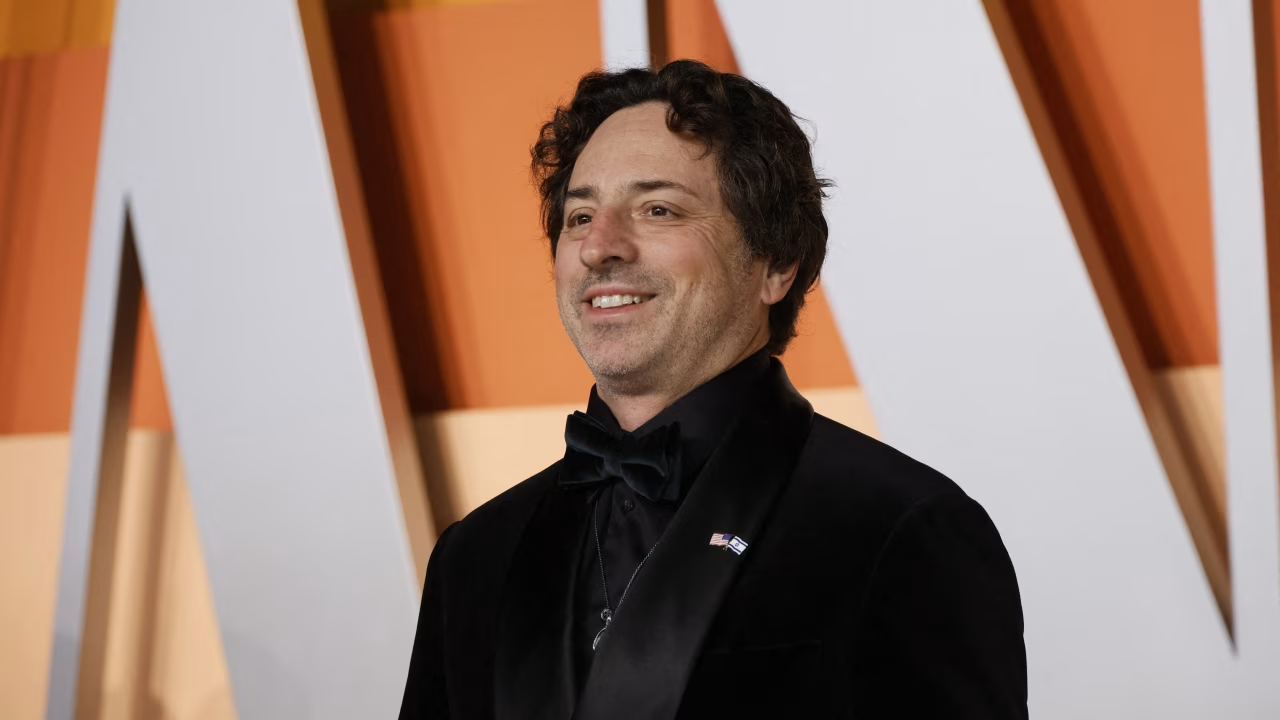
At the state level, Larsen was surpassed by a single individual: Google co-founder Sergey Brin.
Brin personally directed $86 million toward moderate, pro-business political action committees throughout California. The report attributes much of that activity to the billionaire tax proposal. He also put $500,000 into opposing San Francisco’s CEO tax.
The Big Four
The report identifies four names as driving the overwhelming majority of the spending: Larsen, Brin, and venture capitalists Marc Andreessen and Ben Horowitz.
Together, those four accounted for $209 million in personal political spending this cycle — a 147 percent jump over their combined total for the entire 2023-24 cycle.
Factor in their companies, and the four alone represent $331 million of the $336 million total.
Who Made the List, and Who Didn’t
Forbes estimates California is home to around 200 billionaires. The report narrowed its focus to top spenders and deliberately excluded anyone whose money went primarily toward their own campaign or a relative’s.
That methodology produced two notable omissions.
Tom Steyer, the former venture capitalist, spent more than $200 million running for governor — far more than most names on the list — but was excluded because the money funded his own candidacy.
Irwin Jacobs was left out as well. California Common Good said he would have qualified, but argued that much of his spending was tied to his granddaughter’s congressional race in San Diego. DoorDash CEO Tony Xu was included in his place.
The complete list: Larsen, Brin, Anna and Greg Brockman, Moritz, John Doerr, Reed Hastings, Patrick Collison, Tim Draper, Peter Thiel, Eric Schmidt, Ron Conway, Stewart Resnick, and Xu.
Money Doesn’t Always Buy Outcomes
Here’s the complication that runs through the entire story: enormous spending has produced a striking number of losses.
Moritz spent millions on San Francisco’s 2024 election with little to show for it. Steyer’s $200 million-plus gubernatorial campaign didn’t survive the primary. Centimillionaire Saikat Chakrabarti also failed to advance in his bid to succeed Nancy Pelosi.
Silicon Valley’s preferred gubernatorial candidate, Matt Mahan, raised more than $15 million from executives including Brin — and finished sixth in the June primary. Ethan Agarwal, backed as a challenger to South Bay Congressman Ro Khanna, fared no better.
Even Proposition D’s opponents came up short, and the billionaire tax measure they spent against reached the November ballot regardless.
An Older San Francisco Tradition
Concentrated wealth influencing City Hall is not a new phenomenon in San Francisco.
Real estate developer Walter Shorenstein spent decades and hundreds of millions building the city’s skyline, keeping the Giants from relocating to Florida, and establishing himself as a Democratic kingmaker with reach into national politics.
What’s changed is the scale and the speed. This year’s numbers reflect a different order of magnitude, driven by tech and crypto fortunes rather than real estate.
Big-money spenders also performed well in San Francisco during the most recent primary, suggesting the influence varies considerably by race and jurisdiction.
The PAC Pipeline
Beyond individual donations, the report tracked the vehicles carrying this money.
It identified a network of political action committees funded by California billionaires and large corporations, finding that 20 of them had already raised $289 million combined this year.
That figure dwarfs total PAC spending during the 2024 primary elections — a comparison the report emphasizes as evidence of a fundamental shift rather than an incremental increase.
What’s Actually at Stake
Two policy fights explain much of the spending: the proposed state billionaire tax and San Francisco’s CEO pay-gap tax.
Both would impose direct costs on the people and companies writing the checks. That alignment between financial interest and political spending is neither hidden nor especially complicated — and it’s the central argument advanced by the report’s authors.
With the billionaire tax headed to voters in November, the spending documented here likely represents an opening position rather than a final tally.
Author