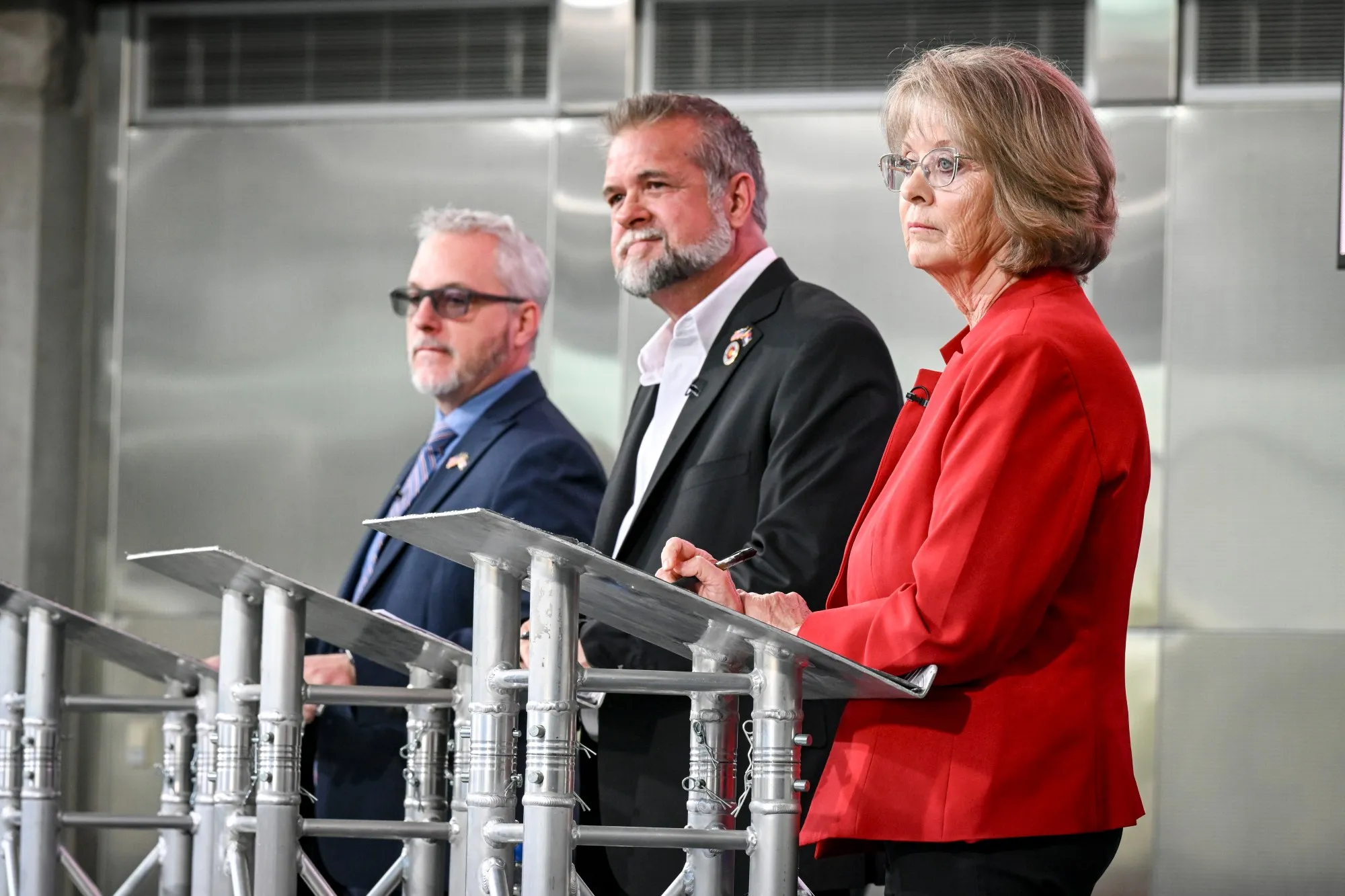
The Colorado governor race just produced an outcome that Democrats did not expect and could hardly have designed better for themselves: Victor Marx, an unproven and divisive figure, has won the Republican nomination.
The reaction from Democrats has been something close to disbelief. The reaction from many Republicans has been closer to alarm.
A Nominee His Own Party Won’t Back
The clearest signal of trouble came from inside the GOP primary itself.
Both of Marx’s opponents — state Sen. Barb Kirkmeyer and state Rep. Scott Bottoms — said before the vote that they would not support his candidacy if he won.
He won anyway.
That leaves the Republican Party heading into a statewide general election with a nominee whose own rivals have publicly refused to endorse him.
The Supermajority Math
To understand why Democrats are so energized, look at the legislature.
Colorado Democrats currently hold 66 of the 100 seats in the state Legislature. That is one seat short of a supermajority in both chambers.
One seat.
University of Denver political science professor Seth Masket explained what crossing that threshold would unlock.
“Having a supermajority means the Democrats can override a veto without needing any Republicans to do it,” he said. “They can refer legislation to voters without any Republicans to do it.”
In practical terms, it would render Republican legislators nearly irrelevant to the mechanics of governing.
The Turnout Problem
Here is where the governor’s race and the legislative races intersect.
Masket argued that Marx atop the ticket could suppress Republican turnout in down-ballot contests — not through defection, but through apathy.
“Unless there’s like a really competitive other race in their district, I think a lot of Republican voters might just not bother to turn out,” he said. “That puts a supermajority a little more in Democrats’ grasp.”
That is the quiet danger of a weak top-of-ticket candidate. It is not that voters switch sides. It is that they stay home, and the legislative candidates who needed their votes lose by margins no one anticipated.
“DEFCON 1”
Cole Wist, a former Republican state lawmaker who is now unaffiliated and backing Democrat Phil Weiser for governor, did not soften his assessment.
“If the Republican Party was at DEFCON 3 before the primary, I think they’re at DEFCON 1,” he said.
Wist believes Marx’s presence will drag down Republican competitiveness in state House and Senate races — though he acknowledged the picture is not uniform.
“I think so many legislative races are really localized, and it depends on the quality of the candidates,” he said. “But in a close race, I think that what’s happening nationally, and what’s happening in the governor’s race, could clearly affect down-ballot races.”
The Warning About One-Party Rule
Notably, Wist did not celebrate the prospect of a Democratic supermajority — despite supporting the Democratic gubernatorial nominee.
“Supermajorities are bad for our state because you don’t get the best public policy when both parties don’t have some ability to control the agenda,” he said.
Weiser himself has echoed that concern, which is an unusual thing for a candidate poised to benefit from it.
Speaking to 9NEWS anchor Kyle Clark last week, Weiser said it is not healthy for any state to have one party dominate simply because the other party has become dysfunctional.
Democrats Have Their Own Fractures
The Republican identity crisis is more advanced, but Democrats are not immune.
Republican commentator Kelly Maher, who backed Kirkmeyer in the primary, pointed to the recent defeat of 15-term Congresswoman Diana DeGette by Democratic Socialist Melat Kiros as evidence that the same forces are beginning to work on the left.
“I just think Republicans have been there a lot longer in the midst of our identity crisis than the Democrats,” Maher said.
Her framing was memorable: “I tell my Democrat friends, ‘I am the ghost of Christmas future. Welcome to the party.'”
Maher’s argument is that just as Republicans across Colorado have been broadly associated with Donald Trump, Democrats may soon find themselves associated with Kiros and the party’s socialist wing — whether individual candidates want that or not.
Why the Comparison Breaks Down
There is a structural flaw in that analogy, and it matters.
Kiros appears on ballots in exactly one place: Congressional District One, in the Denver area.
Marx appears on ballots statewide.
One is a local phenomenon that Republicans can point to rhetorically. The other is a name every Colorado voter will see when they open their ballot in November.
The Broader Picture
Democrats are not entirely unified either. Primary results across the state have produced a mix of moderates alongside a growing contingent of progressives and Democratic Socialists winning state House and Senate nominations.
A supermajority, if achieved, would not necessarily be a coherent one. Governing coalitions can fracture from within just as easily as they can be blocked from outside.
But that is a problem for after the election.
What This Election Now Turns On
For Republicans, the task is damage control: keeping legislative races competitive despite a nominee much of the party has disowned, and convincing their voters to show up for down-ballot contests they might otherwise skip.
For Democrats, the opportunity is unusually clean. One seat in each chamber. A demoralized opposition. And a Republican gubernatorial candidate whose own primary rivals refused to say his name with any enthusiasm.
Whether that translates into a veto-proof majority — and whether Colorado is better off if it does — are separate questions. November will only answer the first one.
Author