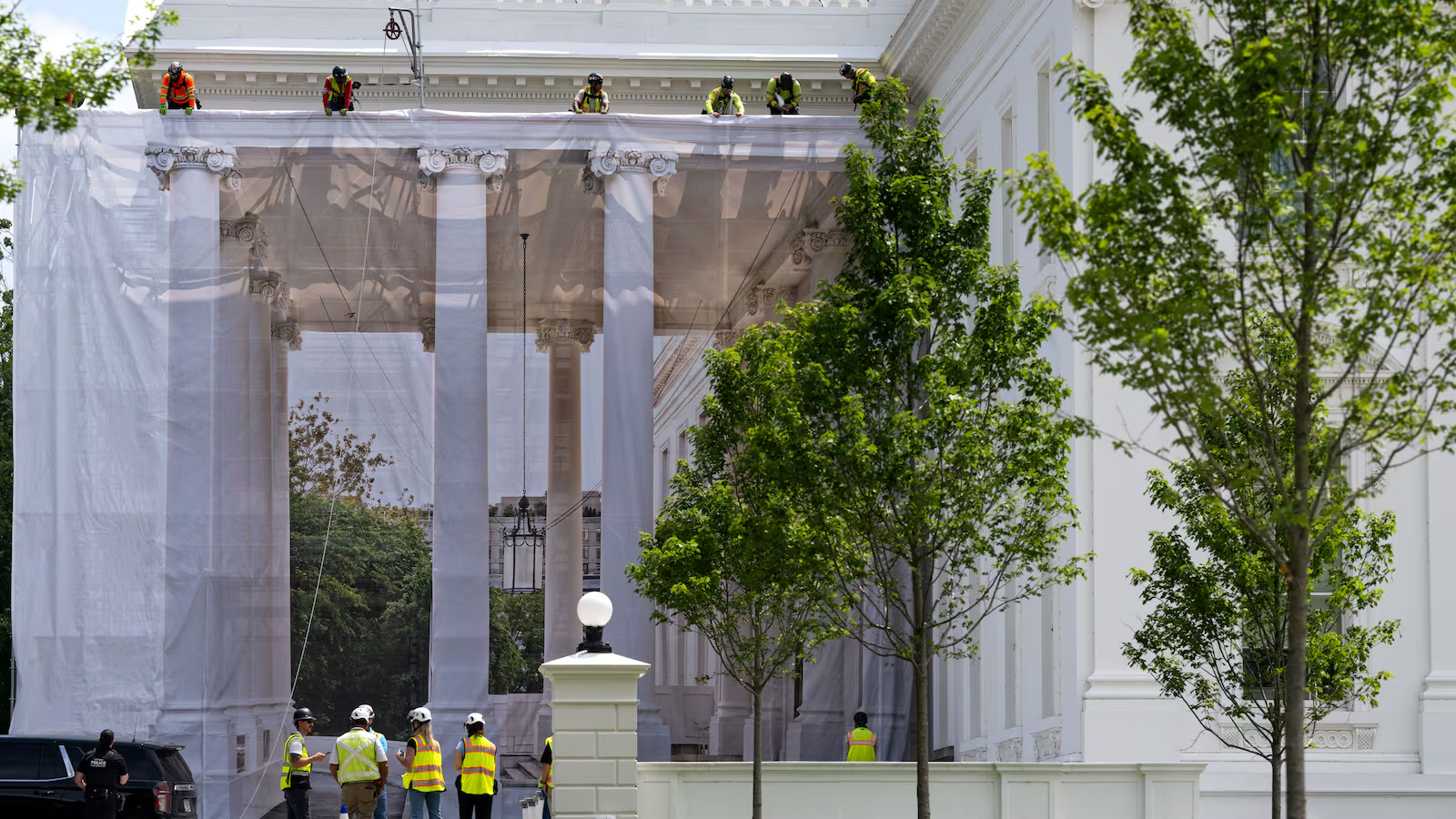
Something is happening at the North Portico of the White House, and the tarps covering it are printed to look exactly like the portico they conceal.
A White House official confirmed the work involves “security enhancements and upgrades,” with completion expected around mid-September.
What those enhancements actually are has not been disclosed.
The Camouflaged Construction
The visual detail is worth pausing on. The project has been wrapped in large tarps bearing printed images of columns and a lamp — a facsimile of the very facade they are hiding.
From a distance, the entrance to 1600 Pennsylvania Avenue still looks like itself. Up close, it is a picture of a building placed over a building.
This is not the only work underway on the front face. In late June, scaffolding appeared around the columns near the main entrance. At the time, a White House official described that as standard restoration work to repair the stone columns.
Now there are two projects layered on top of each other, and only one of them has a stated purpose.
The Bigger Proposal: Fencing Off Lafayette Park
The North Portico work is modest compared with what the administration is proposing next.
According to a plan submission to the Commission of Fine Arts, the administration wants to fence off Lafayette Park — and potentially Pennsylvania Avenue itself.
The document lays out multiple options, including permanent non-scalable fencing standing 8 or 9 feet tall.
The language in the submission attempts to soften the concept, describing an approach that may include discreet fencing, monitoring systems and alarms, applied in a way that preserves everyday openness while allowing temporary closures when needed.
The commission is scheduled to take up the proposal on July 16.
The Justification
The plan makes its reasoning explicit, and it centers on protest.
It identifies Lafayette Park and Pennsylvania Avenue as a focal point where the public gathers for demonstrations. It notes that some of those assemblies escalate into what it terms non-peaceful demonstration.
Then comes the operative sentence: a permanent fence, properly anchored, would provide separation that would assist in de-escalating most potentially violent protest.
The submission also argues that the current arrangement — temporary fencing and bike racks currently blocking the park — is not sustainable long-term.
Which frames the choice as a binary: keep the improvised barriers, or build permanent ones.
What Lafayette Park Has Always Been
The proposal touches something sensitive.
Lafayette Park sits directly across from the White House and has functioned for generations as the country’s most symbolically loaded protest ground. Its proximity is the point. A demonstration there is visible from the president’s residence.
Permanently fencing it does not eliminate protest. It relocates it — and, critically, it moves it further from the people it is meant to address.
That is precisely why the proposal is likely to draw significant public comment.
A Broader Reshaping
The security work fits into a much larger pattern of physical changes to the White House grounds since Trump returned to office.
The list is substantial:
- A granite helipad under construction on the South Lawn for Marine One, which Trump announced last week would be paid for by Sikorsky Aircraft, a Lockheed Martin subsidiary
- The demolition of the East Wing last year to make room for a large ballroom
- The Rose Garden grass paved over to create a patio with tables
- Two massive flagpoles erected on the North and South lawns
- Plaques installed beneath presidential portraits along the West Wing Colonnade, branded the “Presidential Walk of Fame”
Trump has described the ballroom project as a “shield” and a fortress for future presidents — language that aligns neatly with the fencing proposal and the unexplained portico work.
The Legal Pushback
Not all of it has proceeded unopposed.
The National Trust for Historic Preservation sued to block the ballroom construction. A US District Court judge issued an order halting the work.
That order was subsequently placed on hold while an appeals court hears the case, allowing construction to continue for now.
The litigation reflects a tension that runs through every one of these projects: the White House is simultaneously a working residence, a security asset, and a historic structure that belongs, in some meaningful sense, to the public.
What the Tarps Represent
There is an accidental symbolism in the current scene.
A printed image of an open, familiar building draped over construction whose purpose has not been explained. Fencing proposed to keep protesters at a distance, justified by the possibility that they might not remain peaceful. A ballroom described as a shield.
Whatever emerges from behind the tarps in September, the direction is consistent. The People’s House is becoming harder to approach.
Author