A First Amendment lawsuit ICE now faces is drawing national attention, as a New York man accuses federal officers of trying to silence him for daring to criticize the agency. The case raises pointed questions about where the line falls between protected political speech and genuine threats, and whether the government crossed it.
The Man Behind the Lawsuit
David Streever, a U.S. citizen living in Rochester, filed suit on Monday in Washington, D.C., taking aim at both the Department of Homeland Security and Immigration and Customs Enforcement. His central claim is that officials trampled on his constitutional right to speak out against the government.
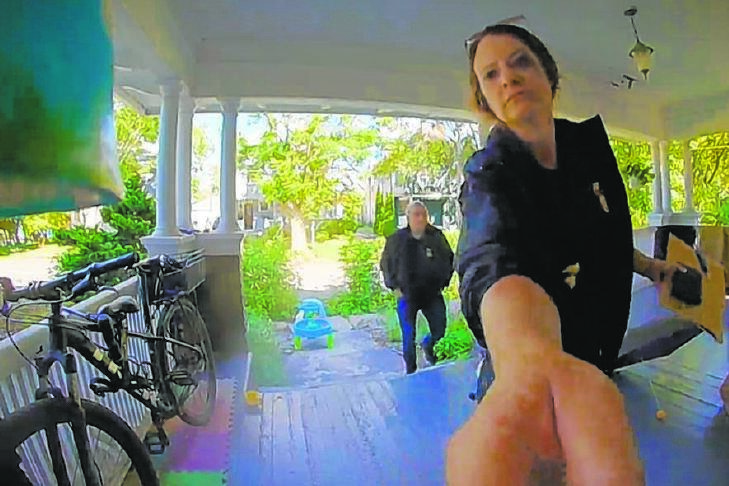
The trigger for the legal action was an unsettling encounter at his home. While Streever was traveling in Finland with his seven-year-old daughter last month, two officers appeared at his residence and handed his wife a warning notice. The document informed him that an email he had written months earlier was being treated as a threat.
An Email Born of Outrage
The message at the heart of this dispute was sent back in January. Streever addressed it to Todd Lyons, who served as acting director of ICE at the time. His anger stemmed from a tragic event: an ICE agent had shot and killed U.S. citizen Renee Nicole Good during an immigration raid in Minneapolis.
The email itself was undeniably harsh in tone. Streever condemned Lyons in fierce language, calling him a “monstrous human being” and predicting he would face a reckoning. He drew a chilling historical comparison, likening the official to a notorious Nazi figure.
Beyond the insults, the email contained sweeping predictions of Lyons’s downfall. Streever wrote that the official’s defense of what he called an obvious execution in Minnesota would ultimately destroy him. He suggested that even the president would eventually abandon Lyons, leaving him consumed by shame. The message went on to describe a future in which Lyons would torment himself with guilt until the end of his days, unable to escape the truth about his own actions.
A Warning Delivered
When federal officers arrived at Streever’s home, his wife answered the door and received the warning notice. The document stated that her husband “may be in violation of federal law” because of the email he had sent to the former acting director.
The notice, which was reviewed by reporters, pressed Streever to “promptly remove and/or discontinue” his behavior. It cautioned that the warning would be “taken into consideration” if he continued to be involved in what it described as criminal activities.
A Persistent Pursuit
What happened next forms a key part of the complaint. Streever’s wife informed the officers that he was abroad but would return to Rochester later that week. Rather than waiting, however, federal agents chose to pursue him more aggressively.
The lawsuit outlines a series of escalating actions:
- Officers attempted to confront Streever at a New York City hotel after his return from Finland, though hotel staff turned them away.
- That same night, agents repeatedly called his phone, leaving voicemails in which they identified themselves only as Homeland Security Investigations.
- The intensity of the pursuit left a lasting emotional mark on his family.
Perhaps most poignant was the effect on his young daughter. During their train ride home, Streever explained to her that federal officers might try to confront him. The little girl reportedly broke down in tears, frightened for her father’s safety.
The Legal Argument
Representing Streever is Adam Steinbaugh, an attorney with the Foundation for Individual Rights and Expression. He contends that the email, however inflammatory, falls squarely within the protections of the First Amendment and does not constitute a legitimate threat.
Steinbaugh offered a particularly compelling point about timing. He argued that if someone genuinely threatens a government official, authorities don’t wait five months to respond. The lengthy delay before officers acted, he insisted, demonstrates that Streever never posed any real danger. In his view, the entire effort was designed to intimidate lawful speech and nothing more.
Streever’s Perspective
For his part, Streever expressed genuine shock that his email led to federal officers appearing at his door. He emphasized his deep appreciation for the right to speak openly on matters of public concern.
He also voiced hope that others would not be discouraged from peacefully sharing their opinions, even when those opinions challenge the government. Reflecting on his motivations, Streever explained that he had been profoundly disturbed by the shooting in Minnesota and felt compelled to take some kind of action.
Writing to the head of ICE, he said, seemed like the least he could do to channel his outrage. He never imagined it would result in a knock on his door or officers descending on his hotel in the middle of the night.
The Government Responds
The lawsuit also names Homeland Security Secretary Markwayne Mullin. His office pushed back firmly against the accusations, with a statement declaring that any claim DHS and its components are attempting to suppress free speech is categorically false.
Through the complaint, Streever is asking the court to order DHS and ICE officials to halt what he describes as coercion and retaliation against him for engaging in protected speech.
A Pattern of Concern
Streever’s case did not unfold in isolation. During the same week his warning was delivered, another New Yorker reported a similar experience. Paigelynne Gonyea, a poll worker from Syracuse, said two federal officers confronted her at a voting site during the state’s primaries.
The officers questioned her about a social media post concerning Jonathan Ross, the ICE officer involved in Good’s death. Gonyea believes the warning stemmed from a January post in which she shared a picture of Ross with a caption suggesting he should be indicted. Notably, that post came after Ross had already been publicly identified by the media.
The government offered a different account of the Gonyea situation. A DHS spokesperson, Lauren Bis, shared an image of a separate post in which Gonyea allegedly shared Ross’s address, though part of it was redacted. Bis maintained that Gonyea had committed a federal crime by posting the officer’s address online, warning that anyone who exposes officers in this way would be investigated and brought to justice.
Final Thoughts
The clash between David Streever and federal authorities strikes at fundamental questions about free expression in America. On one side stands a citizen who channeled grief and anger into a strongly worded email. On the other stands a federal agency that viewed those words as a potential threat worthy of home visits and late-night phone calls.
As the case moves through the courts, it will likely serve as a test of how far the government can go in responding to harsh criticism. For Streever and his supporters, the stakes extend well beyond one man’s email, touching on whether ordinary Americans can voice outrage at their government without fear of a knock at the door.
Author