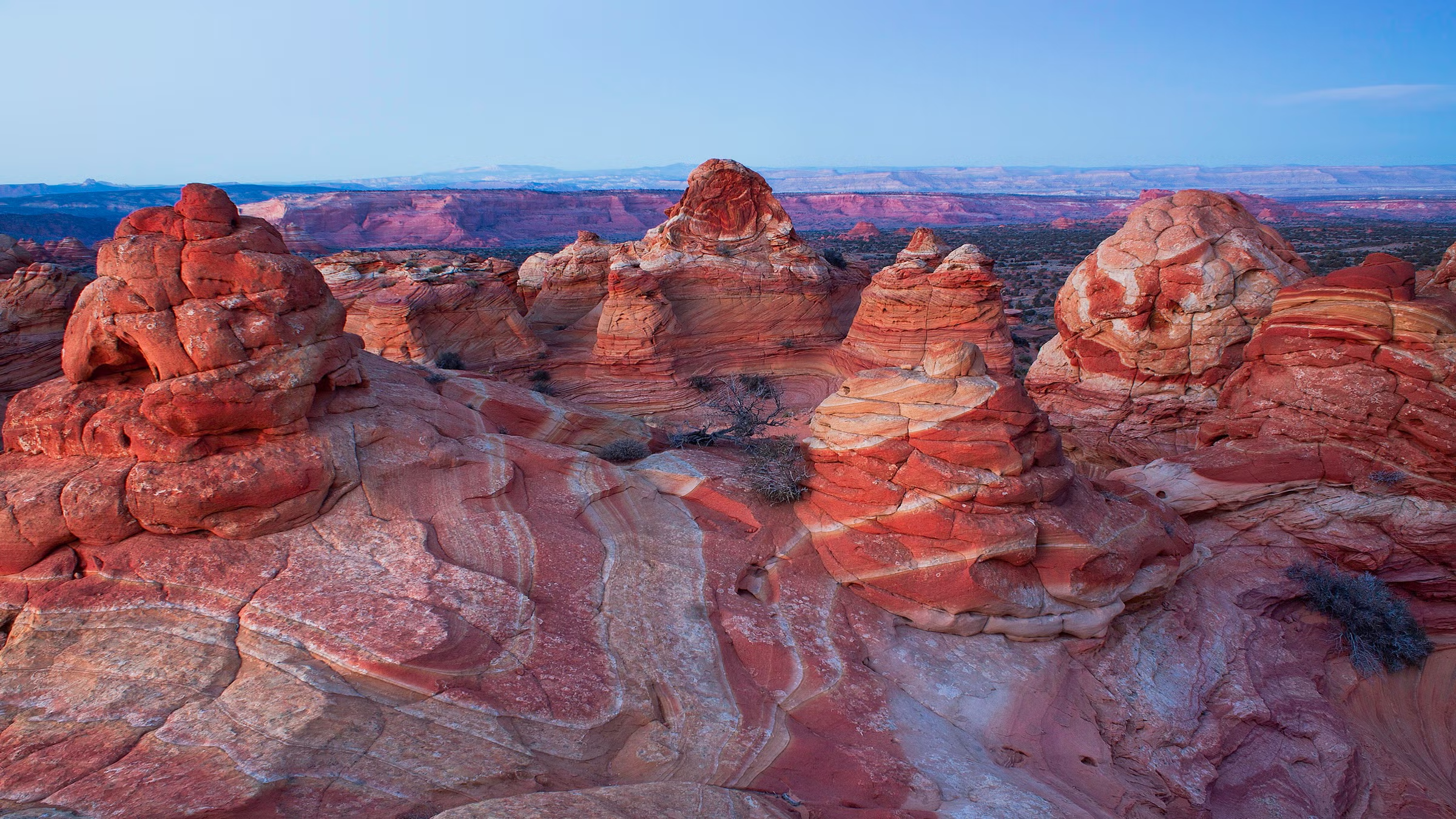
Bears Ears national monument is once again at the center of a fight that has consumed American public lands policy for the better part of a decade. President Donald Trump announced Monday that he is dramatically shrinking both Bears Ears and Grand Staircase-Escalante in Utah — reviving a battle he started in his first term and lost.
The move reverses proclamations issued by previous presidents who used the Antiquities Act, a 1906 statute granting the executive branch authority to protect land with cultural, historical, or scientific value.
The Scale of the Cut
The numbers tell the story bluntly.
Together, the two monuments covered more than 3.2 million acres — an expanse roughly the size of Connecticut. Trump’s order reduces that combined footprint to under 303,000 acres.
That is a deeper cut than the one he ordered during his first term, which President Joe Biden subsequently reversed.
Trump characterized the decision as returning land to the people.
Why These Two Monuments?
The land in question is not just scenic. It is valuable.
Grand Staircase-Escalante sits atop substantial coal reserves. The Bears Ears region contains uranium. Both also encompass extraordinary geological formations and sites considered sacred by several Native American tribes.
That collision — between extractable resources and cultural significance — is precisely why these particular monuments keep ending up in the crosshairs.
The Ping-Pong Match
The recent history reads like a game of political tennis.
During his first term, Trump issued only a handful of Antiquities Act proclamations. Two of them shrank Bears Ears and Grand Staircase-Escalante. He also created the Camp Nelson National Monument in Kentucky, honoring a Union Army hospital and recruiting site for Black soldiers during the Civil War.
Biden’s very first use of the act was to undo those reductions, restoring both Utah monuments to their previous size. He cited their spiritual, cultural, and prehistoric significance.
Biden went on to establish ten new monuments, including:
- The site of the 1908 race riot in Springfield, Illinois
- A monument honoring Emmett Till and his mother, Mamie Till-Mobley
- Protected land in the California mountains
- A sacred Native American site near the Grand Canyon
Now Trump has swung back the other way.
Utah Cheers, Tribes Object
Supporters of the reduction argue the boundaries had ballooned far beyond what was necessary, choking off access to minerals they consider essential.
Utah officials, who have long insisted the state should control its own land, welcomed the order.
Gov. Spencer Cox, a Republican, framed the debate as one of method rather than principle. The question, he said, has never been whether to protect these lands, only how best to do it. His office maintained that acreage removed from the boundaries remains protected under existing federal and state law.
Conservationists and tribal citizens see it differently. They warn the order clears a path for mining while trampling on the co-stewardship arrangement at Bears Ears, which is jointly managed by tribal nations and federal agencies.
Davina Smith-Idjesa, a citizen of the Navajo Nation and co-chair of the Bears Ears Inter-Tribal Coalition, rejected the premise entirely. Her people’s connection to the place, she said, cannot be erased by the stroke of a pen.
Can a President Legally Shrink a Monument?
This is the question courts have never definitively settled.
Environmental groups contend the Antiquities Act is a one-way street: presidents may create monuments, but not dismantle them.
History complicates that argument. Since 1912, presidents have issued more than a dozen proclamations reducing monuments, according to National Park Service records.
Some examples:
- Woodrow Wilson cut Mount Olympus National Monument in Washington roughly in half. It is now Olympic National Park.
- Harry Truman did the same to Santa Rosa Island National Monument.
- Dwight Eisenhower shrank six monuments, including Arches in Utah, Great Sand Dunes in Colorado, and Glacier Bay in Alaska — all three of which later became national parks.
So the precedent exists. Whether it holds under modern legal scrutiny is another matter, and litigation seems all but certain.
Monument, Park, or Forest?
The distinctions matter, and they are frequently muddled.
National monuments are usually created by presidential proclamation. More than 100 exist, managed by agencies including the National Park Service, the Bureau of Land Management, and NOAA. Designation brings sweeping protection — not just for a specific feature or artifact, but for the surrounding landscape, with drilling, mining, and new construction barred.
National parks are created by Congress, not presidents. They operate under the 1916 Organic Act, which imposes the strictest development limits of any federal land category, mandating conservation of scenery, wildlife, and history.
National forests answer to a different logic entirely. The Forest Service, established in 1905, oversees roughly 300,000 square miles across 43 states. These lands are managed for renewable resources — timber, water, wildlife habitat, grazing, recreation — but parcels can also be leased to private companies for oil, gas, and coal extraction.
The Origin Story
The Antiquities Act exists because of looting.
Theodore Roosevelt signed it after years of lobbying by scientists and educators alarmed at the commercial plundering of archaeological sites. It became the first American law establishing legal protection for cultural and natural resources on federal land.
Roosevelt wasted no time. On September 24, 1906, he designated Devils Tower in Wyoming — the towering rock butte later immortalized in “Close Encounters of the Third Kind” — as the country’s first national monument.
Every president since, with only three exceptions, has used the law.
What Happens Now
Expect lawsuits. Expect protests. And expect that if the White House changes hands again, the boundaries may move once more.
That, ultimately, is the deeper problem the Utah monuments expose: land that is supposed to be preserved for centuries is being redrawn on a four-year cycle.
Author