The Houthi missile attack on Saudi Arabia marks the most dangerous escalation in a conflict that has been largely frozen for four years — and it began with a runway.
Yemen’s Houthi movement said Monday it had launched ballistic missiles and drones at Abha International Airport in southwestern Saudi Arabia, retaliating for air strikes on Sanaa’s airport that it blamed squarely on the kingdom.
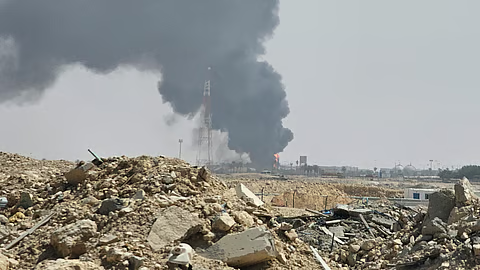
The Saudi-led coalition said its air defences dealt with the incoming missiles. No casualties were reported.
The Strike That Started It
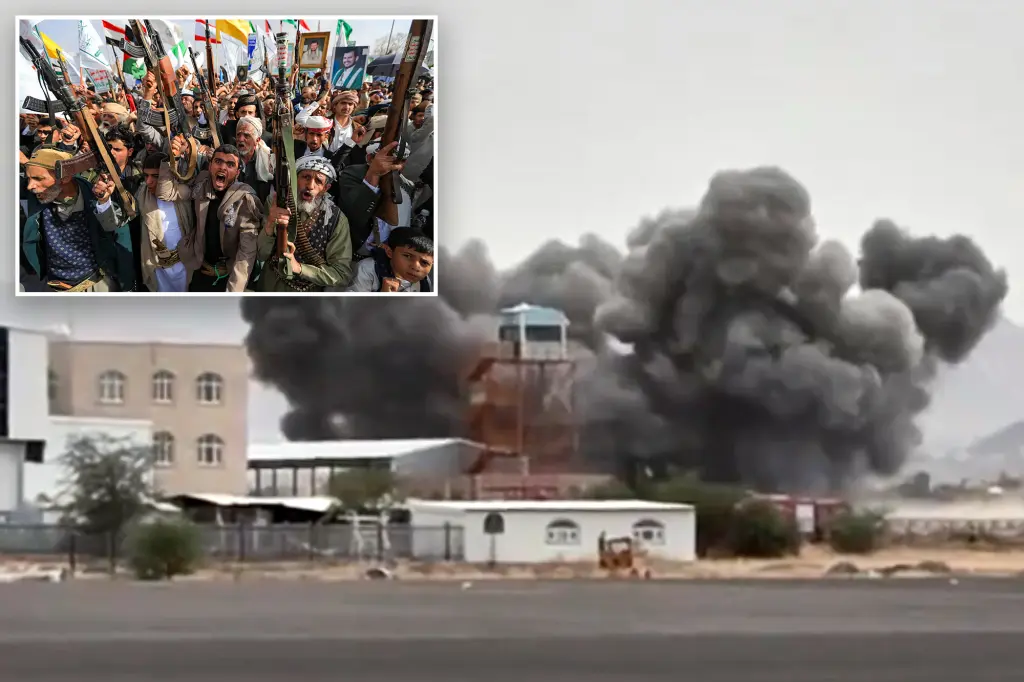
Earlier Monday, footage circulating on social media showed smoke rising above rooftops in Sanaa following strikes at the city’s international airport.
The Houthis’ al-Masirah television reported that both departure and landing runways had been targeted. The group described the attack as blatant aggression by Saudi Arabia.
But Riyadh was not the one claiming responsibility.
A Dispute Over One Aircraft
Yemen’s internationally recognised government, based in the southern port of Aden, said its own forces carried out the strikes — and explained why.
At the center of the incident was a dispute over an aircraft carrying a Houthi delegation returning from Iran, where they had attended the funeral of the late supreme leader Ayatollah Ali Khamenei.
The Yemeni defence ministry accused the Houthis of blocking national Yemeni aircraft from landing at Sanaa while simultaneously insisting on allowing an Iranian plane to enter Yemeni territory. The runway, it said, was targeted as a consequence.
The Iranian plane was forced to divert. According to the Houthis, it eventually landed in the Red Sea city of Hudaydah, roughly 150 kilometres to the southwest.
For more than a decade, aircraft entering Yemeni airspace have required clearance from the Saudi-led coalition — a system the coalition maintains it operates at the Yemeni government’s request.
The Houthi Response
Houthi military spokesperson Yahya Saree rejected the government’s account and pointed at Saudi Arabia.
He declared that the strikes had ended the de-escalation phase of the conflict and warned they would not go unanswered or unpunished.
Saudi authorities offered no comment before Saree announced Monday evening that the Houthis had fired ballistic missiles and drones at Abha International Airport in response to what he called criminal Saudi aggression.
He also issued a warning to commercial airlines, telling them to avoid Saudi airspace until the blockade on Sanaa International Airport is lifted.
The coalition spokesperson later confirmed on X that air defences had intercepted ballistic missile threats launched toward the Southern Region.
Why This Matters
This is the first significant escalation between the Houthis and Saudi Arabia since an informal truce took hold four years ago.
That truce was never formalised. It simply held — an uneasy quiet that allowed both sides to step back without conceding anything.
Monday’s exchange suggests that arrangement may now be over.
The Backdrop
Yemen’s civil war began in 2014, when the Houthis drove the government out of Sanaa. It intensified sharply in 2015 after a Saudi-led coalition of Arab states intervened to restore the government’s authority.
The consequences have been catastrophic:
- More than 150,000 people killed
- One of the world’s worst humanitarian crises
- More than 22 million people in need of some form of aid, according to the UN
The Houthis, backed by Iran, control the northwest of the country, including the capital.
International Alarm
An emergency session of the UN Security Council convened in New York.
Assistant Secretary General Khaled Khiari voiced concern about the strikes, warning that neither Yemen nor the broader region can afford another cycle of escalation. He urged all parties to engage constructively in negotiations under UN auspices.
The United Kingdom’s representative condemned what it called reckless Houthi attacks on Saudi Arabia, arguing they threaten regional security.
Iran’s foreign ministry took the opposite position, condemning the strike on Sanaa’s airport as a clear violation of international law.
The Larger Danger
What makes this escalation particularly volatile is the timing. It unfolds against a regional backdrop already inflamed by conflict involving Iran, and it drags Saudi Arabia — which has spent years quietly disentangling itself from Yemen — back toward the fighting.
A dispute over whether a single aircraft could land has now put missiles back in the sky between two countries that had, for four years, agreed to stop shooting at each other.
Author