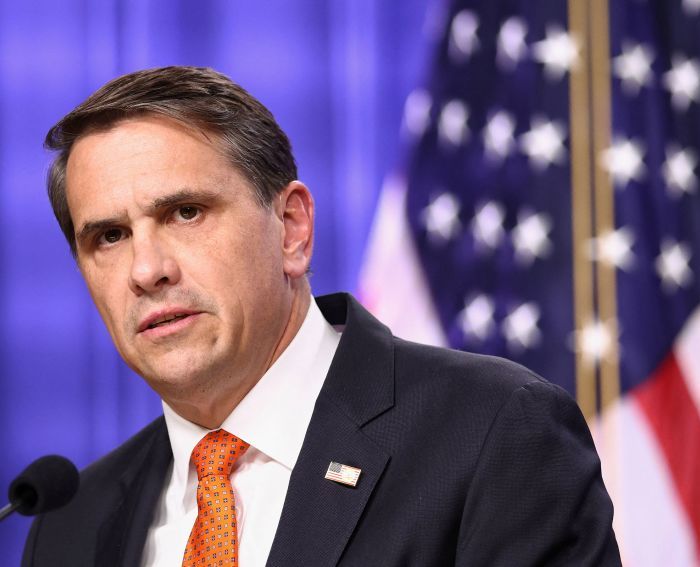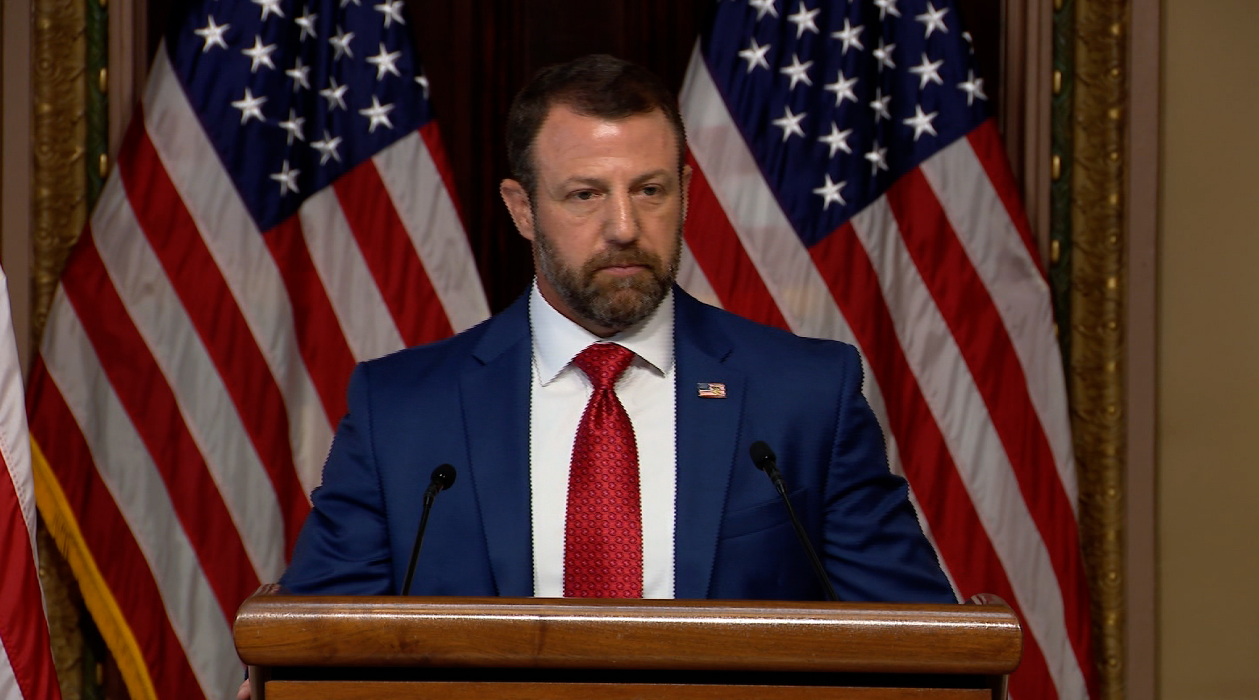
The administration’s election security demands now come with an explicit threat attached: comply, or lose federal money. Homeland Security Secretary Markwayne Mullin made that plain on Friday, expanding on warnings President Donald Trump had issued to the nation the night before.
Mullin’s remarks tracked closely with Trump’s own, but he added something the speech had left vague — an enforcement mechanism, and a list of who’s in the crosshairs.
Maximum Pressure, Applied at Home
Mullin reached for language usually reserved for adversarial foreign governments, promising a campaign of “maximum pressure” to force compliance from states.
He also gestured toward consequences for people Trump has accused of deceiving the public about the 2020 election, a contest Trump continues to falsely claim he won. Mullin insisted the effort isn’t about relitigating that race, framing it instead as an exercise in exposing what happened and preventing a repeat.
Pressed on targets, he pointed inward. His department, he said, is examining figures within the intelligence community and the previous administration under Joe Biden. Anyone who deliberately misled the public, misused their authority, or abandoned their responsibilities would face accountability.
Four States in the Crosshairs
Both Trump and Mullin named the same four states as the initial focus: California, Pennsylvania, New Jersey, and Nevada.
The selection is not random. Each is either a decisive swing state or a Democratic stronghold. Each is populous. And each carries more Electoral College weight than the average state — which matters enormously in a system that decides presidential elections by state-level tallies rather than raw national votes.
Mullin claimed those four states together carry 250,000 non-citizens on their voter rolls. He provided no source or methodology for the number.
He also repeated Trump’s broader assertion that roughly 278,000 foreign nationals nationwide are registered to vote. Again, no explanation of how the administration reached that total has been offered.
Election specialists point out a critical distinction the figure obscures: appearing on a registration list is not the same as casting a ballot. Registration errors happen. Successfully voting as a non-citizen requires clearing multiple screening steps that states already apply.
What the Research Actually Shows
The empirical record on non-citizen voting is thin to the point of near-nonexistence.
A Brennan Center for Justice review of 42 jurisdictions during the 2016 election found that suspected non-citizen ballots amounted to roughly .0001 percent of votes cast. That’s a rounding error, not a threat to outcomes.
The pattern of claims is also familiar. In 2016, Trump captured the Electoral College while losing the national popular vote, and attributed the gap to millions of illegal ballots — an assertion no investigation has substantiated.
Notably, the declassified documents the White House released alongside Thursday’s speech did not back up the sweeping “deep state” cover-up allegations Trump made from the podium.
Money as Leverage
The most concrete part of Mullin’s announcement was financial.
He said the department intends to make its security requirements mandatory for states seeking federal grants or reimbursement for administering federal elections. States that want the money will have to comply.
He described the demands as narrow — securing voting machines and cleaning up voter registration lists — and insisted the administration wasn’t reaching beyond that.
Critics read it differently. Withholding election funding gives Washington direct leverage over how states run their own elections, which is precisely the arrangement the Constitution assigns to states rather than the federal government.
The Push Toward Federal Control
The funding threat fits a longer pattern.
Trump has consistently questioned the reliability of electronic voting and pushed for paper ballots. He’s also sought limits on mail-in voting, despite having voted by mail himself.
His administration has repeatedly demanded that states hand over voter registration data to federal authorities. Multiple federal courts have blocked attempts to assemble a national voter database from that information.
The system the administration wants to use for cross-checking — the Systematic Alien Verification for Entitlements database, known as SAVE — carries its own documented flaw. It has incorrectly identified naturalized citizens born abroad as non-citizens, raising the prospect that a scrub of voter rolls could strip eligible Americans of their registration.
Earlier this month, the administration sent letters to election officials nationwide warning of prosecution if non-citizen voters turn up on their rolls.
States Push Back
The response from targeted states came quickly and sharply.
California Governor Gavin Newsom posted a video of Mullin’s remarks alongside a defiant message, asserting that his state runs free, fair, and secure elections and would defend them. His closing line — a direct challenge to the administration to test that — signaled a willingness to litigate.
Other state leaders have similarly hinted at legal action, setting up a constitutional confrontation over who controls election administration.
A Fight With the Networks
Mullin’s speech extended into another arena: the television networks that declined to carry Trump’s address live.
The White House had asked for primetime airtime without disclosing the speech’s contents in advance. Media critics urged networks to refuse, arguing that an unfiltered platform for unverified election claims could erode public confidence heading into the 2026 midterms.
ABC, NBC, and CNN ultimately kept the half-hour address off their main channels. Fox News carried it, though with qualifications.
Trump used the speech itself to attack the networks that passed, describing them as participants in a scheme to perpetuate fraud and suggesting their broadcast licenses should be revoked.
Mullin backed him up, calling the networks shameful and questioning what they might be concealing. He asked why an organization calling itself a news outlet would decline to deliver news to the public.
The license threat isn’t new. The administration made a similar move last September during a dispute involving late-night host Jimmy Kimmel.
The FCC’s lone Democratic commissioner, Anna Gomez, rejected the threat outright as unconstitutional. She argued the agency has no power to punish a station for declining to air an overtly political speech, and called the effort a transparent attempt to intimidate broadcasters. She noted that networks have made comparable editorial calls under presidents from both parties, and that the speech remained freely available online to anyone who wanted it.
What Comes Next
Two fronts will define this fight. The first runs through the courts, where states are likely to challenge both the funding conditions and any renewed push for a federal voter database. The second runs through the FCC, where the license threats will test whether an independent agency absorbs political pressure or resists it.
Underneath both sits an unresolved question about the 2026 midterms: whether a sustained campaign of unproven fraud claims changes how Americans regard the results — regardless of what any investigation ultimately finds.
Author