The escalating saga of US Iran Strait of Hormuz drones took another dangerous turn on Friday, as American forces shot down at least four Iranian drones while Iran launched ballistic missiles toward Gulf nations. The exchange marked the latest spasm of violence threatening an already fragile cease-fire between the two countries — and raised fresh fears of a wider regional flare-up.
U.S. Central Command detailed the back-and-forth in a series of statements, painting a picture of a truce holding together by the thinnest of threads.
How the Latest Exchange Unfolded
According to Central Command, the sequence of events began when U.S. forces downed four Iranian one-way attack drones launched toward the Strait of Hormuz. The military described these drones as posing an immediate threat to regional maritime traffic.
In response, U.S. forces struck back at Iranian coastal surveillance radar sites located in Goruk and on Qeshm Island, off the Iranian coast. The stated goal was to thwart any further attacks before they could materialize.
Iran did not stay quiet for long. Hours later, it fired seven ballistic missiles toward Kuwait and Bahrain. Of those, six were shot down and one fell short of its target, according to Central Command.
A Familiar and Troubling Pattern
Friday’s events echoed a rhythm that has become disturbingly routine in recent days. Roughly two hours after Central Command announced it had downed the Iranian drones, Kuwait’s military reported that its air defenses were actively intercepting hostile drones and missiles.
The regional alarm spread quickly:
- Kuwait’s military issued its statement early Saturday local time but did not specify where the incoming drones and missiles had originated.
- Bahrain’s interior ministry confirmed that warning sirens had been activated early Saturday, though it stopped short of identifying what triggered them.
Iran Claims Responsibility
Iran’s Islamic Revolutionary Guards Corps stepped forward to take credit for the retaliation. In a statement published by Iranian state media early Saturday, the Guards said they had responded to U.S. attacks in Sirik and on Qeshm Island by striking what they called “enemy bases” in the region.
The statement specified targets, claiming the Revolutionary Guards had launched ballistic missiles at the Ali Al Salem Air Base in Kuwait and at the U.S. Navy Fifth Fleet’s facilities in Bahrain. Iran also issued a warning, threatening a stronger response if such U.S. strikes were repeated.
The US Pushes Back on Damage Claims
Central Command was quick to counter Iran’s narrative of success. The military said the Iranian attacks had been swatted away with no damage to U.S. bases and no harm to American personnel.
In firm language, the military stated that American forces remained vigilant and postured to respond to what it called unjustified Iranian aggression in self-defense.
Keeping the Strait Open
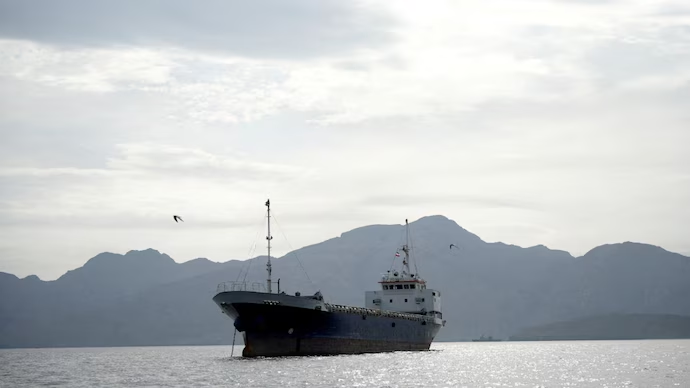
Despite the persistent danger, the U.S. has been working to keep critical shipping lanes functioning. A U.S. official said Friday that American forces had, over the past month, helped coordinate the safe passage of more than 100 commercial vessels through the Strait of Hormuz — both into and out of the Persian Gulf.
The official, speaking anonymously to discuss operational matters, acknowledged that travel through the waterway remains risky amid stalled negotiations to end the war. The strait is a vital artery for global energy shipments, making its security a matter of international concern.
A Deadly Backdrop
The renewed military volleys carried added weight given recent events. They came just two days after a civilian was killed and dozens of others injured at Kuwait’s international airport, following an Iranian barrage of missiles and drones.
That airport attack stood out as one of the most significant Iranian strikes to date — and the first known fatality in a Gulf nation since the cease-fire took effect in early April. Kuwait said the assault on Wednesday involved 13 ballistic missiles and 17 drones.
A Pattern of Pressure on US Allies
Iran’s targeting of Gulf nations is part of a broader strategy that has unfolded throughout the war. Tehran has repeatedly struck major energy facilities, ports, and hotels in Gulf countries, seeking to punish U.S. allies and ratchet up economic pressure on the Trump administration.
The reach of these attacks has extended beyond a single country. Central Command said on Wednesday that Iran had also fired missiles and drones at Bahrain, another U.S. ally in the Gulf, as well as at civilian sailors in nearby waters. The military reported that none of those strikes hit their targets.
A Cease-Fire in Name Only?
The fundamental tension lies in a truce that exists on paper but is constantly tested in practice. While U.S. and Iranian attacks have slowed considerably since the two sides announced a cease-fire, they have never fully stopped.
Both sides continue to frame their actions through the language of self-defense. Central Command, for instance, characterized its Wednesday operations as “self-defense strikes” on an Iranian military ground control station on Qeshm Island. Iran, in turn, casts its retaliation as a justified response to American aggression.
An Uncertain Road Ahead
The latest exchange underscores just how precarious the situation in the Gulf remains. With drones falling, missiles flying, and both sides claiming the moral high ground of self-defense, the cease-fire looks increasingly like a temporary pause rather than a genuine path to peace.
As negotiations to end the war stall and the violence continues to simmer, the Strait of Hormuz sits at the center of a volatile standoff — a narrow waterway where the risk of a single miscalculation could reignite a far broader conflict.
Author