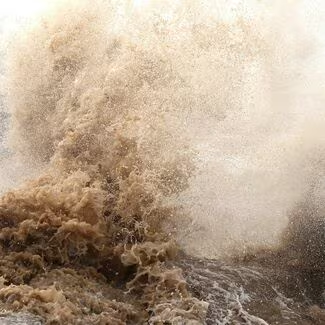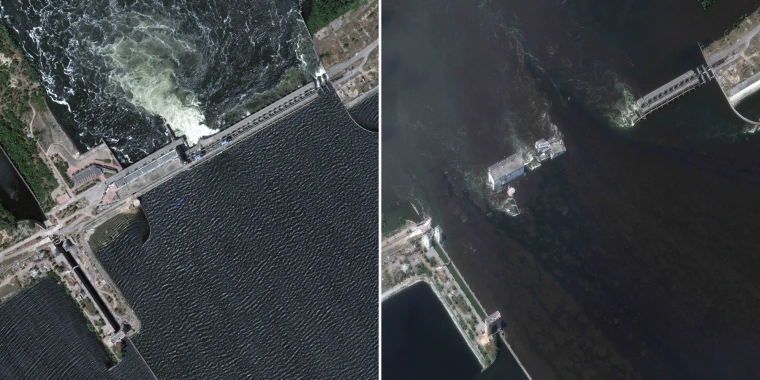
The Belgorod Reservoir dam damage reported on July 19 has sent water pouring downstream and raised familiar questions about strikes on water infrastructure in the Russia-Ukraine war.
The Belgorod-based outlet Pepel reported the damage, attributing it most likely to a Ukrainian strike and citing anonymous sources alongside satellite imagery.
What the Imagery Shows
Pepel’s analysis of satellite photographs identified a damaged spillway section running roughly 30 metres, or about 98 feet, in length.
Water is moving through that breach without control.
The outlet’s sources also reported that the road along the crest of the dam has been compromised, which affects both access for repair crews and any local traffic that relied on the crossing.
Downstream Effects
The consequences arrived quickly.
As floodwater moved downstream, the Nezhegol River began rising. In Shebekino, the town the river runs through, beaches were already under water according to Pepel’s reporting.
Shebekino sits close to the Ukrainian border and has been among the more frequently affected settlements in the Belgorod region throughout the war.
Not the First Time
This dam has been damaged before.
An earlier incident occurred in the autumn of 2025. Authorities said repairs at that time were completed within five days.
Pepel assesses the current damage as more serious than that episode, though it has not detailed the basis for that comparison beyond the scale of the visible breach.
If accurate, a longer repair timeline would mean sustained downstream flow and continued pressure on the Nezhegol.
The Kakhovka Precedent
Any damage to dam infrastructure in this war invites comparison to the Kakhovka dam, which collapsed in Ukraine’s Kherson region in the summer of 2023.
That collapse flooded several dozen settlements across the Kherson and Mykolaiv regions, displacing residents and causing extensive environmental damage.
Russia and Ukraine each blamed the other. No agreed account has emerged in the years since.
The comparison matters here for reasons of scale rather than similarity. Kakhovka was a catastrophic failure of a much larger structure. The Belgorod damage, as described, involves a breached spillway section rather than structural collapse.
Why Water Infrastructure Keeps Coming Up
Dams occupy an uncomfortable position in this conflict.
They are dual-use in the most literal sense. A reservoir supplies drinking water, supports agriculture and generates power. It also represents a stored quantity of energy that, released, functions as a weapon against everything downstream.
International humanitarian law treats installations containing dangerous forces, including dams, with special protection precisely because attacking them puts civilian populations at risk in ways that cannot be controlled once the water is moving.
That protection is not absolute, and both sides in this war have accused the other of attacks on water infrastructure.
What Remains Unclear
Several things are not established:
- No independent confirmation of Ukrainian responsibility has been published
- Russian authorities have not issued a detailed public assessment of the damage
- The expected repair timeline is unknown
- The full downstream flood extent has not been mapped publicly
- Whether any evacuation orders have been issued for affected areas is unstated
Pepel’s reporting rests on anonymous sources and satellite imagery, which is a reasonable basis for a preliminary account but not a substitute for on-the-ground verification.
The Local Reality
For residents of Shebekino and settlements along the Nezhegol, the attribution question is secondary to the water.
Border regions on both sides of this conflict have absorbed damage that receives limited attention relative to front-line combat. Flooded beaches are a minor first indicator. Whether the water rises further depends on how quickly the spillway can be closed and how much the reservoir holds behind it.
What to Watch
The immediate indicators are practical rather than political.
If repair crews can reach the site and begin work, the 2025 precedent suggests the damage may be contained within days. If the compromised roadway prevents access, or if the breach is larger than the earlier incident, the timeline extends and the downstream flooding continues.
Russian authorities have not yet made a public statement, and their eventual account will likely be the first official acknowledgement of what happened at the dam on July 19.
Author