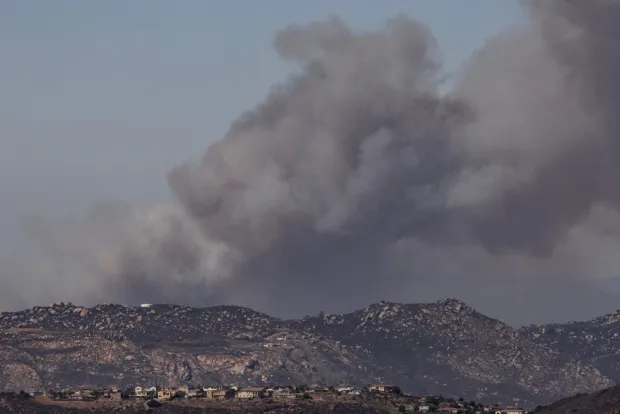
The Creelman fire Ramona residents watched erupt Wednesday afternoon went from nothing to a full-scale emergency in a matter of hours, pushing more than 2,000 people out of their homes and forcing a helicopter rescue of two people caught near where the flames began.
By late afternoon it had consumed 315 acres. Cal Fire later reported containment at 20 percent — meaningful progress on a blaze that had spent much of the day running free.
Two People, One Helicopter
The most urgent moment of the response came early.
Two individuals became trapped near the fire’s point of origin, close enough to the ignition point that ground access was not an option. Crews used a helicopter to extract them.
Capt. Mike Cornette of Cal Fire San Diego confirmed that neither person was injured. As of Wednesday evening, officials had received no reports of injuries connected to the fire at all.
That is a notable outcome given how quickly conditions deteriorated.
A Fire That Started After Lunch
Authorities placed the ignition just before 3 p.m.
Within a few hours it had grown to more than 300 acres and was advancing toward San Diego Country Estates — a planned resort-style community housing roughly 10,000 residents.
The resort announced on social media that it was evacuating guests, describing the decision as a precaution rather than a response to immediate danger. That kind of early action tends to look excessive right up until the moment it doesn’t.
What the Response Looked Like
Cal Fire and local agencies moved aggressively on both fronts.
Images and video circulating on social media captured the scale: helicopters releasing water into a sky heavy with smoke, hillsides carrying visible orange fire lines, and daylight dimmed by the plume.
Cornette described the aerial work as productive, saying aircraft had significantly slowed the fire’s advance.
Ground infrastructure came together quickly as well:
- A local high school opened as a shelter point for evacuees
- A rodeo grounds was designated for large animal drop-off
- Evacuation orders covered more than 2,000 people by early Thursday
That large animal provision matters more than it might appear. Ramona is horse country, and evacuation decisions in rural areas frequently stall because residents will not leave livestock behind. Establishing a designated drop-off removes one of the most common reasons people delay departure.
The Smoke Problem
Air quality warnings accompanied the fire response.
Officials cautioned that conditions in heavily smoke-affected areas near the blaze could reach unhealthy levels. Even locations with lighter smoke were flagged as potentially unhealthy for sensitive groups — a category that includes children, older adults, and anyone with respiratory or cardiac conditions.
The recommendation was straightforward: limit time outdoors.
Wildfire smoke travels considerably farther than flames, which means the health footprint of a fire like this extends well past any evacuation boundary.
Ready to Go
Kirk Delph, a 52-year-old Ramona resident, described the posture that people in fire-prone California have learned to adopt.
He had been watching the fire since it started and had prepared to leave if conditions shifted. His bags were already packed. If things change, he said, they are ready to move.
That is exactly the right response, and it reflects something specific about communities that live with this risk annually. Preparation is not panic. It is the thing that makes a calm departure possible when the order arrives.
Why Ramona Is Vulnerable
The geography here works against firefighters.
Inland San Diego County combines dry chaparral, hilly terrain, and summer heat into a landscape built for rapid fire spread. Add wind and a fire can outrun containment lines faster than crews can establish them.
Communities in this zone sit at what fire managers call the wildland-urban interface — the boundary where development meets undeveloped vegetation. It is the most difficult environment in which to fight fire, because protecting structures and attacking the fire itself often require crews to be in two places at once.
Reading 20 Percent Containment
Containment percentages are frequently misunderstood.
The number does not describe how much of the fire has stopped burning. It describes how much of the fire’s perimeter has been secured with control line that crews expect to hold.
Twenty percent means four-fifths of the edge remains open. It is progress worth reporting, but it is not reassurance. The remaining perimeter is where the fire can still grow.
What Comes Next
The immediate objectives are predictable: extend containment line, protect structures at the community edge, and hold the fire short of San Diego Country Estates.
Weather will determine much of the outcome. Overnight humidity recovery typically slows fire behavior and gives crews their best working window. Afternoon heat and any wind increase reverse that advantage.
For residents under orders, the guidance remains unchanged — stay out until officials clear the area, monitor official channels rather than social media rumor, and keep the vehicle loaded.
For those like Delph still watching from just outside the line, the bags stay packed.
That is simply what July looks like in this part of California.
Author
-
Lucienne Albrecht is Luxe Chronicle’s wealth and lifestyle editor, celebrated for her elegant perspective on finance, legacy, and global luxury culture. With a flair for blending sophistication with insight, she brings a distinctly feminine voice to the world of high society and wealth.