Scarborough Shoal Confrontation Marks Third Clash in a Single Week
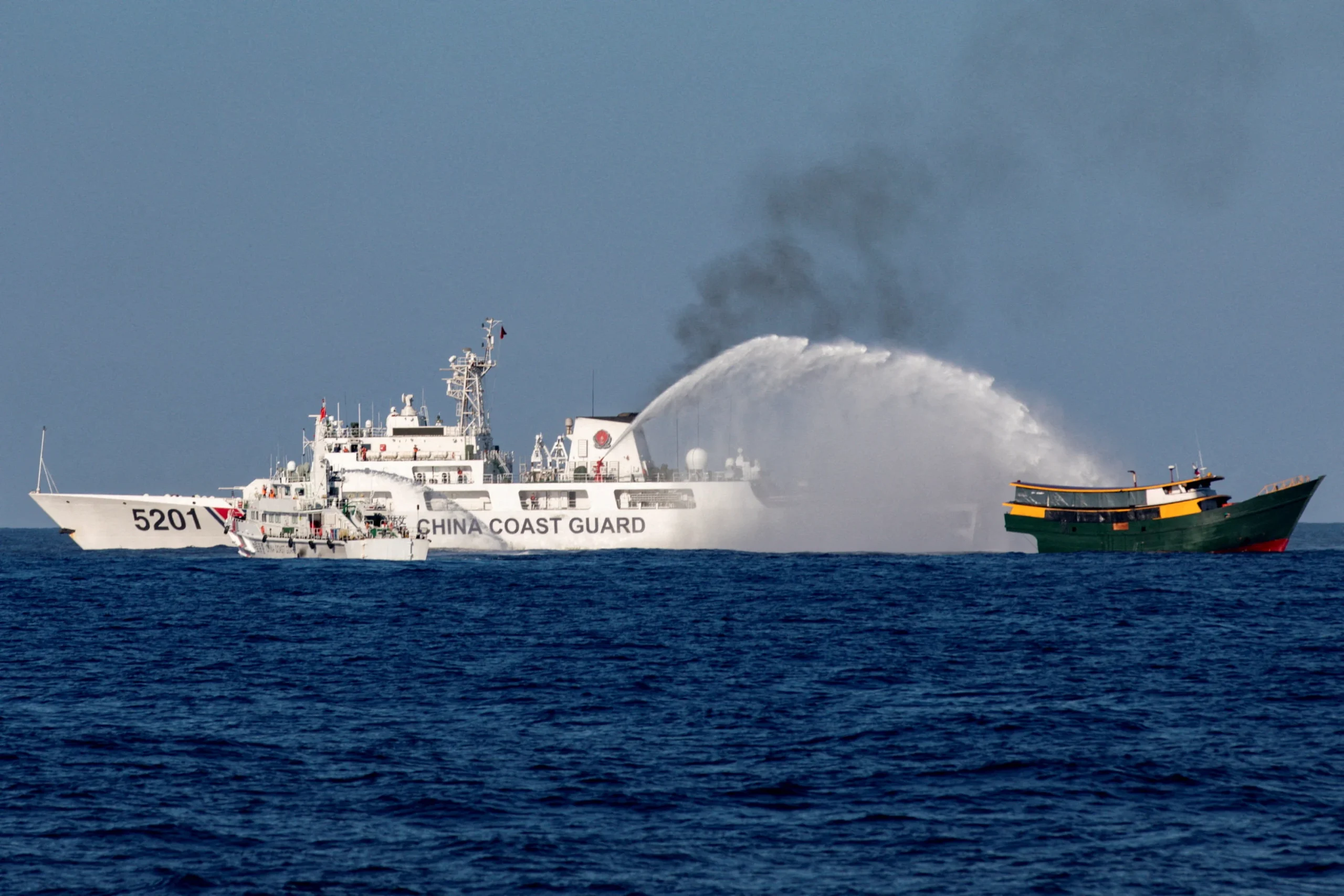
Chinese vessels fired water cannon at Philippine ships near Scarborough Shoal on Friday, including one carrying a CNN crew — the third tense encounter in these contested waters within a week.
The shoal itself is unremarkable to look at. An uninhabited rock with a central lagoon, valued mainly for the rich fishing grounds inside and around it.
What makes it dangerous is everything layered on top: a vital global shipping lane, a mutual defense treaty binding Washington to Manila, and China’s sustained effort to consolidate control over disputed features. In that configuration, a navigational error or a single misjudged action could escalate quickly.
What Happened on the Water
CNN was granted exclusive access aboard a vessel from the Philippine Bureau of Fisheries and Aquatic Resources, running fuel to local fishermen near the shoal.
As the Philippine ships neared, several larger China Coast Guard vessels closed in — near enough that the crew could make out the faces of personnel aboard.
A warning came over a megaphone instructing the Philippine ships to leave immediately, with a threat of firm action in accordance with the law if they did not. One Chinese vessel circled continuously while its water cannon struck the Philippine ship.
The Numbers Involved
Philippine authorities later described a substantial imbalance:
- 15 Chinese vessels, drawn from the coast guard and the maritime militia
- 10 Philippine ships, three of them from the Philippine Coast Guard
- One small government propeller plane flying low over the vessels
The Philippine Coast Guard said its ships faced a series of water cannon attacks and dangerous manoeuvres. One Chinese vessel closed to within seven metres — roughly 23 feet — of the ship carrying the CNN crew, which the agency described as posing serious risk of collision.
Two Accounts of the Same Event
Chinese state broadcasting characterised the day differently, reporting that the coast guard took lawful enforcement measures against Philippine vessels engaged in illegal activity in waters under Chinese jurisdiction around Huangyan Island — Beijing’s name for the shoal.
Asked by CNN’s Mike Valerio to respond, Chinese foreign ministry spokesperson Lin Jian said the measures were legitimate and lawful, describing them as professional, standard and beyond reproach.
How It Ended
The Philippine ships eventually abandoned the mission and returned to port, citing an approaching typhoon.
Tension dropped sharply once they turned away, though China Coast Guard ships remained visible in the distance hours later, still shadowing the Philippine vessels.
That shadowing had begun long before the confrontation. Overnight, sailing through predawn darkness, the 30-metre Philippine ship was trailed by a China Coast Guard vessel measuring 111 metres — nearly four times its size, a physical illustration of the disparity between the two maritime forces.
The Two Earlier Incidents
Friday’s encounter completed a sequence that began Monday at Second Thomas Shoal in the Spratly Islands.
The Philippines maintains a small garrison there aboard the BRP Sierra Madre, a grounded World War II-era ship. According to the Philippine military, a China Coast Guard vessel launched a smaller boat that approached the Sierra Madre, prompting the Philippines to send two rigid-hulled inflatable boats to escort it away.
Philippine video shows eight Chinese personnel in a boat ramming one of the smaller craft, with blows exchanged using wooden batons and oars. Two Philippine service members were injured and evacuated.
Chinese authorities accused Manila of spreading misinformation, saying it was the Philippine boats that rammed and fiercely attacked their personnel.
Thursday brought the second incident. China’s Coast Guard said it drove off two Philippine vessels accused of intruding near Scarborough Shoal. The Philippine military described water cannon use and dangerous navigation aimed at blocking a resupply run for fishermen. No injuries were reported, and that mission continued.
Washington Responds Both Times
The State Department condemned China’s actions after Monday’s clash as dangerous and aggressive.
Secretary of State Marco Rubio echoed that on Thursday while attending an ASEAN meeting in Manila, stating that the United States has a role and will not abandon its allies — a point he said has been made abundantly clear.
The commitment is not rhetorical. The Philippines is a mutual defense treaty ally, obligating Washington to respond to an attack on Philippine territory and potentially on Philippine vessels at sea.
A Crowded Legal Dispute
Scarborough Shoal sits 140 miles west of Luzon and roughly 530 miles from China’s Hainan province. China, the Philippines and Taiwan all claim it. Beijing has effectively controlled it since 2012 through near-continuous coast guard presence.
The broader South China Sea dispute involves more parties still. Vietnam, Malaysia, Brunei and Taiwan also claim portions of the roughly 250 islands, reefs and atolls scattered across 1.4 million square miles of water.
An international tribunal ruled in 2016 that China has no legal foundation for claiming historic rights over most of the sea. Xi Jinping rejected the finding and construction continued regardless — military installations, airstrips and artificial islands, despite a pledge he made during a 2015 White House visit not to pursue exactly that.
Why the Timing Matters More This Year
The Persian Gulf has changed how analysts read this dispute.
After coming under attack from the United States and Israel, Iran managed to close the Strait of Hormuz, halting as much as 20% of global oil trade along with supplies critical to agriculture and computer chip manufacturing.
The parallel is uncomfortable. One third of global maritime trade passes through the South China Sea annually. A comparable disruption there would carry economic consequences that dwarf the Gulf.
Escalation by the Numbers
Confrontations have grown more frequent and more physical. In June 2024, China Coast Guard personnel brandished axes at Philippine troops and slashed their rubber boats.
The presence data tells its own story. According to the Asia Maritime Transparency Initiative at CSIS, Chinese coast guard vessels logged 993 ship days around Scarborough Shoal in June alone — nearly matching their total for all of 2025.
The United States has adjusted as well, relocating Coast Guard vessels previously stationed in Bahrain before the Iran war to the eastern Pacific.
What Three Incidents in a Week Suggest
Individually, each encounter follows a familiar script: a Philippine mission, a Chinese intercept, competing accounts, an American statement.
The compression is what stands out. Three confrontations in five days, involving injuries in one case and a 23-foot near-collision in another, against a backdrop of Chinese presence around the shoal increasing roughly twelvefold year over year.
None of it has produced casualties beyond bruises. But the margin for error is measured in metres, and both sides are operating more ships in the same water than at any point previously.
Author
-
Lucienne Albrecht is Luxe Chronicle’s wealth and lifestyle editor, celebrated for her elegant perspective on finance, legacy, and global luxury culture. With a flair for blending sophistication with insight, she brings a distinctly feminine voice to the world of high society and wealth.