The federal voter list executive order signed by President Trump remains blocked across nearly half the country after an appellate court refused on Saturday to let the administration enforce it.
Judges on the 1st U.S. Circuit Court of Appeals upheld a lower court injunction, rejecting the administration’s bid to implement mail-in voting restrictions in the 23 states that sued ahead of November’s midterm elections. The decision leaves in place an injunction issued by a federal judge in Boston in June.
What the Order Would Have Done
Trump signed the directive in March. It instructed the director of U.S. Citizenship and Immigration Services and the commissioner of the Social Security Administration to assemble what the order called a state citizenship list identifying eligible voters.
The second component went further. It directed the U.S. Postal Service to deliver mail ballots only to individuals appearing on that list.
Taken together, the two provisions would have created a federally maintained roster functioning as a gatekeeper for mail voting nationwide — a substantial departure from how American elections have historically been administered.
The President’s Rationale
Trump presented the order as a protection against non-citizens casting ballots. Speaking in the Oval Office before signing it, he said the cheating associated with mail-in voting is legendary.
Studies of voter fraud have consistently found documented cases to be rare, though supporters of tighter verification argue that existing detection methods are inadequate rather than that fraud is absent. That disagreement over what the evidence shows sits underneath much of the litigation.
The Legal Challenge
Democratic officials from 23 states and the District of Columbia filed suit in U.S. District Court in Boston.
Their argument was structural rather than primarily about fraud. Under the Constitution, authority to set the time, place and manner of elections rests with the states, subject to congressional override. Neither grant of power belongs to the president. On that reading, the executive order attempted to exercise authority the office does not possess, regardless of its policy merits.
State election officials raised practical objections as well, warning that a federally generated eligibility list would be vulnerable to errors and could produce widespread confusion. Any database assembled from immigration and Social Security records would inevitably contain outdated entries, name mismatches and clerical mistakes — and each of those errors, in this design, would translate directly into a voter not receiving a ballot.
The Rulings
U.S. District Court Judge Indira Talwani, nominated to the bench by President Barack Obama, agreed with the states and halted implementation for the November 3 elections.
Her order applied only within the states that joined the lawsuit, an important limitation. Courts have grown more cautious about issuing nationwide injunctions in recent years, and the result here is a patchwork: the executive order is unenforceable in the plaintiff states and technically remains on the books elsewhere.
Saturday’s appellate decision preserved that arrangement heading into the election.
The White House and the Justice Department did not immediately respond to a request for comment on Sunday.
Why the Timing Matters
Election litigation operates under a clock that ordinary lawsuits do not.
Courts have long been reluctant to permit significant changes to election procedures close to voting, on the reasoning that late alterations confuse voters and overwhelm administrators. That principle tends to favor whichever side is defending the existing arrangement as an election approaches.
With the midterms in early November, the practical window for reversing this outcome before ballots go out is narrowing quickly. Even a successful appeal would face the question of whether implementation could realistically occur in time.
The Broader Constitutional Question
Stripped of the politics, the case turns on a boundary that has generated repeated disputes: how far executive orders can reach into areas the Constitution assigns elsewhere.
Presidents direct federal agencies routinely, and USCIS, the Social Security Administration and the Postal Service are federal entities. The administration’s position rests on that authority — the order tells federal bodies what to do, not states.
The states’ counterargument is that the effect determines the analysis. An instruction that conditions ballot delivery on federal approval regulates elections in substance whatever it does in form, and states cannot be stripped of authority through indirect means.
Higher courts may eventually weigh in on that question. For now, two levels of the federal judiciary have sided with the states.
What Happens Next
The administration retains the option of seeking Supreme Court review, though no filing has been announced.
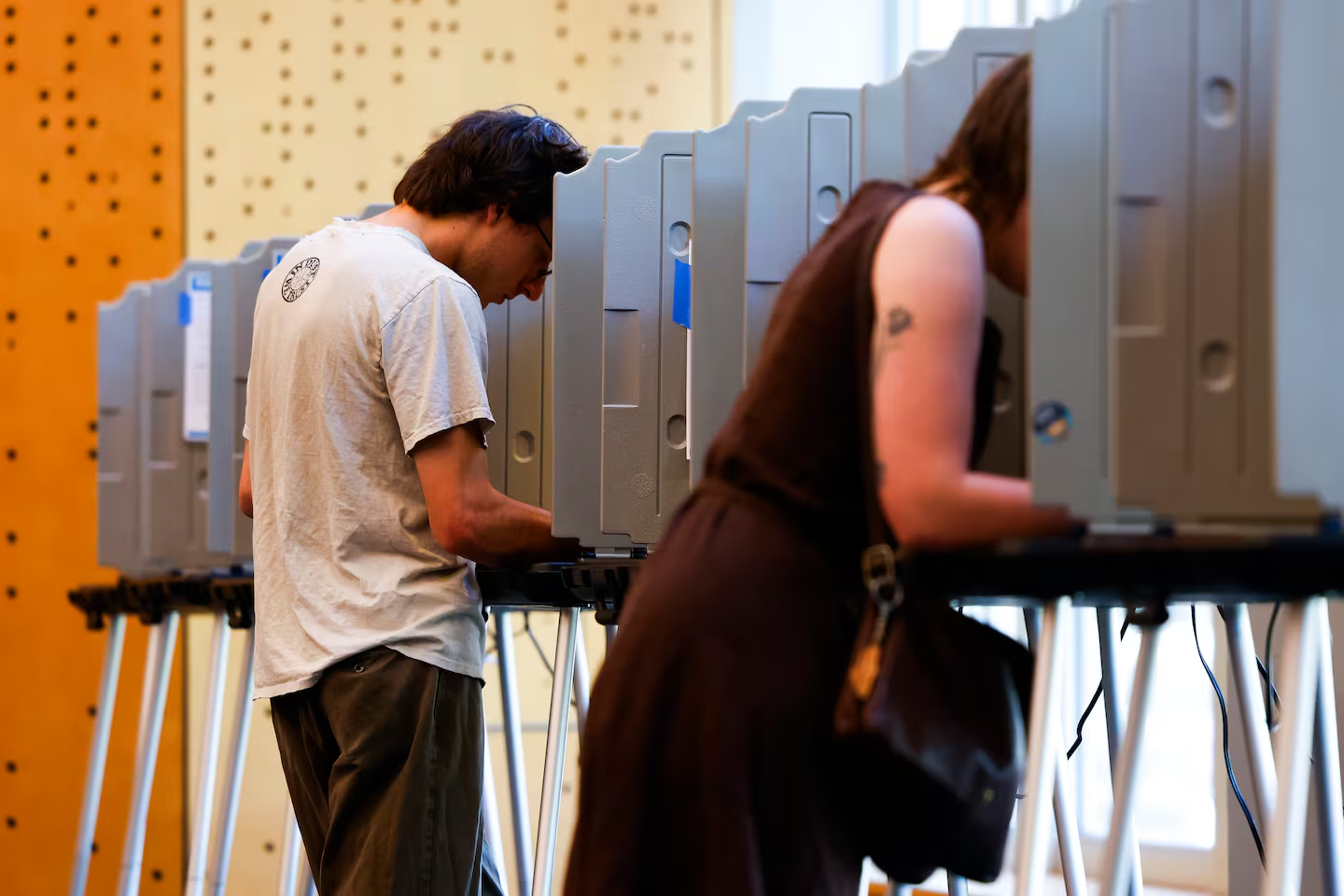
Voters in the 23 plaintiff states and the District of Columbia will vote in November under existing state procedures. In states that did not sue, the legal situation is murkier, and election officials there will have to determine how to proceed with an order that has been enjoined elsewhere but not in their jurisdictions.
That uneven landscape is itself likely to generate further disputes — which is generally what happens when national election policy is settled state by state through litigation rather than through legislation.
Author
-
Lucienne Albrecht is Luxe Chronicle’s wealth and lifestyle editor, celebrated for her elegant perspective on finance, legacy, and global luxury culture. With a flair for blending sophistication with insight, she brings a distinctly feminine voice to the world of high society and wealth.