The Nepal flash floods that tore through communities along the Chinese border have left hundreds unaccounted for and entire settlements buried under mud the color of wet cement. What triggered it was not an earthquake, as first reported, but a glacier giving way high in the mountains.
Rescue teams worked through Thursday across two countries, searching ground that in many places no longer resembles what was there two days ago.
The Numbers
Nepal’s National Disaster Risk Reduction and Management Authority reported 826 people missing and 165 confirmed dead as of Thursday. Operations concentrated on Nuwakot and Rasuwa, the districts that absorbed the worst of it.
Across the border, Chinese state broadcaster CCTV reported 558 missing in Tibet, including 260 foreign nationals. Two villagers had been rescued. At least three deaths were confirmed by Thursday morning.
Hikmat Singh Ayer, chief executive of Nepal’s Tourism Board, told CBS News that at least 33 Americans were among the missing foreigners.
What the Water Did
The flood destroyed villages, homes, roads, bridges, and power generation facilities.
Footage broadcast by regional outlets and shared on social media captured torrents ripping through valleys and mountain passes, taking bridges and dams with them and carrying buildings away.
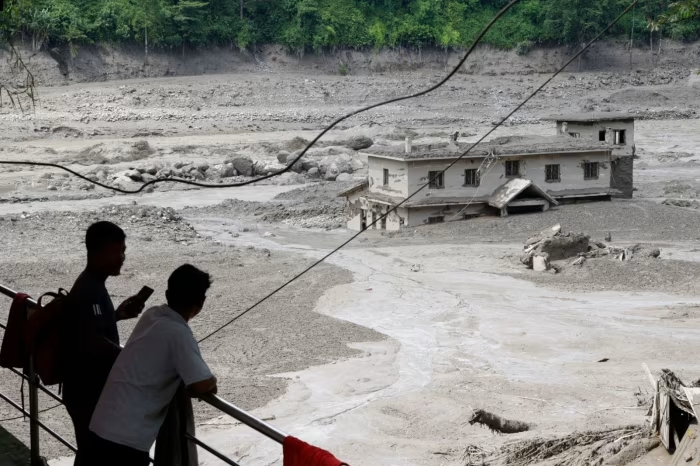
Drone imagery from Nepal showed roads erased and structures swallowed. In Nuwakot, the mud line reached second-story windows. Debris dangled from tree limbs and power lines. Vehicles disappeared beneath the sediment. Survivors emerged coated head to foot.
The geography made everything worse. These steep valleys serve as economic arteries and travel routes, but they funnel water with terrible efficiency when something upstream fails.
No Time to Move
Warning, where it existed at all, amounted to minutes.
Resident Shoyam Rajbhandari described arriving at Dhunge bazaar and watching the flood arrive within half an hour, wrecking the entire market. People were getting ready for work when it hit. He said nobody could account for how many were missing or killed.
The Rescue Effort
Army and private helicopters have been flying since early morning.
Nepalese army spokesperson Brigadier General Raja Ram Basnet said more than 100 people were pulled from flood zones by helicopter on Thursday. At least eight foreign nationals were flown to Kathmandu. Army teams also extracted people trapped in facilities connected to the Trishuli hydropower project.
Bodies have been recovered roughly 62 miles downstream in Chitwan district, an indication of how far the surge carried.
Dozens of injured people have been moved to Kathmandu for treatment unavailable locally.
Conditions on the Tibetan Side
A mudslide struck near Gyirong Port, the land border crossing, on Wednesday.
CCTV reported mud averaging more than five feet deep across surrounding areas, with some stretches of road buried under six feet or more. Every road leading to the port sustained damage and communications were severed.
Light rain has continued, raising the risk of additional collapses or landslides.
Rescuers also discovered a barrier lake forming in the direction of the port, an obstacle that complicates operations considerably and carries its own danger if it breaches. Chinese authorities dispatched a large military transport aircraft carrying a response team.
Nepali officials had earlier reported that hundreds of foreigners were unaccounted for, among them Indian pilgrims traveling to Mount Kailash in Tibet, a site sacred in Hinduism.
International Response
Secretary of State Marco Rubio posted a message of solidarity with the Nepali people, saying the State Department is prepared to provide humanitarian assistance to Nepal’s government.
The U.S. Embassy in Nepal offered condolences to families of those killed, said the situation is being closely monitored, and announced it is sending an adviser to the region along with a $500,000 grant to Catholic Relief Services.
The Dalai Lama issued a statement Thursday saying he was praying for the dead and extending sympathy to the bereaved and everyone affected.
It Was Never an Earthquake
The initial seismic reading pointed the wrong direction.
The U.S. Geological Survey first announced a magnitude 4.4 earthquake early Wednesday roughly 41 miles north of Kathmandu near the border. It later revised that finding, concluding the signal was actually a magnitude 5.2 glacial collapse that sent debris surging downstream.
The revision drew on data from nearby seismic stations, long period seismic waves, and satellite imagery. USGS concluded no earthquake had occurred at all.
Climate researchers at the Kathmandu-based International Centre for Integrated Mountain Development reached the same conclusion, attributing the flood to a glacial avalanche.
Their hydrological data underscores the violence involved. At one location on the Trishuli river, water levels climbed as much as 27 feet within thirty minutes. The Lhende Khola, a tributary feeding the Bhotekoshi, experienced the peak flooding.
A Pattern, Not an Accident
Saswata Sanyal, a disaster risk reduction specialist at the research center, pointed out that the Lhende Khola has now flooded twice within 14 months.
This time an ice and rock avalanche from a glacier on the Nepali side dammed the river, then released everything downstream at once.
He stressed the urgency of early warning systems in what he called a warming Himalaya.
The previous event came last August, when a glacial lake in Tibet overflowed during high temperatures. Nine people died and a bridge linking Nepal and China was damaged.
The Larger Threat
The Himalayan range holds many of the world’s highest peaks and a substantial share of its remaining glaciers. Steep slopes above densely settled valleys create conditions where instability upstream translates immediately into catastrophe below.
Intense monsoons and accelerating glacial melt have both become more frequent as the climate warms.
Research conducted in Kathmandu earlier this year found glaciers across the Hindu Kush Himalaya melting at rates that have doubled since 2000.
Hundreds of millions of people depend on these ice systems for water. What happened this week is a preview of what an unstable Himalaya delivers, and there is little indication the pattern will slow.
Author