The International Stabilization Force Gaza framework moved a step closer to reality on Sunday when Israel’s security cabinet approved the legal measures allowing the force to enter the territory — while attaching a condition that gives Israel considerable control over who actually shows up.
The ISF forms part of President Donald Trump’s 20-point peace plan. An Israeli official said the cabinet had signed off on the key legal groundwork and that the force would operate in full coordination with the Israeli military, according to the Times of Israel.
A Small Force With No Start Date
The scale being discussed is modest. Reuters reported the force will consist of around 200 personnel drawn from what were described as friendly countries, including Uganda and Morocco.
No timeframe has been announced for deployment.
The cabinet also determined that Israel will hold approval authority over which nations may contribute troops. That provision matters more than the headcount. It means the composition of an international force will be shaped by one of the parties to the conflict rather than by a neutral body.
Where It Will Operate
The ISF is to work in areas of Gaza that fall outside Israeli military control — a description that requires context to understand.
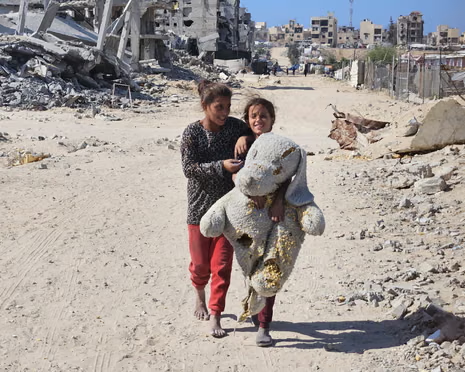
Israel currently occupies close to 70 percent of the Strip. Its population of nearly two million people has been compressed into a shrinking portion of the territory as Israel continues shifting the so-called Yellow Line, the boundary marking where it withdrew to under the first phase of the agreement.
That leaves the stabilization force operating in the remaining fraction, alongside a population under severe pressure.
Since the deal took effect, Israel has determined who may enter Gaza and how much aid and food is permitted through, following two years of war.
A Ceasefire That Keeps Producing Casualties
A ceasefire between Hamas and Israel was agreed in October. Reports of Palestinians being killed by the Israeli military have continued almost daily since.
According to the Palestinian Ministry of Health, 1,200 Palestinians have been killed since the agreement was implemented, with 3,888 wounded.
Those figures complicate the language surrounding the ISF’s mission. A force described as stabilizing is entering an environment where a formal ceasefire has coexisted with sustained casualties for months.
The Rest of the Plan
The stabilization force is one component of a broader architecture set out in Trump’s framework.
The plan calls for an international Board of Peace to supervise administration and reconstruction, and for the creation of a National Committee for the Administration of Gaza, a technocratic body intended to govern in the interim. It also requires Hamas to disarm and Israel to withdraw from the Strip.
Neither of those last two conditions has been fulfilled.
Nickolay Mladenov, director-general of the Gaza Board of Peace, welcomed the cabinet’s decision. The former Bulgarian foreign and defence minister described Israel’s move as a critical element of the agreed framework — one that supports stabilisation, advances demilitarisation, and enables a transition toward effective Palestinian transitional administration under the new committee.
His enthusiasm sits against a notable fact: the vast majority of Western countries declined to join the Board of Peace.
That reluctance reflects unease about participating in a governance structure for territory still under active occupation, and about lending legitimacy to arrangements whose ultimate political destination remains undefined.
Timing With Washington
The cabinet’s approval arrived one day before Netanyahu is scheduled to travel to Washington.
That sequencing is unlikely to be coincidental. Arriving with a concrete deliverable on a signature American initiative strengthens the Israeli prime minister’s position in discussions that will inevitably cover the pace of implementation and pressure over conditions in Gaza.
The Questions the Approval Leaves Open
Several practical issues remain unresolved, and they will determine whether the ISF becomes meaningful or symbolic.
Two hundred personnel is a small number for a territory of nearly two million people. What mandate they carry, what rules of engagement apply, and what they are actually empowered to do have not been detailed publicly.
Coordination with the Israeli military raises questions of independence. A force operating in full coordination with one party is unlikely to be perceived as neutral by the other.
The selection process is similarly consequential. Israeli approval over contributing countries means governments critical of Israeli conduct are unlikely to participate — which shapes both the force’s character and how Palestinians receive it.
And the sequencing problem persists. The plan envisions Hamas disarming and Israel withdrawing. Neither has happened, and a stabilization force entering before either condition is met inherits a situation the framework assumed would already be resolved.
What to Watch
The markers ahead are straightforward. Whether a deployment date is set. Which countries ultimately receive Israeli approval. Whether the Yellow Line continues moving. Whether daily casualties decline once the force is present.
And, underneath all of it, whether the transitional administration the plan describes ever acquires real authority, or whether Gaza’s governance remains an arrangement negotiated over the heads of the people living there.
Author
-
Lucienne Albrecht is Luxe Chronicle’s wealth and lifestyle editor, celebrated for her elegant perspective on finance, legacy, and global luxury culture. With a flair for blending sophistication with insight, she brings a distinctly feminine voice to the world of high society and wealth.