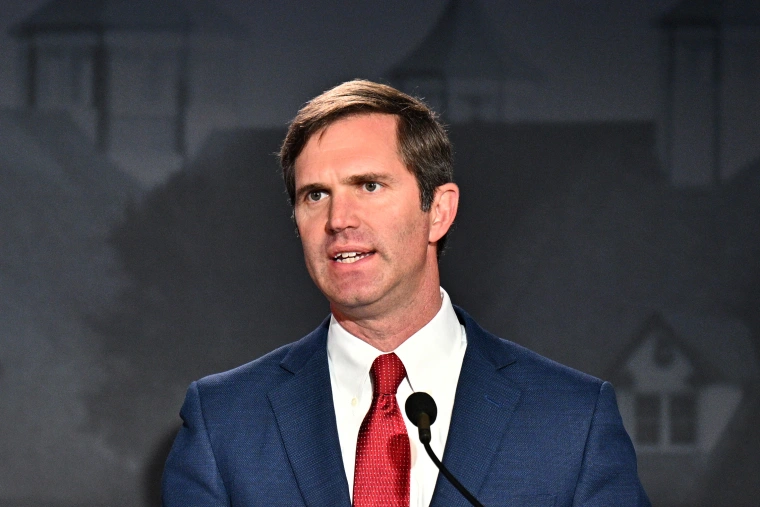
Beshear calls on McConnell to resign — or, at minimum, to stand in front of Kentuckians and demonstrate that he is still capable of doing the job. That ultimatum, delivered in a letter Tuesday, transformed a simmering question about a senator’s health into an open political confrontation between the two most recognizable figures in Kentucky politics.
Governor Andy Beshear, a Democrat frequently mentioned as a 2028 presidential prospect, wrote directly to Senator Mitch McConnell asking him to address the public verbally and provide evidence of his capacity to continue in office. The alternative he offered was blunt: step aside.
What Prompted the Letter
McConnell, 84, was hospitalized on June 14. Only weeks later did his office disclose that a fall was responsible.
On Monday, that office confirmed he had not been medically cleared to leave the rehabilitation facility where he has been receiving physical therapy. The statement also acknowledged that he would miss a significant Kentucky political gathering as well as upcoming votes in the Senate.
For Beshear, that was the tipping point. He had already asked in early July for more detail about the senator’s condition following weeks of public silence. Tuesday’s letter went considerably further, moving from a request for information to a demand for either proof or resignation.
Neither McConnell’s office nor the office of Senate Majority Leader John Thune offered comment on it.
A Second Letter to Senate Leadership
Beshear did not stop with McConnell. He sent a separate letter to Thune, urging the majority leader to look into the senator’s condition himself if McConnell does not publicly demonstrate that he remains able to serve.
That request puts Thune in an awkward position. The Senate has no established mechanism for evaluating whether a member is medically fit, and the chamber has historically treated such matters as private. Leadership rarely intervenes in a colleague’s health situation, in part because doing so would establish a precedent that could later be turned against anyone.
Beshear’s framing in that letter was pointed. He argued that the entire episode — the speculation, and even the need for his own letter — could have been avoided with a modest degree of openness.
A Senator Who Has Never Shared Much
McConnell led Senate Republicans for close to two decades and built a reputation for controlling information with unusual discipline. His personal life has always been the part of his career he guarded most closely.
That pattern has held during this hospitalization. Since mid-June, his office has issued substantial updates twice, on July 12 and again on July 27. Each came paired with a single photograph.
Two updates across six weeks is not nothing, but it leaves considerable room for interpretation. In the absence of the senator’s own voice — a recorded statement, an interview, an appearance of any kind — online speculation has expanded to fill the gap, which tends to be what happens when official channels go quiet.
Why This Is Landing Differently Now
A demand like Beshear’s would have been unusual a few years ago. It is far less so today, because the politics around aging officeholders have shifted sharply.
Senator Dianne Feinstein’s decline and death in office in 2023 prompted uncomfortable questions about who was actually performing her duties during her final months. President Joe Biden’s withdrawal from the 2024 race came after concerns about his age and health had become the dominant story of his campaign rather than a footnote to it. And this month, Senator Lindsey Graham died suddenly at 71, a reminder that these questions are not confined to the very oldest members.
Each episode has chipped away at the assumption that a lawmaker’s medical situation is nobody’s business but their own. Voters increasingly treat it as a governance question: if a seat exists to represent people, they want assurance that someone is occupying it in a meaningful sense.
The Political Calculation
It would be naive to read Beshear’s letter as purely procedural.
He is a Democratic governor in a state that votes overwhelmingly Republican, which makes him one of the more interesting figures in his party and a plausible national candidate. Publicly challenging Kentucky’s most powerful Republican carries obvious risk, but it also demonstrates a willingness to confront rather than accommodate — a quality Democratic primary voters have shown they value.
There is a practical dimension too. Kentucky law governs how Senate vacancies are filled, and any resignation would set off a process with real consequences for the balance of the chamber. Both parties understand that, which is why a question that sounds medical is being fought over as a political one.
For Republicans, the situation is genuinely difficult. Defending a colleague’s privacy is a defensible instinct, but doing so while he misses votes and public events invites exactly the criticism Beshear is making.
What Would Actually Settle It
The remedy Beshear proposes is not complicated. He is not asking for medical records or a physician’s testimony. He is asking McConnell to speak.
A brief video statement, a phone interview, an appearance at any public event — any of these would answer the central question more effectively than another written update accompanied by a photograph. That is the gap Beshear is exploiting, and it is one McConnell’s office could close quickly if the senator is well enough to do so.
Until then, the silence itself has become the story. And in Washington, silence rarely stays neutral for long.
Author
-
Lucienne Albrecht is Luxe Chronicle’s wealth and lifestyle editor, celebrated for her elegant perspective on finance, legacy, and global luxury culture. With a flair for blending sophistication with insight, she brings a distinctly feminine voice to the world of high society and wealth.