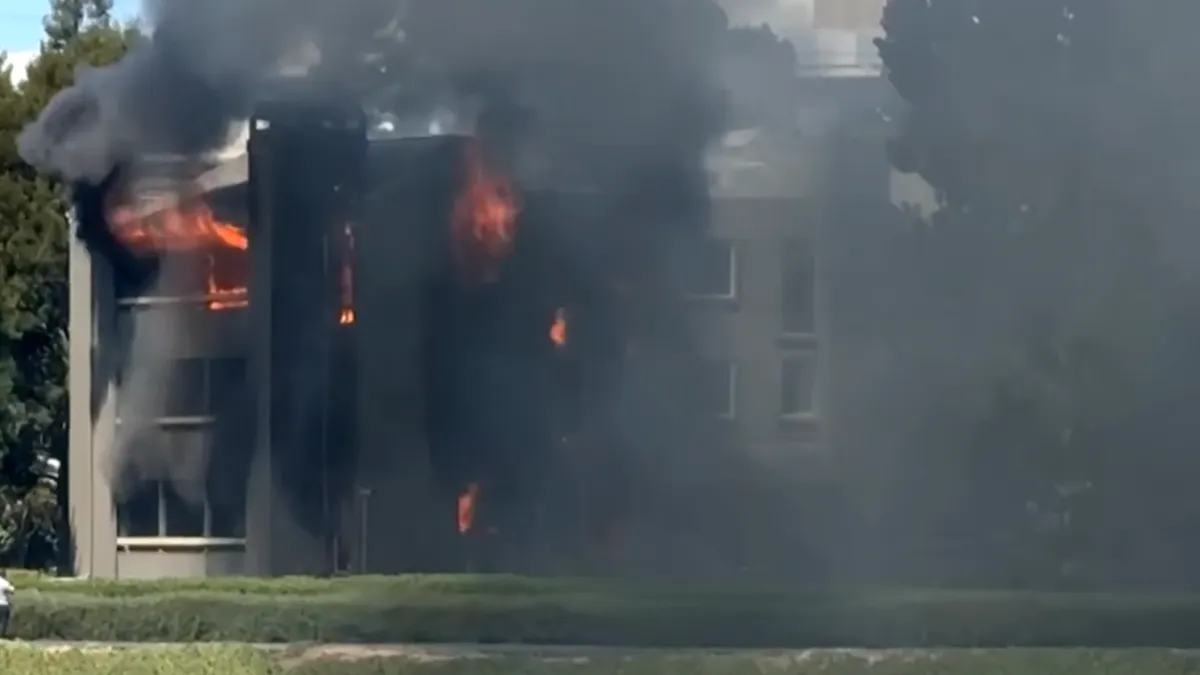
The Foster City fire that erupted Sunday afternoon escalated with unusual speed, climbing to a six-alarm response as San Mateo County crews fought flames that had already spread from the ground floor to the top of a condominium complex. Every resident got out safely, along with their pets, but four firefighters were injured and one made a mayday call after losing track of his partner inside the burning structure.
How the Afternoon Unfolded
The first report came in around 2:30 p.m. at 815 Sea Spray Lane.
What crews found was a difficult combination. Flames had taken hold on the first floor and were moving upward through the building. Wind and hot weather compounded the problem, feeding the fire and making conditions harder for the personnel working it.
Multiple ambulances and fire apparatus were dispatched as the incident grew. A six-alarm designation signals a major commitment of resources, drawing engines, ladder trucks, and personnel from across the region rather than relying on local stations alone.
Firefighters reported the fire started on the first floor and worked its way rapidly to the third.
Rescues From Third-Floor Windows
Evacuating the complex proved more complicated than simply clearing hallways. Some residents were reportedly rescued through third-floor windows, indicating that interior escape routes had become impassable in at least parts of the building.
Despite that, authorities confirmed no residents were injured. Everyone living in the complex was accounted for, and pets were brought out as well.
That outcome deserves recognition. A fire that climbs three floors in a multi-unit residential building on a Sunday afternoon, when many people are home, carries substantial potential for casualties.
Injuries Among the Crews
Four firefighters sustained injuries during operations, all described by police as minor.
The breakdown reported by authorities:
- One firefighter suffered burns
- Two experienced smoke inhalation
- Two of the injured were transported to a local hospital for treatment
The most alarming moment came when a firefighter working inside the structure called a mayday after losing visual contact with his partner. In fire service terminology, a mayday is the highest-priority distress call, triggering an immediate shift in operational focus toward locating and extracting the affected personnel.
Authorities said the firefighter was safely evacuated.
Why Mayday Calls Matter
For anyone unfamiliar with fireground operations, the significance of that call is easy to underestimate.
Interior conditions during a working structure fire can reduce visibility to nothing. Smoke fills spaces completely, and crews operate in pairs precisely because separation in those conditions becomes dangerous almost instantly. Losing a partner means losing orientation, and orientation is what allows a firefighter to find the way out.
Departments train rapid intervention teams specifically for these scenarios, held in reserve to enter and retrieve personnel in trouble. That the situation resolved with the firefighter safely out reflects both training and a degree of good fortune.
Smoke Visible Across the Bay
The scale of the fire was apparent well beyond Foster City. Smoke from the blaze could be seen as far away as Oakland, across the bay.
The Foster City Police Department issued an advisory for residents in the surrounding area, instructing them to keep windows and doors shut against the thick, heavy smoke lingering nearby. Everyone else was asked to stay away from the area entirely, both for their own safety and to keep access routes clear for emergency vehicles.
Smoke advisories after fires of this size are not merely precautionary. Combustion products from burning building materials, furnishings, and insulation carry genuine respiratory risk, particularly for children, older residents, and anyone with existing conditions.
The Long Tail of a Major Fire
Officials indicated operations would continue for several hours after the initial knockdown. That reflects standard practice at large structure fires, where the visible flames represent only one phase of the work.
Crews must locate and extinguish hidden fire spreading through wall cavities, attic spaces, and floor assemblies. Hot spots can smoulder for hours and reignite if left unaddressed. Overhaul work of this kind is unglamorous but essential.
The cause remains under investigation, which is expected at this stage. Fire investigators typically cannot begin detailed examination until the scene has cooled and been made structurally safe.
What Comes Next for Residents
For the people who lived at Sea Spray Lane, Sunday’s outcome was simultaneously the best possible and deeply disruptive.
Nobody was hurt, which is the outcome that matters most. But a condominium complex damaged across three floors is unlikely to be habitable in the near term. Displaced residents will be navigating temporary accommodation, insurance claims, and uncertainty about when or whether they can return.
Multi-unit buildings complicate that picture further. Damage to shared systems and structural elements can affect units that never saw flame, and repair decisions often involve homeowners associations rather than individual owners acting alone.
The Bigger Takeaway
A six-alarm fire in a residential complex, with rescues through upper-storey windows and a mayday called inside, could easily have ended differently.
That it did not comes down to a fast escalation of resources, crews willing to enter a building that was actively spreading fire upward, and residents who got out when told to. Four firefighters paid for that outcome with injuries. All of them are expected to be fine.
Author
-
Lucienne Albrecht is Luxe Chronicle’s wealth and lifestyle editor, celebrated for her elegant perspective on finance, legacy, and global luxury culture. With a flair for blending sophistication with insight, she brings a distinctly feminine voice to the world of high society and wealth.