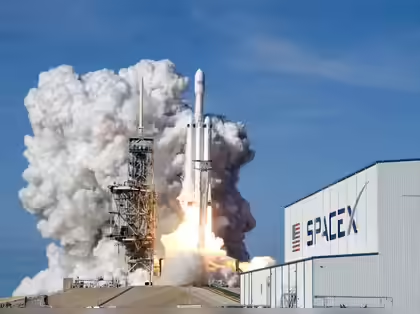
SpaceX AI spending has become the dominant story in the company’s first quarterly report as a public company, overshadowing revenue figures that actually beat what analysts had projected.
The numbers behind that concern are substantial. Capital expenditures tied to the xAI unit, which operates the Grok service, reached $15.8 billion for the quarter. Analysts had expected roughly $13.09 billion, according to Bloomberg News data.
That figure represents approximately double the previous quarter’s AI spending, and it accounted for the majority of SpaceX’s total $18.4 billion in quarterly capital expenditures.
The Market Reaction Was Immediate
Shares had climbed 9% during regular trading Tuesday ahead of the report. That advance evaporated once the numbers landed.
The stock fell more than 10% before Wednesday’s market open, reversing the entire pre-earnings run and then some.
For a rocket company, the scale of AI infrastructure investment has become difficult for investors to reconcile with the core business, particularly when the spending is accelerating rather than stabilising.
Where the Revenue Came From
The revenue picture itself was not the problem.
SpaceX exceeded analyst expectations, with most of the top line generated by Starlink, its satellite connectivity offering.
That performance had consequences beyond SpaceX’s own share price. Strong Starlink results pushed down shares of major wireless carriers including AT&T and Verizon, along with Viasat, which now faces direct competition from SpaceX in providing in-flight connectivity to airlines.
A separate announcement Tuesday, detailing a partnership with Nvidia on a future satellite project, gave the stock a temporary lift while simultaneously knocking shares of other datacenter infrastructure providers such as AMD.
A Turbulent Debut
SpaceX has covered enormous ground in a short period.
The company became a multitrillion-dollar entity almost immediately following a record-setting IPO on June 12. It then shed roughly $1 trillion in value nearly as quickly, as markets absorbed anticipation of insider selling alongside broader unease about AI spending across the sector.
Even after that decline, the valuation remains above $1 trillion, keeping SpaceX among the most valuable companies in the world.
The Lockup Expiration
A structural factor is now compounding the pressure.
The overwhelming majority of SpaceX stock remains privately held. Only about 5% of the company’s 13.9 billion shares trade on the open market.
Musk holds roughly 42%. Remaining shareholders are classified as insiders by regulators and have been prohibited from selling until now.
That restriction, known as a lockup period, expires Wednesday. Up to 20% of insider-held shares become eligible for sale on the open market.
The mechanics are straightforward. More available shares means greater supply, and greater supply against unchanged demand typically pushes prices down further.
Merger Speculation Grows
Investor chatter about a potential merger between SpaceX and Tesla has intensified.
Such a combination would consolidate Musk’s control across his technology holdings even further than his current position allows, and would create a single entity spanning launch services, satellite internet, electric vehicles, and artificial intelligence.
Nothing has been announced, and the speculation currently rests on investor conversation rather than company statements.
Not Everyone Is Selling
Retail sentiment has not tracked institutional concern uniformly.
Forde Todd, 20, received three shares through the IPO allocation and has since bought and sold additional shares on the open market. He told NBC News he intends to keep his original IPO shares despite the decline.
His reasoning was less about valuation models than conviction. He described being in it for the love of the game and said he genuinely believes in the company.
He added a broader thesis about the sector, arguing that eventually everyone will want exposure to the space economy.
What Investors Are Actually Weighing
The tension in this stock is reasonably clear once the pieces are laid out.
On one side sits a proven revenue engine in Starlink, a dominant launch business, and a partnership with Nvidia signalling continued expansion.
On the other sits AI capital expenditure that doubled in a single quarter, exceeded expectations by nearly $3 billion, and consumed most of the company’s total capex.
Investors are essentially being asked to accept enormous near-term spending on the promise of returns that have not yet materialised, at the same moment that supply of shares is about to increase substantially.
Whether that combination represents a buying opportunity or a warning depends heavily on how much patience an investor brings, and how much they believe the xAI investment will eventually justify its cost.
Author
-
Lucienne Albrecht is Luxe Chronicle’s wealth and lifestyle editor, celebrated for her elegant perspective on finance, legacy, and global luxury culture. With a flair for blending sophistication with insight, she brings a distinctly feminine voice to the world of high society and wealth.