An Indonesia earthquake emergency birth unfolded in a shaking hospital room last week, as surgeons worked by flashlight to deliver a premature baby while a 7.7-magnitude quake tore through East Nusa Tenggara province.
Maria Florida Nogo Kelen, 39, was undergoing emergency surgery in Nagekeo — close to the epicentre — when the ground began breaking apart homes, buildings and bridges around her. She delivered her fourth child amid the tremors, fighting both the shaking and her own deteriorating condition.
“During the surgery, I was not afraid,” she said afterward. She had to stay healthy for her children.
Why the Operation Could Not Wait
The delivery came two months early. A complicated pregnancy had created serious risks for both mother and baby, and her doctors said Maria could have suffered a fatal seizure if the birth were delayed.
Power failed intermittently as the surgery proceeded. Staff resorted to flashlights while the building continued to move.
Obstetrician Yona Sara Pardede described a team with no alternatives available to it. As humans, she said, they were afraid. The procedure was difficult because the baby was so small. She recalled asking God for help, noting that the facility did not even have a ventilator.
That last detail says a great deal about the conditions. A 1.3-kilogram infant delivered at roughly 32 weeks would normally receive respiratory support as a matter of course.
A Baby Named for the Moment
The girl was born weighing 1.3 kilograms — about 2.87 pounds — during aftershocks. Her parents named her Gempita.
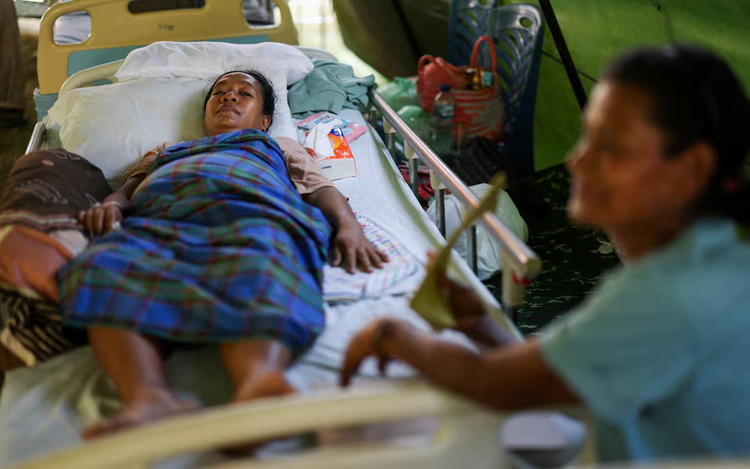
She has remained stable in an incubator, though not in any neonatal unit. The incubator sits on a patch of grass inside a tent outdoors in Nagekeo, under direct sun.
Maria herself suffered a haemorrhage following the birth. She said she was grateful simply to be alive, and grateful to the doctors who stayed with her.
Even after the room had collapsed, she said, they did not abandon her and her daughter.
The Scale of the Disaster
Saturday’s earthquake is Indonesia’s deadliest since a 2022 quake killed hundreds in West Java. The toll across East Nusa Tenggara stands at 54 dead.
The damage extended to the medical system itself. Hundreds of hospitals and homes were affected, forcing healthcare workers across the province to treat the injured in tents outside rather than in the buildings meant to house them.
Rescue teams searched the area Monday for people believed trapped beneath rubble, while authorities delivered aid by aircraft.
Life in the Evacuation Camps
Residents are sheltering in tents rather than returning to their houses. Several described urgent needs for clean water and food.
The reluctance to go home is not primarily about structural damage. Most people are simply afraid of aftershocks — a fear that is entirely rational following a quake of this magnitude, as significant secondary tremors can continue for days or weeks.
That fear creates its own crisis. Populations living outdoors face compounding problems:
- Limited access to safe drinking water
- Exposure to heat and weather without adequate shelter
- Sanitation conditions that raise disease risk quickly
- Disrupted supply of medication for chronic conditions
- Newborns and elderly residents in environments unsuited to either
Gempita’s incubator on the grass illustrates the situation precisely. The equipment functions. The setting is one no clinician would choose.
Medicine Without Infrastructure
What happened in that operating room reflects a pattern common to disaster medicine. Clinical decisions get made against conditions rather than within them.
The surgical team faced a patient who could not safely wait, a building actively moving, unreliable electricity and equipment they did not have. They proceeded anyway, because the alternative carried a higher probability of death.
Pardede’s remark about the missing ventilator was not a complaint about resources so much as a statement of what was at stake. Delivering a severely premature infant without respiratory support available is a decision made only when the other option is worse.
What Comes Next
Search operations continue for those still unaccounted for. Aid deliveries by air are ongoing, and the immediate needs in the camps — water, food, shelter — remain unmet for many families.
The longer recovery will involve assessing damaged hospitals, restoring power infrastructure and rebuilding housing in a region that will remain seismically active regardless of what gets constructed.
For one family in Nagekeo, though, the accounting is simpler. A mother who nearly died is alive. A daughter born two months early and weighing less than three pounds is stable. And a medical team that had every reason to run stayed in a collapsing room until the work was finished.
Author
-
Lucienne Albrecht is Luxe Chronicle’s wealth and lifestyle editor, celebrated for her elegant perspective on finance, legacy, and global luxury culture. With a flair for blending sophistication with insight, she brings a distinctly feminine voice to the world of high society and wealth.