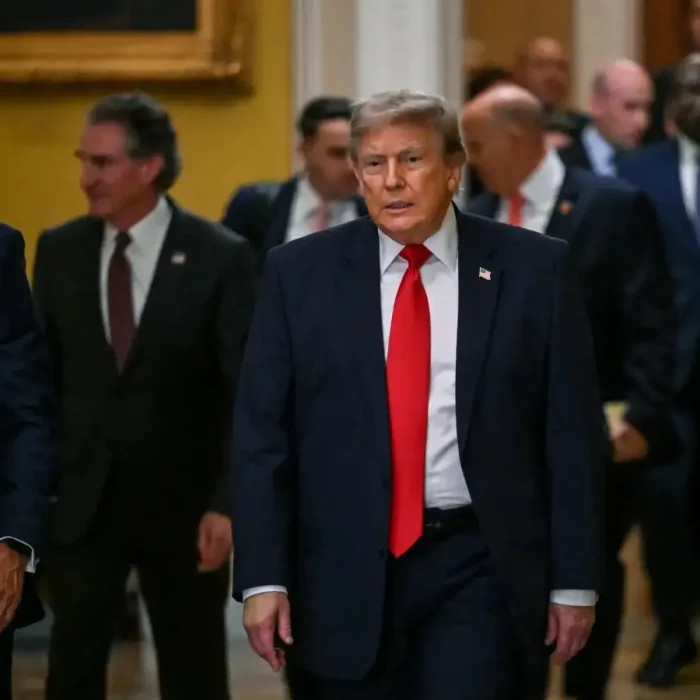
A reported munitions shortage has become one of the most contested stories in Washington, with President Donald Trump publicly rejecting the claim, threatening prison for those who disclosed it, and multiple news organizations standing by reporting that American weapons inventories have been drawn down sharply by the war with Iran.
Trump laid out his position on Truth Social. He asserted the United States possesses massive quantities of munitions, particularly of certain types, and that large amounts are being manufactured and delivered as needed. He then went further, declaring that those who leaked what he called treasonous statements are being hunted down and that long prison sentences will be pursued.
What the Reporting Actually Says
The denial followed a cluster of reports published this week.
Reuters, citing unnamed sources, reported Tuesday that the U.S. Army has expended virtually its entire global stockpile of long-range precision missiles. Those weapons matter beyond American operations. Ukraine has relied on the same class of munitions for strikes inside Russia, meaning depletion has allied consequences as well.
The operational significance is direct. Long-range missiles allow targets to be struck from beyond the reach of enemy air defenses. Without them, according to Reuters, Trump has been forced to consider using piloted aircraft to deliver bombs instead, an option that places crews at substantially greater risk.
The Camp David Confrontation
The Washington Post reported Thursday that Trump accused Defense Secretary Pete Hegseth of misleading him about shortages of both long-range missiles and missile interceptors during a meeting at Camp David last week, citing two people familiar with the discussion.
According to that account, Hegseth did not dispute the shortage. He reportedly attributed the problem to his deputy, Stephen Feinberg, and faulted him for leaving the president uninformed.
The administration rejected the story completely. White House press secretary Karoline Leavitt called the exchange entirely fabricated, saying it literally never happened and that the president retains full confidence in Hegseth.
Pentagon spokesperson Sean Parnell issued a broader denial, stating that Hegseth did not mislead anyone about munitions posture and did not blame Feinberg. He described the claims regarding depleted stockpiles, internal disagreements and the secretary’s position on Iran as equally fictional.
That last phrase is notable. The denial extends past the meeting to the underlying inventory question itself.
The Numbers Being Reported
The specificity of the figures is part of why the story has proven difficult to dismiss.
Reuters, citing a source, reported that roughly half the global supply of Tomahawk cruise missiles has been expended since the war began.
A July analysis from the Center for Strategic and International Studies found that between February and July, approximately 65 percent of Patriot ballistic missile interceptors and 38 percent of THAAD interceptors were used.
The Washington Post previously reported that more than 1,300 Army tactical ballistic missiles were fired in the opening weeks of fighting, more than 850 Tomahawks during the first month, and over 1,000 Patriot and THAAD interceptors.
Why Replacement Is Slow
Understanding why these numbers alarm defense analysts requires understanding production reality.
Advanced interceptors and precision missiles are not manufactured on scalable commercial timelines. Production depends on specialized components, a small number of qualified suppliers, and lead times measured in years. Surging output is not simply a matter of authorizing money.
Interceptors present a particularly difficult economic problem. Defending against incoming fire often means expending an expensive, hard-to-replace interceptor against a comparatively cheap threat. That exchange ratio favors the attacker in any prolonged exchange.
This is why the reported percentages carry weight regardless of absolute inventory size. A stockpile that took a decade to build can be consumed in months of sustained operations.
The Pattern of Reversals
The shortage reporting arrives against a backdrop of shifting presidential decisions on Iran.
Over the weekend, Trump pulled back from threats to launch major attacks, continuing a pattern that has recurred throughout the conflict. He had repeatedly indicated in recent weeks that he was weighing strikes on major energy targets, framed as retaliation for attacks on U.S. bases in the Middle East and Iran’s continued control over the Strait of Hormuz.
Trump said he canceled the most recent planned strikes because of progress toward an agreement to end the war. Multiple outlets reported the reversal followed a call in which Saudi Crown Prince Mohammed bin Salman urged him to avoid further escalation.
Diplomatic movement continues. Iranian state news agency IRNA reported Thursday that Iran is close to an agreement with Oman to reopen the Strait of Hormuz. Trump told reporters Wednesday that an announcement could come within a day or two, saying substantial progress had been made.
Two Explanations, One Set of Facts
The competing narratives can be summarized cleanly.
In one version, inventories are genuinely strained, that constraint is influencing whether the president authorizes further strikes, and officials disclosed it because they consider the situation serious.
In the other version, the reporting is false, the stockpiles are adequate, and the restraint on Iran reflects diplomacy rather than logistics.
The threat to prosecute leakers sits awkwardly between them. Pursuing people for disclosing information is a response that implicitly acknowledges something was disclosed.
What Would Settle It
Rhetoric will not resolve this. A few concrete developments would.
Whether congressional committees with oversight authority request classified briefings on interceptor and precision munition inventories. Whether the next budget or supplemental request prioritizes munitions replenishment at unusual scale. Whether additional outlets independently confirm the CSIS figures. And whether production contracts are accelerated in ways that become publicly visible.
Budget documents are harder to spin than press statements. If replenishment funding surges in the coming months, that will answer the question more definitively than anything said from a podium.
Author