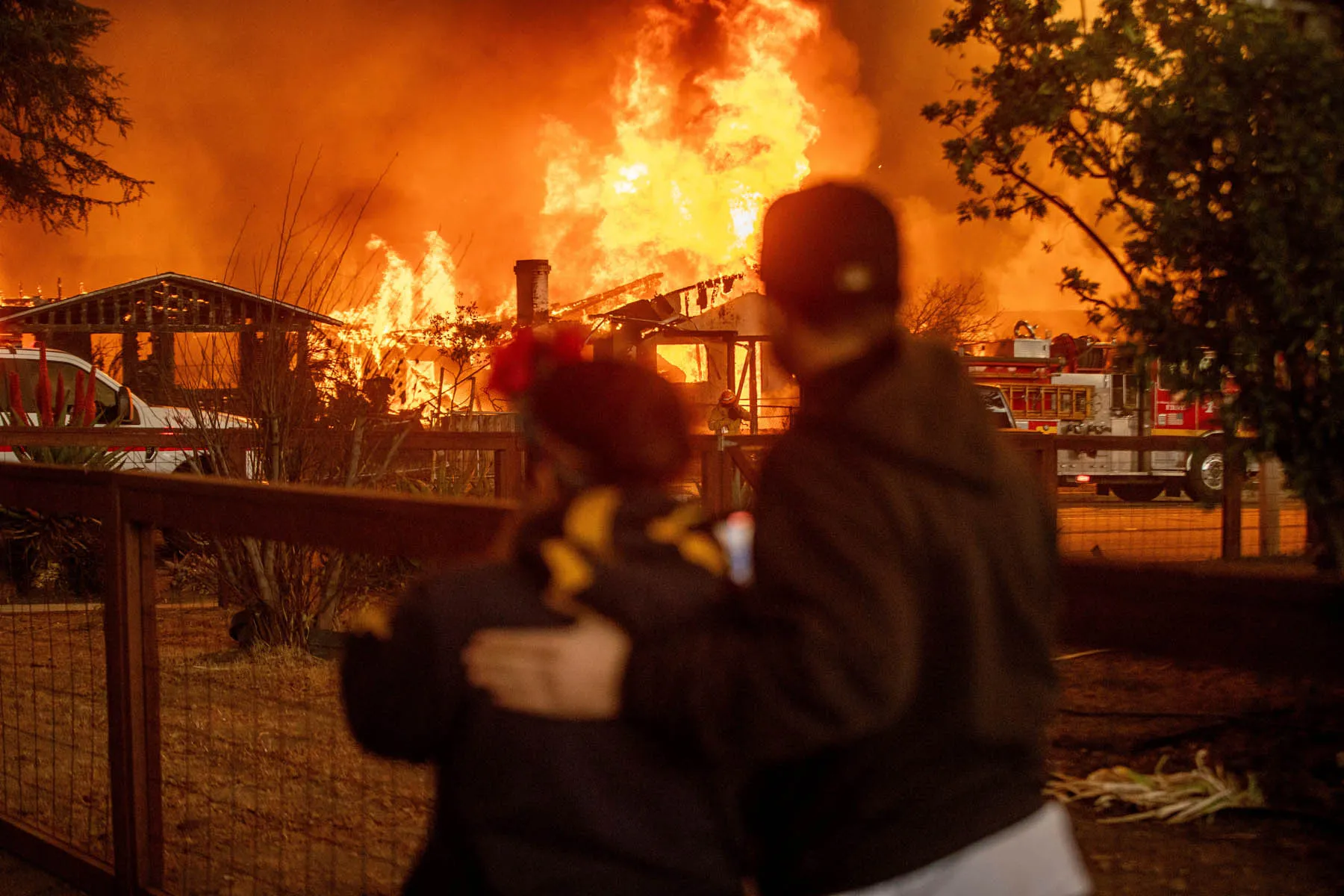
A wildfire arson investigation that now centers on a suspect with a violent criminal past began with something far more ordinary: a grandfather noticing that a stranger was standing somewhere strangers never stand.
Paul Child was driving his grandson to pick up a friend Saturday when he spotted a bald man near the railroad tracks along West Euclid Road, looking into the tree line. At that moment, he thought little of it.
The Second Pass Changed Everything
About ten minutes later, Child drove the same stretch again. The man had not moved on.
This time the posture was different. Child said the man appeared bent over, doing something in the brush, grass and trees. When he noticed the truck, he straightened up and began acting nervous.
The reaction registered with his grandson too, who asked aloud what the man was doing.
Minutes after the family returned home, Child’s daughter, Ana Dillon, looked toward the same section of track and saw a massive cloud of white smoke, followed by black.
Child’s reaction was immediate and unprintable in polite terms. He was certain the man he had just seen had started the fire.
A Frantic Half Hour
Child called 911 and then tried to reach the only other homeowner on the dead-end road. The neighbor was away but answered by phone, and Child warned him that fire was moving toward his property where workers were inside a shop behind the house. The family drove down to tell them in person to leave.
By then flames were spreading through dry grassland and firefighters were arriving. Dillon described packing everything and everyone, including animals, as the fire advanced.
They evacuated their nearly 17-acre property with five dogs and two cats.
Child flagged down an Airway Heights police officer and gave a description recorded in court documents: a bald white male in a green T-shirt carrying a backpack. He also told officers exactly where the man had been positioned before smoke appeared.
Spokane County deputies located and detained someone matching that description shortly afterward.
The Identification
Child, his grandson and the grandson’s friend rode with an Airway Heights officer to where deputies were holding the man.
From inside Child’s pickup, roughly 50 yards away, the three watched deputies bring the man out of a patrol vehicle and turn him toward them.
Child acknowledged the limits of what he could actually confirm, saying build and clothing were the identifiable features. But he described no hesitation among the three of them that this was the person they had seen.
Authorities later arrested Aaron F. Farinacci on suspicion of first-degree arson in connection with the Old Trails Fire, the largest of three blazes that destroyed hundreds of structures and forced roughly 67,000 people to evacuate.
Relief Turned to Unease
The family learned the next day that deputies had initially released Farinacci before rearresting him once investigators developed further evidence.
Court records reviewed by Fox News Digital show Farinacci was charged with first-degree murder after fatally shooting his father during an argument in Arizona in 2010. He later pleaded guilty to reduced charges of manslaughter and aggravated assault, served roughly eight years and was released in 2020.
That history reframed the entire experience for Child. The man knew where he lived, he said, and learning about the prior case left him thinking about the possibility of a return visit.
Why the Man Stood Out at All
The reason any of this happened is geographic. The county permanently closed the dead-end stretch of road several years ago, leaving only two homes past the barricade.
Child said trespassing has been rare since. When the family does see someone, they typically drive up and ask if the person is all right, and nine times out of ten that ends the encounter.
Dillon put it more directly. With only two houses on the street and the road officially closed, anyone present is unusual enough that the family almost always calls Crime Check. Someone standing or kneeling near the train tracks who is not a city worker, she said, is an immediate warning sign.
Why Arson Cases Are So Hard to Prove
Retired Bureau of Alcohol, Tobacco, Firearms and Explosives executive Scott Sweetow said witness accounts like Child’s are a starting point rather than a conclusion.
The sequence matters. Investigators must first establish where a fire began before they can determine how. That means working backward from the aftermath, reading how terrain and vegetation burned, and systematically eliminating plausible accidental explanations.
Sweetow described arson generally as extremely difficult to investigate, requiring a meticulous and focused effort not demanded by most other cases. The core complication is that the evidence itself is usually damaged by the very fire under examination.
Investigators reconstruct the earliest moments using witness statements, video, cellphone data, first-responder observations and physical evidence. They also work through potential causes including lightning, power infrastructure, trains, discarded smoking materials and other ignition sources.
That elimination process can support a conclusion that a person started a fire even without a single item that definitively proves ignition.
Sweetow also addressed the initial release, saying it did not strike him as unusual. In a fast-moving emergency where deputies were managing evacuations and investigators had not finished their work, building the case first reflects sound police procedure rather than error.
What Investigators Concluded
Court records show fire investigators eventually determined the blaze originated at the location Child described.
They ruled out trains and nearby electrical infrastructure. Their finding was that the fire was consistent with dry grass ignited by an open flame from a match or lighter.
That conclusion aligns the physical evidence with the eyewitness account, which is precisely the kind of convergence these cases depend on. As Sweetow noted, wildfire arson prosecutions typically rest on the accumulated weight of many facts rather than one decisive discovery.
For Child and his family, the outcome came with mixed feelings. Their attention likely saved a neighbor’s property and helped investigators identify a suspect within hours. It also placed them, briefly and unknowingly, in close proximity to someone with a history they knew nothing about.
Author