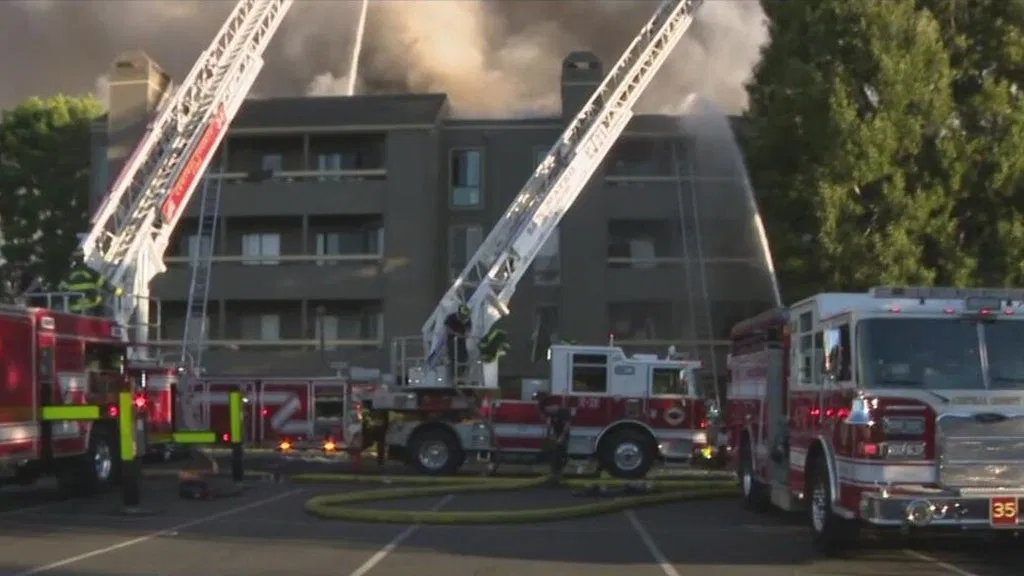
Police have arrested a man in connection with the six-alarm Foster City fire that injured firefighters and displaced more than 50 families on Sunday, alleging he left a propane barbecue unattended on his first-floor patio.
Authorities have not released his name because he has not yet made a court appearance. He faces an additional charge of obstructing a police investigation, though officials have not disclosed details of that allegation.
Returning to What Was Left
Residents of the Sea Spray Lane complex were allowed back Thursday to survey the damage. What they found was extensive.
Entire units were gutted. Sections of the building were charred and walls had been blown out. Personal belongings, including children’s school supplies, were scattered across the property.
The entire building has been red-tagged, with city crews posting signs prohibiting entry due to hazardous conditions. Emergency crews have warned that a total collapse remains possible, and barriers are in place to keep people at a safe distance.
A Rumor That Circulated From Day One
Alfred Tolentino, who lives in a building across the street from the one that burned, said speculation about the cause had spread almost immediately.
He described hearing the rumor from the first day and called it upsetting, adding that he hopes other tenants will now be careful about anything involving fire outdoors.
Tolentino provided a photograph of a propane barbecue taken after the fire, though it has not been confirmed whether that grill was the source of the blaze. He said gas grills are not permitted at the complex.
What the Fire Code Actually Says
The rules here are not ambiguous, and they exist for exactly this scenario.
The California Fire Code prohibits operating open-flame cooking devices on combustible balconies or within 10 feet of combustible construction, unless the structure is protected by a sprinkler system.
The complex did not have one.
That combination, a propane grill near combustible construction in a building without sprinkler protection, describes precisely the risk the code was written to prevent. Multifamily wood-frame buildings can spread fire vertically and horizontally with remarkable speed once flames reach exterior siding or reach into a wall cavity.
The Damage Extended Beyond the Flames
Fire suppression itself caused significant secondary damage across the property.
Tolentino said his garage flooded, describing six to seven inches of water carrying debris from the burning building. Among what washed in were graduation photographs and personal items, a detail he found particularly disturbing.
That kind of water damage is common in large residential fires and often affects units that never burned. Firefighting a six-alarm structure fire requires enormous volumes of water, and it goes where gravity takes it.
Where Displaced Residents Stand
More than 50 families lost their homes, and the Red Cross has been assisting those displaced.
With the building red-tagged and structurally unsafe, residents cannot retrieve belongings from the affected structure. Recovery for people in that position typically stretches across months, involving temporary housing, insurance claims and, for renters without coverage, substantial uncompensated loss.
The Obstruction Charge
The additional charge of obstructing a police investigation is notable, and officials have said nothing about what it involves.
In fire cases, obstruction allegations can arise from a range of conduct, including providing false statements to investigators or interfering with evidence at a scene. Without detail from authorities, the specifics remain unknown.
What is clear is that the charge is separate from the underlying allegation about the barbecue, and it suggests investigators encountered something beyond the initial cause determination.
The Broader Lesson
Cases like this tend to prompt the same realization among apartment residents everywhere: the rules about balcony grilling are not arbitrary property management preferences.
They exist because a single unattended flame in a densely occupied wood-frame building can produce exactly this outcome. Injured firefighters. Dozens of families without homes. A structure so compromised it may collapse.
For anyone living in similar housing, the practical takeaways are straightforward. Know whether your building permits any open-flame cooking outdoors and where. Understand whether your building has sprinklers. And recognize that renters insurance, which many people skip, is what separates a difficult few months from financial catastrophe when something like this happens.
The investigation continues, and the suspect is expected to appear in court.
Author
-
Lucienne Albrecht is Luxe Chronicle’s wealth and lifestyle editor, celebrated for her elegant perspective on finance, legacy, and global luxury culture. With a flair for blending sophistication with insight, she brings a distinctly feminine voice to the world of high society and wealth.