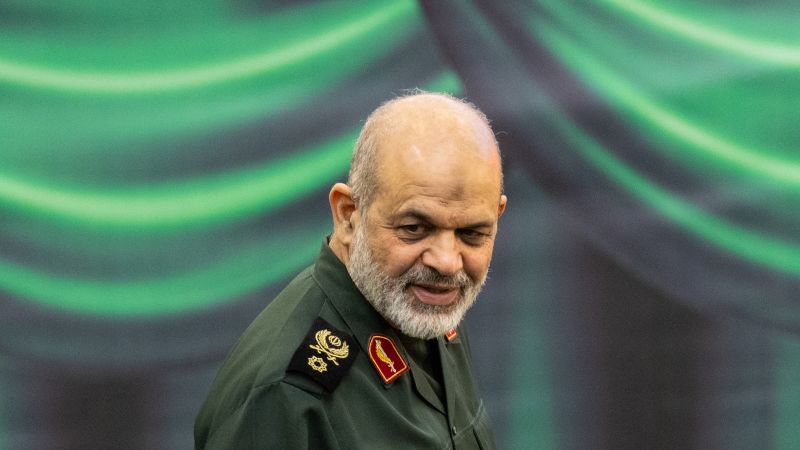
Iran has appointed Mohsen Rezaei, the longtime former commander-in-chief of the Islamic Revolutionary Guard Corps, to lead its highest national security body. The announcement came Sunday from the Iranian presidency.
The Mohsen Rezaei security council appointment is notable for reasons beyond the usual reshuffle politics. Rezaei, 71, has been the subject of an international arrest warrant for two decades over his alleged role in the 1994 bombing of the AMIA Jewish community center in Buenos Aires, one of the deadliest antisemitic attacks in modern history.
A Council Reeling From Losses
Rezaei is the second person selected to head the Supreme National Security Council since Israel assassinated Ali Larijani in mid-March, only weeks into the US-Israeli war with Iran.
When Israel’s military announced Larijani’s killing, it described him as Iran’s de facto leader following the death of former supreme leader Ali Khamenei on the war’s opening day.
The current supreme leader, Khamenei’s son Mojtaba, was wounded in that same strike and has not appeared publicly since.
The council functions somewhat like a politburo, containing a spread of political positions and internal rivalries. It is now working through the loss of multiple senior figures.
Rezaei replaces Mohammad Bagher Zolghadr, who moves into a role as political adviser to Khamenei. Presidency spokesman Mehdi Tabatabaei announced on X that following Zolghadr’s resignation and reassignment, President Masoud Pezeshkian had named Rezaei to lead the body.
Hard Lines on Hormuz
Rezaei arrives with recent public positions that signal little appetite for compromise.
Earlier this month he stated that Iran will never permit an unauthorized route through the Strait of Hormuz. The waterway was treated as international and served as a primary artery for global oil supply before Tehran began obstructing it at the war’s outset.
In July he went further, describing control of the Strait as more important than dozens of atomic bombs, a pointed reference to the nuclear program that sits at the center of the conflict.
Those statements matter more now that he holds the security portfolio rather than an advisory one.
The AMIA Case
Rezaei commanded the IRGC from 1981 to 1997, a period covering nearly the entire Iran-Iraq war, before moving into a series of senior political roles. Most recently he served as military adviser to the younger Khamenei.
It was during his IRGC tenure, according to Argentine authorities, that he was involved in the AMIA attack. An Argentine court ruling determined the bombing was carried out by Hezbollah operatives with Iranian funding. Eighty-five people were killed and hundreds injured.
Alberto Nisman, the lead investigator into the bombing who was himself murdered in 2015, concluded that the decision to proceed was made at a meeting in Mashhad on August 14, 1993, convened by what he identified as the Iranian leadership’s Committee for Special Operations.
His 2006 indictment named Ayatollah Ali Khamenei as head of that council and stated that the final decision to strike the AMIA center was made by Khamenei together with then-president Ali Akbar Hashemi Rafsanjani.
According to the indictment, an office headed by Rafsanjani conceived and directed the operation. Rezaei, a member of that body, is alleged to have co-authored the plan, and Nisman charged that his involvement continued into the implementation stage.
These remain allegations. Rezaei has never faced trial.
Two Decades of Unenforced Warrants
Interpol has maintained a Red Notice for Rezaei’s arrest since 2007. Five other Iranians and one Lebanese national are sought in connection with the same case.
Enforcement has been another matter entirely.
In 2022, Argentina asked Qatar to detain Rezaei while he was in the Gulf state. Qatar declined to act. Argentine federal judge Daniel Rafecas wrote to Qatari authorities at the time stating that the accusation stems from what he described as Rezaei’s proven presence at the meeting where the attack on AMIA headquarters was decided.
Earlier that same year, Rezaei appeared publicly at the inauguration of Nicaragua’s president, prompting an angry response from Argentina. Its Foreign Ministry called his presence an affront to Argentine justice and to the victims of the attack in Buenos Aires.
What the Appointment Signals
Elevating a figure under an active international warrant to run national security is not an oversight. It is a statement about how much weight Tehran assigns to those warrants.
It also reflects the depleted bench Iran is working with. After losing its supreme leader, the man Israel identified as his de facto successor, and several other senior officials, the pool of people with both the standing and the survival record to hold the post has narrowed considerably.
Rezaei brings sixteen years commanding the IRGC and a hard position on the Strait of Hormuz. For Argentina and for the families of eighty-five people killed in 1994, his promotion is a reminder that a Red Notice has meant very little for twenty years.
A note on sourcing: this piece works from the reporting provided. The allegations against Rezaei have not been tested in court, and the situation in Iran remains fast-moving.
Author
-
Lucienne Albrecht is Luxe Chronicle’s wealth and lifestyle editor, celebrated for her elegant perspective on finance, legacy, and global luxury culture. With a flair for blending sophistication with insight, she brings a distinctly feminine voice to the world of high society and wealth.