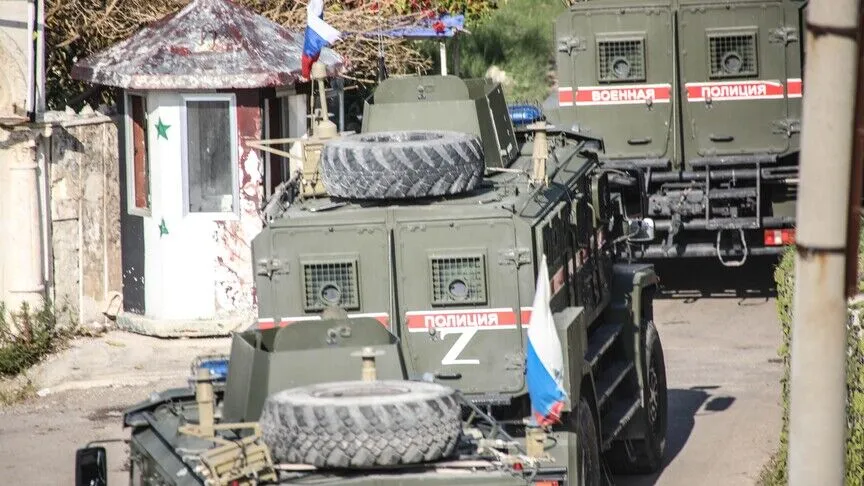
The Syria Russia bases agreement announced Sunday brings a close to one of the longest-running open questions left by the fall of the Assad government. According to the Syrian Foreign Ministry, quoted by the state news agency, the two countries have signed a memorandum of understanding determining what happens to Russia’s facilities at Tartus and Khmeimim.
It took eighteen months of intensive negotiation to get there.
What the Deal Actually Does
The arrangement splits the facilities into two categories, and the distinction matters.
Civilian assets move to Syrian control. That includes Khmeimim airport and the commercial berth at Tartus port, both of which will be folded gradually into the country’s civilian administration.
Military facilities take a different path. Rather than being handed over or shut down, they are to be repurposed as joint training and qualification centres, under terms the ministry described as preserving the interests of both parties.
The transition is meant to be complete within three months.
The Ports Component
Syria’s General Authority for Ports and Customs issued its own statement confirming that Syria will assume control of the commercial sites Russia had been operating at Tartus port. That includes Pier No. 4 along with its associated warehouses and supporting facilities.
That detail carries weight because of what was reported last month. Reuters had described Russian efforts to build a commercial logistics hub at Tartus using Pier No. 4, a restricted area located outside the naval base itself.
At the time, both sides indicated the hub would remain under Syrian control, with operations requiring approval from Syria’s ports and customs authority.
Sunday’s announcement appears to formalize that Syrian oversight rather than reverse it.
Why These Two Sites Matter So Much
For anyone unfamiliar with the strategic picture, Tartus and Khmeimim are not ordinary installations.
The naval facility at Tartus has been Russia’s only warm-water port on the Mediterranean, giving its navy a maintenance and resupply point that does not require transiting the Turkish straits for every service call. Khmeimim air base provided the air bridge that sustained Russian operations across the region.
Together they represented Moscow’s principal military presence in both the Mediterranean and the wider Middle East. Losing them entirely would have significantly reduced Russia’s ability to project force or sustain operations in Africa and the eastern Mediterranean.
That is why negotiations dragged on for a year and a half.
Reading the Compromise
The structure of the agreement suggests neither side got what it initially wanted.
Syria’s new leadership, which took power after Bashar al-Assad was removed in December 2024, faced obvious pressure to demonstrate that foreign military arrangements made by the previous government would not simply continue unchanged. Reclaiming civilian infrastructure and asserting customs authority over port operations delivers that.
Russia, for its part, avoided outright expulsion. Converting military sites into joint training centres preserves a presence and a working relationship, even if it does not preserve the operational freedom of the old arrangement.
The phrase describing arrangements that protect the interests of both sides is doing considerable work, and the practical meaning will only become clear as implementation proceeds.
The Questions the Announcement Leaves Open
Several things remain unspecified in what has been made public.
The scale of any continuing Russian personnel presence at the joint centres has not been described. Neither has the command structure governing them, nor whether Russian naval vessels retain access to Tartus for maintenance and resupply under the new terms.
The financial dimension is also absent. Basing agreements typically involve payment, lease terms or offsetting arrangements, and none of that has been detailed.
Three months is an aggressive timeline for transferring control of an airport, port infrastructure and military facilities simultaneously. Whether it holds is worth watching.
What It Signals
Beyond the specific facilities, the agreement marks a recalibration of the relationship between Damascus and Moscow.
Under Assad, Russian access was effectively guaranteed by dependence. The new framework runs through Syrian regulatory authority, with the ports and customs body positioned as the approving entity for commercial operations. That is a different relationship, formally at least.
Whether it functions that way in practice is the real test, and it will be answered over the coming months rather than in a memorandum.
A note on sourcing: this account works from official statements released by Syrian authorities and prior reporting. Key operational details have not been disclosed publicly, and implementation may differ from what has been announced.
Author
-
Lucienne Albrecht is Luxe Chronicle’s wealth and lifestyle editor, celebrated for her elegant perspective on finance, legacy, and global luxury culture. With a flair for blending sophistication with insight, she brings a distinctly feminine voice to the world of high society and wealth.