Severe storms tore across a wide stretch of the Midwest this week, killing at least two people, injuring more than a dozen others, and knocking out power to hundreds of thousands of homes and businesses. Rescue crews were still pulling people from floodwaters Wednesday as utility teams worked through downed trees and tangled lines.
The damage extended from the Chicago area east to western Pennsylvania, with tornadoes, straight-line winds, and flash flooding all contributing.
Lives Lost
A four-year-old boy died in Geneva, Indiana, when a tree collapsed onto a home during Tuesday’s storms, according to the Jennings County Sheriff’s Office.
In Ohio, Governor Mike DeWine said a resident of Roseville died during a medical emergency because flooded roads prevented first responders from reaching them in time. That detail underscores a hazard that often goes unrecognized: flooding cuts off ambulance access, and the consequences fall on people whose emergencies have nothing to do with the weather.
Authorities in Portage, Indiana, were investigating whether the storms contributed to a house explosion that killed one person.
Lightning Strike at a Prison
One of the more unusual incidents occurred at a prison complex southwest of Cleveland, where a lightning strike Tuesday injured 16 incarcerated people, all of whom were hospitalized.
DeWine said four remained hospitalized Wednesday, one with severe injuries.
A Derecho, Not Just a Storm Line
The Storm Prediction Center indicated preliminarily that the system sweeping from Iowa into Indiana over several hours met the criteria for a derecho.
Derechos are extended straight-line wind events that travel long distances while producing heavy rain. Their damage can rival what tornadoes or hurricanes leave behind, but because they lack a visible funnel, people frequently underestimate them until the wind arrives.
The numbers bear that out. Forecasters recorded a gust of 99 miles per hour in Gary, Indiana, with numerous personal weather stations reporting gusts above 80.
The National Weather Service confirmed three tornadoes in counties south of Chicago.
Water Rescues Across Ohio and Pennsylvania
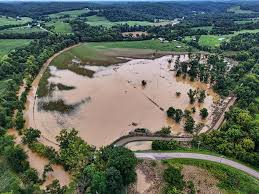
Emergency crews in Ohio and western Pennsylvania conducted numerous water rescues. DeWine deployed 40 members of the Ohio Army National Guard to assist in two counties east of Columbus.
In Crooksville, Ohio, water pushed into Kaitlyn Rodgers’ home in the early hours of Tuesday, rising to knee depth and trapping her, her husband, and four children. The current was too strong for them to leave on their own, and firefighters eventually reached them by boat in the dark.
She described water pouring in and said her most immediate fear was electrical. Her older home has outlets at floor level, and water was coming out of them. She worried her children would be shocked.
That instinct was correct. Submerged electrical systems are among the deadliest hazards in residential flooding, and it is the reason emergency officials advise against wading through water in a flooded home.
In Athens County, roughly 300 people called 911 for assistance Tuesday, including 42 calls involving vehicles stranded in floodwater. Emergency management director Teresa Fouts-Imler said additional calls continued Wednesday as high water moved toward the Ohio River.
The Power Grid Took a Beating
By Wednesday afternoon, more than 650,000 customers across Illinois, Indiana, Ohio, Kentucky, and West Virginia were without electricity.
American Electric Power, headquartered in Columbus, was still assessing damage but had already counted more than 100 broken poles, around 650 downed wire spans, and another 85 spans tangled with trees. Roughly 76,000 of its customers remained without service even after crews restored power to 135,000.
Columbus Mayor Andrew Ginther declared an emergency Wednesday to give the city room to manage outages and cleanup.
Scenes From the Ground
Residents described a kind of weather the region simply is not accustomed to.
Javid Jenkins of Homewood, a Chicago suburb, said his family sheltered in the basement without power and found the experience frightening. He offered a line that captured the regional mood: the area is built for snow and cold, not for this. He was out driving in search of fuel for a generator to save the contents of his refrigerator.
In nearby Tinley Park, Kerry Hourigan stood outside the home she has lived in for 25 years and described total devastation with the roof gone. She admitted her mind had fixed on something small and absurd in the moment, a newly purchased barbecue grill that had vanished entirely.
That mix of catastrophic loss and oddly specific fixation is common after disasters. People often latch onto one manageable detail when the scale of everything else is too much to process.
Record Rainfall
Dayton, Ohio, recorded 2.07 inches of rain in a single day, breaking a record that had stood since 1915.
Photographs circulating on social media from Illinois and Indiana showed submerged roadways, trees dragged into power lines, and homes with sections torn from their roofs.
The Threat Is Not Over
Flood warnings Wednesday extended from northern Illinois into eastern Indiana. Flash flood watches covered a much wider area, reaching from Indiana across Ohio, Kentucky, West Virginia, Virginia, and Tennessee.
The weather service warned that severe thunderstorm and heavy rainfall threats would continue across the Plains, Midwest, Ohio Valley, and central Appalachians over the following days.
Saturated ground makes each subsequent round more dangerous. Rain that would normally soak in instead runs straight into already swollen creeks and rivers.
Practical Guidance While Conditions Persist
A few points are worth repeating in a week like this one.
Do not drive into water covering a road. Depth is impossible to judge, roadbeds wash out invisibly, and vehicles float in surprisingly shallow flow.
Stay clear of downed lines and assume every one of them is live.
Run generators outdoors only, well away from windows and doors. Carbon monoxide poisoning spikes after every major outage event.
Treat floodwater as contaminated and wash thoroughly after any contact.
Photograph damage before beginning cleanup if you intend to file an insurance claim.
Check on elderly neighbors and anyone dependent on powered medical equipment.
What Comes Next
Utility crews face a lengthy restoration effort given the number of broken poles and damaged spans. Flood crests along smaller waterways will continue moving downstream, meaning some communities may see their worst water levels after the rain has stopped.
For a region that measures its weather preparedness in snowfall, this week has been an unwelcome introduction to a different kind of extreme.
Author
-
Lucienne Albrecht is Luxe Chronicle’s wealth and lifestyle editor, celebrated for her elegant perspective on finance, legacy, and global luxury culture. With a flair for blending sophistication with insight, she brings a distinctly feminine voice to the world of high society and wealth.