Ukraine strikes on Russian refineries reached deeper into Russian territory overnight, President Volodymyr Zelenskyy said Thursday, as Kyiv continues a campaign aimed at damaging Moscow’s wartime economy while its own cities absorb barrages it increasingly cannot stop.
The asymmetry defines this phase of the war. Ukraine is hitting targets 800 miles from the front line. It cannot reliably intercept the missiles landing on its own capital.
How Far the Strikes Reached
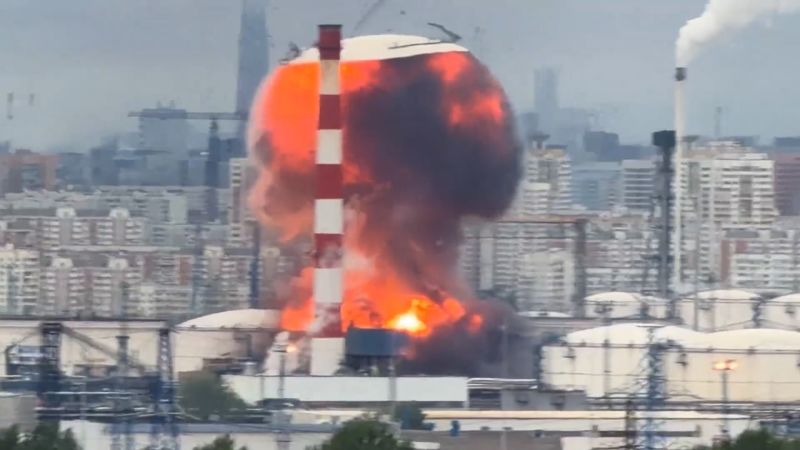
Zelenskyy said Ukrainian forces hit a refinery in Russia’s Bashkortostan region, more than 1,300 kilometers from the front line, along with a facility in the Yaroslavl region roughly 700 kilometers from the border.
Yaroslavl Governor Mikhail Yevrayev confirmed an attack, writing on Telegram that drone debris struck the facility’s oil reservoirs and started a fire. Three private homes also caught fire and several residential buildings were damaged.
Ukrainian forces additionally struck two Russian military patrol boats in the Black Sea, Zelenskyy said, along with vessels belonging to Moscow’s shadow fleet, the network Russia uses to circumvent Western restrictions on oil exports. He did not elaborate.
The Russian Defense Ministry said its air defenses downed 605 Ukrainian drones over Russian territory overnight.
Repeated strikes on refining infrastructure have produced fuel shortages inside Russia and unsettled the domestic population, which is part of the strategic point.
The Air Defense Crisis
Ukraine’s position is considerably worse.
The Kyiv region observed an official day of mourning Thursday after a Russian missile and drone assault killed 17 people the previous day.
Ukrainian officials say only the American-made Patriot system can reliably stop the ballistic missiles Russia has been using in recent weeks. The problem is supply. The war with Iran has drained global stocks of Patriot interceptors, leaving Ukraine exposed precisely as Russia intensifies its campaign.
Zelenskyy said he is working as intensively as possible with every partner capable of supplying interceptors to protect against strikes targeting civilians and civilian facilities.
He spoke with NATO Secretary General Mark Rutte and Finnish President Alexander Stubb about urgently obtaining interceptors from existing stockpiles, and said he and Rutte coordinated efforts to identify countries holding the necessary missiles with capacity to help.
Rutte confirmed on X that he was discussing with allies how to get Ukraine the air defenses it urgently needs.
The Casualty Numbers
The United Nations office in Kyiv released figures Wednesday that quantify the deterioration.
In the first six months of this year, 1,396 civilians were killed and 7,978 injured in Ukraine. That represents a 37 percent increase over the same period last year and a 114 percent jump compared to 2024.
The UN attributed the rise directly to increased long-range aerial attacks by Russia.
Building Its Own Capability
Zelenskyy said he met with senior officials on accelerating development of Ukraine’s own ballistic weaponry, drawing an explicit parallel to how rapidly the country advanced its drone technology during the war.
He described developing indigenous ballistic capability alongside a new anti-ballistic system as something only a small number of countries worldwide have achieved, and asserted that Ukraine has the capacity to do it.
He expects results this year and next, after overcoming what he called key challenges: sourcing critical components, securing technological cooperation with partner nations, and determining where production will be located.
That last point is not a minor logistical detail. Manufacturing sites for strategic weapons become priority targets, and Ukraine has limited territory beyond Russian reach.
Overnight Attacks Across Ukraine
Drone and glide bomb attacks killed at least three civilians and wounded 22 others, authorities said Thursday.
Ukraine’s air force reported Russia fired four missiles and 101 long-range strike drones overnight, with air defenses downing or jamming 66 drones.
Three people were killed in Balakliia in the Kharkiv region, according to Vitalii Karabanov, head of the city’s military administration.
In the neighboring Sumy region, Russian glide bombs wounded 12 people, the National Police said. Apartment buildings and infrastructure sustained damage, with hundreds of windows shattered, according to regional military administration chief Oleh Hryhorov.
In Kherson, a Russian drone struck a bus carrying farmworkers, injuring six. In Zaporizhzhia, a drone hit a residential area and injured four, said regional administration head Ivan Fedorov.
The Strategy Behind the Attrition
Western analysts and officials describe Russia’s approach as exhaustion through volume, committing soldiers, armor and weapons in quantities Ukraine cannot match.
The underlying assumption attributed to Vladimir Putin is that time works in his favor, that Western support will eventually diminish, and that Ukrainian resistance will collapse under sustained pressure.
The interceptor shortage is precisely the kind of development that assumption anticipates.
UN Response
Secretary-General Antonio Guterres condemned attacks by both sides, according to deputy spokesman Farhan Haq.
Haq said the recent strikes follow an alarming pattern of escalation against populated areas, producing what he described as record increases in civilian casualties and widespread destruction of residential and civilian infrastructure in Ukraine, and increasingly within Russia as well.
Guterres also called for freedom of navigation in the Black and Azov seas, citing concern about risks to shipping.
What to Watch
Two questions will shape the coming weeks.
Whether allied countries can locate and transfer interceptor stocks quickly enough to blunt the current Russian campaign. And whether Ukraine’s refinery strikes accumulate into economic pressure Moscow cannot absorb.
Both are races against time. Neither has an obvious answer yet.
Author
-
Lucienne Albrecht is Luxe Chronicle’s wealth and lifestyle editor, celebrated for her elegant perspective on finance, legacy, and global luxury culture. With a flair for blending sophistication with insight, she brings a distinctly feminine voice to the world of high society and wealth.