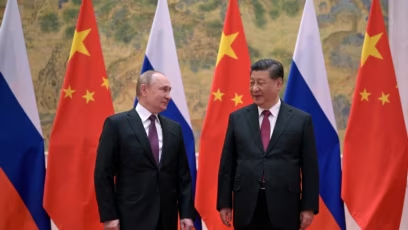
Russian President Vladimir Putin travelled Thursday to Etorofu, the largest and northernmost of four islands off eastern Hokkaido that Japan claims as the Northern Territories. It was his first visit to the disputed chain, and Tokyo responded with immediate and pointed objection.
The other three islands are Kunashiri, Shikotan and Habomai. All four have been under Russian control since the closing days of the Second World War.
Tokyo’s Response
Prime Minister Sanae Takaichi protested strongly when speaking to reporters Thursday afternoon.
She said the Northern Territories are historically and legally an inherent part of Japan, and that a visit by the sitting Russian president is incompatible with Japan’s consistent position on the matter.
The trip follows a precedent set in November 2010, when then-President Dmitry Medvedev became the first Russian head of state to visit Kunashiri. Putin’s arrival on Etorofu raises that precedent to the largest of the four islands.
Timing That Sharpens the Sting
The date carries considerable weight in Japan.
The visit fell during the Bon summer holiday, when families traditionally return to their hometowns to honour ancestors. It also came amid the period when Japan marks the atomic bombings of Hiroshima and Nagasaki and the anniversary of the war’s end, alongside the Soviet invasion of the northern islands that followed.
Two weeks earlier, on July 30, Takaichi had met with junior high school students whose grandparents and great-grandparents once lived on the islands.
At that meeting she acknowledged that relations with Russia are in a very difficult state, while maintaining that Japan’s policy of pursuing sovereignty over the territories and concluding a peace treaty remains unchanged. She described visits to ancestral graves on the islands as a humanitarian matter and one of the highest priorities in the bilateral relationship.
Putin’s Position
Speaking Wednesday in Sakhalin, Putin dismissed Japanese efforts to negotiate the islands’ return.
He characterised Russian control as a settled outcome of the Second World War confirmed in international documents, though he did not specify which agreements he meant.
The Competing Historical Claims
Japan’s case rests on a sequence it considers well documented.
Tokyo maintains that it discovered and surveyed the four islands before Russia arrived, and had established effective control by the end of the nineteenth century. It points to an 1855 treaty between the two countries as confirming the boundary between Etorofu and the Russian island of Uruppu.
Japan further argues that the Soviet Union attacked in August 1945 in violation of a Neutrality Pact then still in force between the two states. Soviet forces occupied all four islands between August and September 5, 1945.
Russia’s position treats the outcome as a legitimate consequence of the war rather than an unlawful seizure.
The People Who Were Displaced
Roughly 17,500 Japanese nationals were living on the four islands in August 1945 when Soviet forces forced them from their homes. Etorofu alone had about 3,608 Japanese residents.
Around 5,000 of those former islanders remain alive today. Their average age is 89.8 years.
That figure explains much of the urgency behind Japan’s position. The generation with direct memory of living on the islands is disappearing, and with it the possibility of anyone returning to a place they personally remember.
Graves They Cannot Reach
Government-organised visits allowing former residents and their relatives to pay respects at ancestral graves on the islands were suspended in 2020 because of the pandemic.
They have not resumed. Relations deteriorated sharply after Russia’s invasion of Ukraine, and the programme has remained frozen.
Since 2022, former islanders have instead conducted memorial services offshore, observing the islands from vessels rather than setting foot on them.
On July 25, a group of 47 people including three former islanders, their descendants, and Hokkaido Governor Naomichi Suzuki held a shipboard ceremony off Cape Nosappu in eastern Hokkaido.
A Community’s Reaction
Hiroki Mori, who represents a group of former Northern Territories residents, expressed disappointment and hoped the visit would not damage bilateral ties further.
He noted the contrast plainly. Former islanders have been unable to visit the graves themselves and have paid respects from ships looking toward the islands. Under those circumstances, he said, news of Putin’s visit will not sit well with them.
Mori also raised a concern that goes beyond protest. Over the years, government programmes brought former Japanese islanders into contact with Russians now living on the islands, building relationships grounded in the hope that the two communities might eventually share the land.
His worry is that those efforts could unravel.
What Putin Did on the Island
According to the Kremlin, Putin toured a fish processing plant, a local school, and a hospital while on Etorofu.
The visit followed his first trip to Sakhalin in thirteen years, where he observed drills conducted by Russia’s Pacific Fleet.
Etorofu has no large naval base, but it holds two airports where Russian military personnel and equipment are stationed.
Why This Dispute Persists
The islands have blocked a formal peace treaty between Japan and Russia for eight decades. The two countries have never concluded one following the Second World War, an unusual situation among major powers.
Periodic negotiations have produced occasional momentum, particularly during earlier periods of warmer relations, but never a settlement. The war in Ukraine effectively ended any near-term prospect.
For Japan, the issue combines territorial principle with a humanitarian dimension that grows more pressing each year. For Russia, the islands carry strategic value in the Sea of Okhotsk and symbolic value as a wartime outcome.
A presidential visit to Etorofu changes no legal position. It does, however, make the practical reality harder to dispute, which is likely part of the point.
Author
-
Lucienne Albrecht is Luxe Chronicle’s wealth and lifestyle editor, celebrated for her elegant perspective on finance, legacy, and global luxury culture. With a flair for blending sophistication with insight, she brings a distinctly feminine voice to the world of high society and wealth.