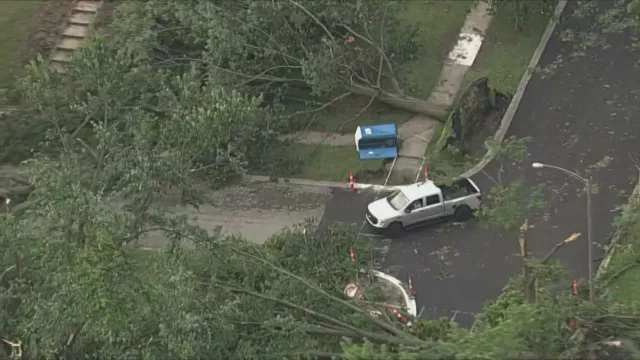
The Indiana power outage affecting tens of thousands of residents in the northwest corner of the state reached its ninth day Thursday, with families throwing away spoiled food, standing in line for hot meals and hunting for anywhere to charge a phone.
Residents described being in survival mode.
What Nine Days Actually Looks Like
The outage began with a deadly storm on August 11 that brought down trees and power lines across the region.
The practical consequences accumulate in ways that are easy to underestimate from the outside.
Refrigerated food spoiled long ago and had to be discarded, which for many households means replacing an entire week’s groceries. Without power, there is no way to cook what replaces it.
Phones become both essential and difficult to maintain. They are the only link to information, family and emergency services, yet charging requires finding a location with electricity and often waiting in line for access.
Laundry becomes impossible at home, which is why residents in Gary have been posting on social media to identify which laundromats have reopened and where working Wi-Fi can be found.
Schools Remain Closed
Gary schools have stayed shut since the storm.
Extended school closure creates a second layer of difficulty for working families. Children who normally receive meals at school need feeding at home, in households where cooking is not possible. Parents who cannot leave children unsupervised may be unable to work.
The educational loss compounds each day, and districts eventually face decisions about how to recover lost instructional time.
Neighbors Filling Gaps
One thread running through the reporting is that residents have organized to help each other rather than waiting for institutional assistance.
People have been collecting and distributing food, diapers and cleaning wipes for low-income neighbors who have the fewest resources to absorb a nine-day disruption.
That informal network matters more than it might appear. Households with savings can buy ice, book a hotel or eat out for a week. Households without those margins face a genuine emergency by day three.
Why Restoration Takes So Long
Outages lasting more than a week generally reflect infrastructure damage rather than simple line faults.
When a storm brings down trees across a wide area, crews must clear vegetation before they can even reach damaged equipment. Poles may need replacement rather than repair. Transformers must be sourced and installed. Work proceeds in sequence, since restoring a neighborhood requires restoring the lines feeding it first.
Utilities typically prioritize hospitals, water treatment facilities and the circuits serving the largest number of customers, which means residential streets with fewer households often wait longest.
None of that makes the ninth day easier for anyone living through it.
Flooding Hits Ohio the Same Day
While Indiana waited for power, central Ohio faced a different emergency.
Heavy rain produced flash flooding across Columbus on Thursday morning, covering roadways and stranding vehicles.
Emergency crews rescued motorists from cars caught in the water. In one incident, responders saved a 12-year-old boy who had been swept off a bridge.
That detail illustrates how quickly urban flash flooding turns lethal. Water moving across a bridge or roadway carries enough force to knock down an adult, and depth is nearly impossible to judge from a distance.
Practical Guidance During Extended Outages
For anyone facing a prolonged loss of power, a few measures reduce risk:
- Discard refrigerated food after four hours without power and frozen food after about 48 hours in an unopened full freezer
- Never run generators indoors, in garages or near windows, since carbon monoxide poisoning kills people every year during outages
- Avoid candles where flashlights are available, as open flames cause house fires during outages
- Check on elderly neighbors and anyone dependent on powered medical equipment
- Keep refrigerator and freezer doors closed as much as possible
And during flooding, the guidance is simpler: do not drive or walk through moving water, regardless of how shallow it appears.
The Broader Pattern
Both events reflect a recurring difficulty. Infrastructure built for the storms of previous decades increasingly encounters weather that exceeds its design assumptions.
Power grids in older communities rely heavily on overhead lines running through mature tree canopy. Drainage systems in dense cities were sized for rainfall rates that now occur more frequently than planners anticipated.
Upgrading either is expensive, slow and politically difficult, which is why the same communities tend to appear in the same headlines.
Where Things Stand
Restoration work continues in northwest Indiana, though residents have received little certainty about timing.
For families entering a tenth day, the Indiana power outage has stopped being an inconvenience and become the organizing fact of daily life.
Author