Two former organizers of the Hong Kong Tiananmen vigil were convicted Friday under the national security law that Beijing imposed on the territory in 2020, closing another chapter in the dismantling of a pro-democracy movement that once drew tens of thousands into the streets.
The Verdict
Lee Cheuk-yan, 69, and Chow Hang-tung, 41, former leaders of the Hong Kong Alliance in Support of Patriotic Democratic Movements of China, were found guilty of inciting subversion.
Both had pleaded not guilty. Each faces up to 10 years in prison.
The alliance itself was also convicted.
The judges did not read out their reasoning in court, saying the full judgment would appear online later. Sentencing will occur at a later date.
What the Vigil Was
For three decades, the alliance organized an annual candlelight gathering that stood as the only large-scale public commemoration of the 1989 Tiananmen Square crackdown anywhere on Chinese territory.
It drew tens of thousands of people every year.
The event was banned in 2020, ostensibly under pandemic restrictions, weeks before Beijing imposed the security law in response to the massive anti-government protests of 2019.
Since Covid restrictions lifted, the former vigil site has been occupied around the anniversary by a carnival organized by pro-Beijing groups.
The Prosecution’s Case
Prosecutors insisted the case was not political.
Their argument centered on one of the alliance’s core demands: ending one-party rule. They characterized this as a call to overthrow the leadership of China’s ruling Communist Party through unlawful means.
The Defense
Both defendants disputed that interpretation of their own words.
Lee told the court the demand was not about ending the party’s leadership but about moving toward democracy and letting people choose who governs them. The Communist Party, he argued, should not enforce dictatorship.
Chow, a barrister who represented herself, said ending one-party rule means ending a state where power operates without restriction. She criticized how the standard for distinguishing right from wrong had been inverted in the proceedings.
Chow’s Account From Custody
In a Patreon post published Thursday, Chow described the conditions of her transport to court.
She recalled being shackled in handcuffs along with waist and ankle chains, and said correctional officers walked her like a dog.
Her response to the impending verdict was defiant. Justice lives in the hearts of the people, she wrote, adding that there is no need to look up to top-down rulings and that one verdict does not matter much.
What Legal Observers Say
Eric Lai, a senior fellow with the Georgetown Center for Asian Law, placed the charge in a mainland context.
Inciting subversion, he noted, has been commonly used in mainland China to criminalize the work of human rights lawyers, activists and intellectuals, including the late Nobel Peace laureate Liu Xiaobo.
His assessment of what the verdict reveals was blunt. The criminal ruling, he said, shows the extent to which Hong Kong’s courts have descended toward the party-led judiciary that operates on the mainland.
A Trial That Moved Fast
The proceedings were initially scheduled for 75 days. Closing statements concluded on day 24.
When the trial opened in January, a third defendant, Albert Ho, entered a guilty plea, a step that typically produces a reduced sentence.
Lee and Chow are expected to argue for lighter penalties at a separate hearing and may be sentenced alongside Ho.
Outside the Courthouse
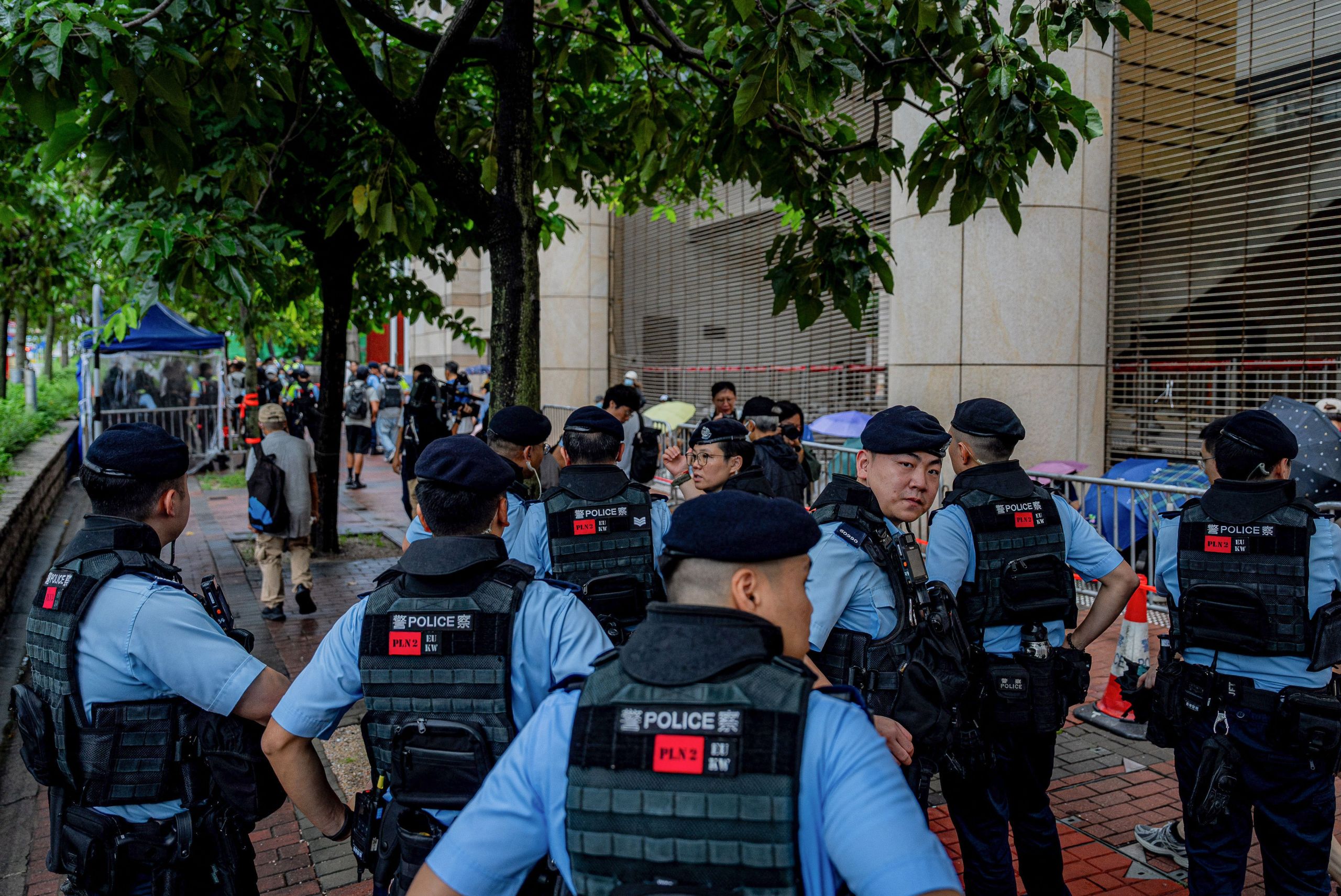
Dozens of people queued in drizzling rain before the hearing.
Tang Ngok-kwan, a former alliance member, said police would not permit him to join the line while carrying materials they deemed sensitive, including bookmarks printed with “vindicate June 4,” a reference to the crackdown’s anniversary date. He chose not to enter the court.
A guilty verdict for the alliance, he said, would upend his understanding of the city’s laws.
Margaret Chan, a former vigil attendee who arrived at 6 a.m., pointed to a detail in the group’s own name, which includes the word patriotic.
Everyone is patriotic, she said. How could that incite anything? Incite others to be patriotic?
What Happened in 1989
Hundreds and possibly thousands of people were killed when military tanks moved into central Beijing during the June 1989 crackdown.
The event proved decisive for China’s trajectory. It established that the market reforms transforming the country into the world’s second-largest economy would not be accompanied by political liberalization.
The Broader Erosion
Beijing has maintained that the 2020 security law was necessary for the city’s stability.
Under it, numerous leading activists have been imprisoned, including former media proprietor Jimmy Lai. Dozens of civil society organizations have dissolved, the alliance among them.
Hong Kong returned to Chinese rule in 1997 under arrangements that promised a distinct legal system and preserved freedoms. Observers describe this trial as symbolizing how far that arrangement has shifted.
What Remains
The Hong Kong Tiananmen vigil no longer takes place. The organization behind it no longer exists. The people who ran it await sentencing.
Chow’s line about justice living in the hearts of people reads as either consolation or defiance, depending on how much weight one gives to memory when the institutions that preserved it have been removed.
Author